Brando Back on the Big Screen – “On the Waterfront”

On-The-Waterfront-Poster-1024x796

Fathom Events Presents:

“On the Waterfront” with exclusive commentary and a special glimpse behind the scenes from Turner Classic Movies host Ben Mankiewicz that will illustrate how this movie, which was filmed in only 36 days, made such a long-lasting cultural impact.

As a classic movie fan, seeing this Marlon Brando Academy Award winning film on the big screen is an opportunity not to be missed!

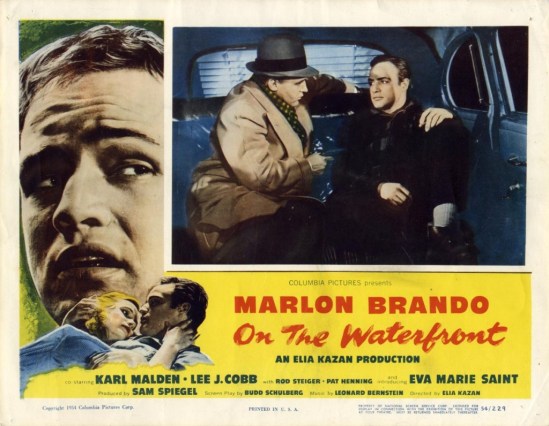
“You don’t understand! I coulda had class. I coulda been a contender. I could’ve been somebody, instead of a bum, which is what I am.” Watch Marlon Brando deliver those famous lines on the big screen when Fathom Events, Turner Classic Movies, and Sony Pictures Entertainment bring On the Waterfront (1954) back to select cinemas nationwide for a special two-day event on Sunday, April 24 and Wednesday, April 27.
brando

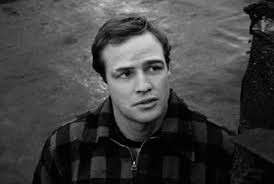
Marlon Brando

Marlon Brando stars as Terry Malloy, a washed-up prizefighter who, through the influence of his brother, Charley (Rod Steiger), a lawyer for a corrupt waterfront union, is employed as an errand boy for the mob. After luring a fellow dockworker and friend to his death to keep him from testifying against labor boss Johnny Friendly (Lee J. Cobb), the appeals of the dead man’s sister (Eva Marie Saint) and a crusading priest (Karl Malden) awaken Terry’s guilty conscience and love prompts Terry to seek redemption. (Fathom Events)

Do not miss the opportunity to see this classic, winner of eight Academy Awards including Best Picture in 1954, as it was meant to be seen – on the big screen!

fathomlogo


Long Live Rock Movies! 😎🎸

“School of Rock” (2003)

school of rock

Let’s start with our substitute teacher, Mr. Schneebly – what kid hasn’t wished for a sub like him?  No grades, being part of a kick butt rock band, defying parents, breaking the rules.  Good, right?

Jack Black’s character Dewey Finn is the forever loser and quintessential wanna be rock star, but when he steals his roommate’s identity as a substitute teacher, (Mr, Schneebly) he discovers he has a  class of very musically talented 5th-grade students. So, Dewey decides to turn his class into a rock band to potentially win the Battle of the Bands and $20,000.  I won’t spoil whether the kids win or don’t win the battle but as a result of the contest they gain self-confidence and continue to play rock in an after school program coached by Dewey.  Long live Rock!

This film totally tapped into my inner rocker!


“The Commitments” (1991)

commitments

What happens when a group of white working class Dubliners forms a soul band?  A rousing film with some great music inspired by legendary artists, Otis Redding, Aretha Franklin and Wilson Pickett.

The band nails the soul of the greats by immersing themselves 24/7 in classic soul standards:

  •     “In the Midnight Hour” – Wilson Pickett
  • “Try a Little Tenderness” – Otis Redding
  • “I Never Loved a Man” – Aretha Franklin
  • Whether on buses, hanging up laundry or in music store windows, they were feeling the soul.  In the words of  Félim Gormley (Dean Fay- Saxophone), “I’m black and I’m proud!”

I’m so glad the movie was authentic with the cast singing on the soundtrack.  (The actors were cast  for their musical abilities.) Lead singer (Andrew Strong “Deco”) was nuts but the standout talent of the band.

The Commitments was voted best Irish film of all time in a 2005 poll sponsored by Jameson Irish Whiskey and launched a generation of Irish musicians and actors.


 “This is Spinal Tap” (1984)


This is spinal tap poster

 OMG, the funniest, dead on satire of a rock metal band ever!

Classic in every sense of the word, Director/Writer Rob Reiner’s masterpiece was also written and scored by the stars:

Rob Reiner – (Marty D. Bergi) – Mokumentarian

Spinal Tap

Christopher Guest – (Nigel Tufnel)

Michael McKean- (David St. Hubbins)

Harry Shearer – (Derek Smalls)

This mockumentary feels so real that some moviegoers thought they were an actual group!

The “Stonehenge” number during the Smell the Glove tour is priceless.  Due to a mix up with size dimensions, the Stonehenge replica for their epic song is 18 inches instead of 18 feet tall.  The little people performers in the number were taller. And Derek Smalls getting stuck in the stage prop egg is hilarious!

 In 2002, This Is Spinal Tap was deemed “culturally, historically, or aesthetically significant” by the Library of Congress and was selected for preservation by the United States National Film Registry.


These are 3 of my favorite Rock Movies – Let me know yours in the comments!


Corporate Media in America-Good Night, and Good Luck 📺

Goodnightgoodluck_poster

Media Responsibility

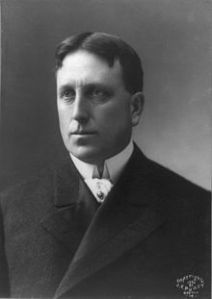
As a journalism student in college, I learned the role/responsibility of the press. I also studied the newspaper mogul, William Randolph Hurst, and yellow journalism (sensationalized stories of dubious veracity).

William Randolph Hearst

William Randolph Hearst

Civics class in high school informed me about the function of the press in the accountability of politicians and government. Well, today it seems all I’ve ever learned and understood about the role of journalists has been abdicated for full on “entertainment”.

Set in 1953, during the early days of television, “Good Night, and Good Luck” focuses on the potential of television to inform and educate the public, so that it doesn’t become, as Murrow put it, only “wires and lights in a box”.

“Good Night, and Good Luck” also portrays how CBS news broadcast journalist Edward R. Murrow (David Strathairn) and his dedicated staff — headed by his co-producer Fred Friendly (George Clooney) and reporter Joseph Wershba (Robert Downey, Jr.) defy corporate and sponsorship pressures, and discredit the tactics used by Joseph McCarthy during his crusade to root out Communist elements within the government.

Joseph McCarthy

Joseph McCarthy

This morality tale is as relevant today as it was in 2005 (if not more so). It seems that broadcast news has turned into entertainment television and lost it’s way as the checks and balances of politics and the government. The news media is supposed to be the Fourth Estate – the fourth estate is a term that positions the press (newspapers, news media) as the fourth branch of government and one that is important to a functioning democracy. In my high school Civics class, I learned that the First Amendment to the Constitution “frees” the press but also carries with it the responsibility to be the people’s watchdog.

fourth estate

In his fight against McCarthy, Murrow first defends Milo Radulovich, an American citizen (born in Detroit) of Serbian ethnicity and former reserve Air Force lieutenant who was accused of being a security risk for maintaining a “close and continuing relationship” with his father and sister, in violation of Air Force regulation 35-62 (a regulation which states that ‘A man may be regarded as a security risk if he has close and continuing associations with communists or people believed to have communist sympathies.’)

Radulovich’s case was publicized nationally by Edward Murrow on October 20, 1953, on Murrow’s program, See It Now: Murrow makes a show on McCarthy attacking him. A very public feud develops when McCarthy responds by accusing Murrow of being a communist. Murrow is accused of having been a member of the leftist union Industrial Workers of the World, which Murrow claimed was false. (Wikipedia)

George Clooney (Director), a journalism student in college, held this project close to his heart. In September 2005, Clooney explained his interest in the story to an audience at the New York Film Festival: “I thought it was a good time to raise the idea of using fear to stifle political debate.”

Clooney and producer Grant Heslov decided to use only archival footage of Joseph McCarthy in his depiction, demonstrating the furor with which McCarthy pressed his communist accusations.

The film was critically acclaimed upon release. It was named “Best Reviewed Film of 2005 in Limited Release” by Rotten Tomatoes, where it achieved a 93% positive review rating. The movie received six Academy Award nominations, including Best Picture, Director (Clooney), and Actor (Strathairn).

goodnightreviews

The late Roger Ebert, in his Chicago Sun-Times review, contends that “the movie is not really about the abuses of McCarthy, but about the process by which Murrow and his team eventually brought about his downfall (some would say his self-destruction). It is like a morality play, from which we learn how journalists should behave. It shows Murrow as fearless, but not flawless.”

So, the next time you’re watching the news on tv or reading your favorite print medium, ask yourself, is corporate media looking out for the people or profits for themselves.


The Incredibles

The_Incredibles

“The Incredibles” is a 2004 American computer-animated superhero comedy film written and directed by Brad Bird, produced by Pixar Animation Studios, and released by Walt Disney Pictures.

theIncredibles_Bird

Brad Bird and Edna Mode

In this lauded Pixar production, married superheroes Mr. Incredible (Craig T. Nelson) and Elastigirl (Holly Hunter) are forced to assume mundane lives as Bob and Helen Parr after all super-powered activities have been banned by the government. While Mr. Incredible loves his wife and kids, he longs to return to a life of adventure and his desire to help people draws the entire family into a battle with superhero obsessed villain –

Syndrome (Jason Lee)

theincrediblesnemisis

and his killer robot. Omnidroid

theincrediblesomnibot

I must say that baby Jack-Jack is my favorite “Super”/Parr family member.

theincrediblesjackjack

Everyone thinks he has no powers and is “normal”. (which is so not true) When I saw this scene with Jack-Jack and his babysitter Kari, I would have spit milk out of my nose (if I was drinking milk😂) Too funny!!

When “The Incredibles” was released I felt it was the best-animated film I’d seen to date. It combined humor with drama and kept the audience engaged from start to finish. There was an audible gasp in the theater during the airplane sequence with Elastigirl and the kids (Dash and Violet).

The Incredibles was written and directed solely by Brad Bird, a departure from previous Pixar productions which typically had two or three directors and as many screenwriters. In addition, it would be the company’s first film in which all characters are human.

theincrediblesplain

Brad Bird came to Pixar with the lineup of the story’s family members worked out: a mom and dad, both suffering through the dad’s midlife crisis; a shy teenage girl; a cocky ten-year-old boy; and a baby. Bird had based their powers on family archetypes.

theincrediblesEdna_mode2

After several failed attempts to cast Edna Mode, Bird took on her voice role himself. It was an extension of the Pixar custom of tapping in-house staff whose voices came across particularly well on scratch dialogue tracks.

There were 781 visual effects shots in the film and the skin of the characters gained a new level of realism from a technology to produce what is known as “subsurface scattering.”

Critic Roger Ebert of the Chicago Sun-Times awarded the film 3½ stars out of 4, writing that the film “alternates breakneck action with satire of suburban sitcom life” and is “another example of Pixar’s mastery of popular animation.”

The film won the Academy Award for Best Animated Feature, beating two DreamWorks films, Shrek 2 and Shark Tale, as well as Best Sound Editing at the 77th Academy Awards. It also received nominations for Best Original Screenplay (for writer/director Brad Bird) and Best Sound Mixing (Randy Thom, Gary Rizzo, and Doc Kane). It was Pixar’s first feature film to win multiple Oscars, followed in 2010 by Up. (Wikipedia)

Movie Music Magic – Danny Elfman 🎼

Danny Elfman

Danny Elfman

Music is essential to a film production. It sets the tone and mood and helps tell the movie’s story. A great musician “behind the camera” is Danny Elfman, who’s scored such film’s as “Pee-Wee’s Big Adventure”, “Batman”  and “The Nightmare Before Christmas”.

Daniel Robert Elfman (born May 29, 1953) is an American composer, singer, songwriter, and record producer. From 1976 to 1995 he was the lead singer and songwriter for the rock band Oingo Boingo.

In 1976, Elfman entered the film industry as an actor. In 1982, he scored his first film, Forbidden Zone, directed by his older brother Richard Elfman. Among his honors are four Academy Award nominations, a Grammy for Batman, an Emmy for Desperate Housewives, the 2002 Richard Kirk Award, and the Disney Legend Award.

I first became aware of Danny Elfman from his band, Oingo Boingo. Their ska driven music was freeing and fun.  Ska-influenced the new wave band in 1979, and then changed again towards a more guitar-oriented rock sound, in the late 1980s. The band’s appearance in Back to School energized the soundtrack with “Dead Man’s Party”.

Oingo Boingo Deadman's Party

“Back to School” (1986)

Some of Elfman’s music influences were Bernard Hermann, Franz Waxman, and Philip Glass. In 1985, Tim Burton and Paul Reubens invited Elfman to write the score for their first feature film, “Pee-wee’s Big Adventure”. Elfman was apprehensive at first, because of his lack of formal training, but with orchestration assistance from Oingo Boingo guitarist and arranger Steve Bartek, he achieved his goal of emulating the mood of such composers as Nino Rota and Bernard Herrmann.

Elfman immediately developed a rapport with Burton and has gone on to score all but three of Burton’s major studio releases. Elfman also provided the singing voice for Jack Skellington in Tim Burton’s The Nightmare Before Christmas and the voices of both Barrel and the “Clown with the Tear-Away Face”. Years later he provided the voice for Bonejangles the skeleton in Corpse Bride.

Trivia: Elfman also composed the theme to “The Simpsons”.

Burton has said of his relationship with Elfman: “We don’t even have to talk about the music. We don’t even have to intellectualize – which is good for both of us, we’re both similar that way. We’re very lucky to connect”. (Wikipedia)

Danny Elfman’s score of “Batman” (directed by Tim Burton) won him a Grammy Award.

Elfman admits his favorite movie to score was “Edward Scissorhands” (Tim Burton director).

edward scissor hands

Tim Burton, Winona Ryder, Johnny Depp and Danny Elfman in 1990.

Danny Elfman has three children: Lola (born 1979), Mali (born 1984), and Oliver (born 2005). On November 29, 2003, he married actress Bridget Fonda.

In October 2013, Elfman returned to the stage to sing his vocal parts to a handful of Nightmare Before Christmas songs as part of a concert titled Danny Elfman’s Music from the Films of Tim Burton. He composed the film score for Oz the Great and Powerful (2013), and composed additional music for Avengers: Age of Ultron (2015) together with Brian Tyler.


The Man with the “Touch” – Ernst Lubitsch 🎬🙌🎥

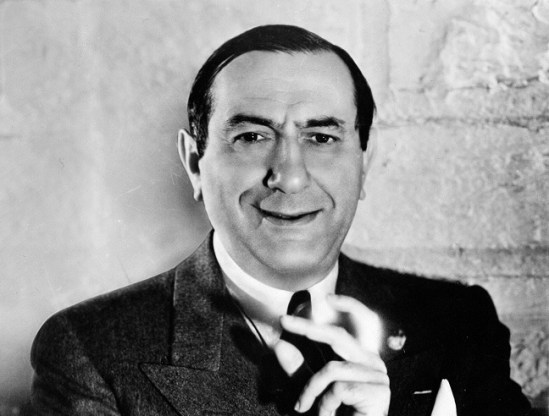
Ernst Lubitsch

Ernst Lubitsch (January 29, 1892 – November 30, 1947)

Keeping with the “Faces Behind the Camera” theme I’m spotlighting the saucy, bedroom comedies director Ernst Lubitsch and his famous “Lubitsch Touch”. This moniker was bestowed on him by other legendary filmmakers including Billy Wilder who was featured in the previous “Faces Behind the Camera” post. The phrase is used to describe the unique style and cinematic trademarks of director Ernst Lubitsch.

Hailed by the likes of Alfred Hitchcock (my other favorite director), Francois Truffaut and Orson Welles as a giant among filmmakers, Ernst Lubitsch was a preeminent figure in the history of cinema who directed some of Hollywood’s most sophisticated and enduring comedies.

Hollywood Sign

More than a great director of actors and action, he added his own personal signature – the “Lubitsch touch” – to all his work creating a sense of style and grace that was rarely duplicated on the screen.

After making a name as a director in his native Germany, Lubitsch was brought over at the behest of silent film star Mary Pickford to direct her in “Rosita” (1923). From there, he made comedies like “The Marriage Circle” (1924) and “Kiss Me Again” (1925), as well as dramas like “The Patriot” (1925). But with the advent of sound, the cigar-chomping director’s career took off with his fascination with a new genre, the musical comedy, and he began displaying his famed Lubitsch touch with classics like “Monte Carlo” (1930) and “One Hour with You” (1932).

He directed his first bona fide masterpiece, “Trouble in Paradise” (1932) later described as “truly amoral” by critic David Thomson (a British film critic and historian). The cynical comedy was popular both with critics and with audiences. But it was a project that could only have been made before the enforcement of the Production Code. After 1935, “Trouble in Paradise” was withdrawn from circulation. It was not seen again until 1968. The film was never available on videocassette and only became available on DVD in 2003.

Lubitsch later hit his stride full force with “Bluebeard’s Eighth Wife” (1938), “Ninotchka” (1939) co-written by Billy Wilder and “The Shop Around the Corner” (1940). Lubitsch reached great artistic heights with “To Be or Not to Be” (1942) and “Heaven Can Wait” (1943) before dying mid-career in 1947, leaving behind a legacy virtually unmatched by a filmmaker before or since.

In 1946, he received an Honorary Academy Award for his distinguished contributions to the art of the motion picture. He was also nominated three times for Best Director.

Lubitsch died of a heart attack on November 30, 1947, in Hollywood, and was buried at Glendale Forest Lawn in Glendale, CA. Leaving Lubitsch’s funeral, Billy Wilder ruefully said, “No more Lubitsch.” Lubitsch has a Star on the Hollywood Walk of Fame at 7040 Hollywood Blvd.


The Faces Behind the Camera 📽


TCM movie lovers

If you’re a movie junkie like me you probably not only know the stars of the film but the Director, The Cinematographer, the Editor, Writers and possibly the Key Grip. The faces behind the camera.

If you attend a movie with me, be prepared to stay through the end credits. I feel it’s imperative to acknowledge those artists who are responsible for the project. Staying for the credits also gives you a foundation to critique a film based on the direction, writing, and editing. Whether or not to see a movie based on a Director’s previous track record or the Cinematographer’s eye for the visuals.

image

This month is dedicated to educating and paying homage to the artists who help put it all together. Let’s begin with one of the top 2 of my favorite Directors, Billy Wilder.

Billy Wilder

Billy Wilder

Billy Wilder (June 22, 1906 – March 27, 2002) was an Austrian-born American filmmaker, screenwriter, producer, artist and journalist, whose career spanned more than fifty years and sixty films. He is regarded as one of the most brilliant and versatile filmmakers of Hollywood’s golden age.

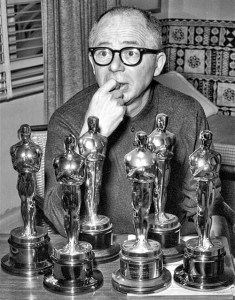
Billy Wilder with Oscars

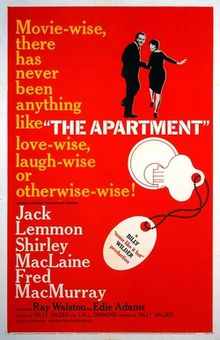
With The Apartment, (starring Jack Lemmon, Shirley MacLaine, and Fred MacMurray) Wilder became the first person to win Academy Awards as the producer, director, and screenwriter for the same film. “The Apartment” was nominated for ten Academy Awards and won five, including Best Picture.

The Apartment (1960)

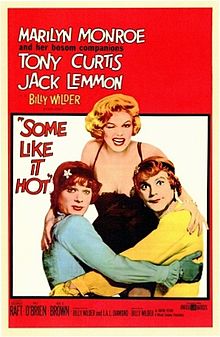
I love Billy Wilder because of his versatility in films and his testing the boundaries of societal norms. The first movie that comes to mind with his pushing the boundaries is “Some Like it Hot” 1959 starring Marilyn Monroe, Jack Lemmon, and Tony Curtis.

The plot revolves around two musicians who dress in drag in order to escape from mafia gangsters whom they witnessed commit the Saint Valentine’s Day Massacre. These are the final lines of the film delivered by (Daphne/Jerry) Lemmon and Joe E. Brown (Osgood) in regards to their pending marriage: Daphne/Jerry: But you don’t understand, Osgood! [Whips off his wig, exasperated, and changes to a manly voice] Uh, I’m a man! Osgood: [Looks at him then turns back, unperturbed] Well, nobody’s perfect!Wow! for 1959 that was pretty radical.

Some_Like_It_Hot_poster

“Some Like It Hot” is considered to be one of the greatest film comedies of all time. It was voted as the top comedy film by the American Film Institute on their list on AFI’s 100 Years… 100 Laughs poll in 2000. The film is also notable for featuring cross-dressing and homosexuality, which led to it being produced without approval from the Motion Picture Production Code. The Code was the set of industry moral guidelines that was applied to most American motion pictures released by major studios from 1930 to 1968. The Production Code had been gradually weakening in its scope during the early 1950s due to increasing societal tolerance for previously taboo topics in film, but it was still officially enforced. The overwhelming success of “Some Like It Hot” was a final nail in the coffin for the Hays Code.

Wilder became a screenwriter in the late 1920s while living in Berlin. After the rise of the Nazi Party, Wilder, who was Jewish, left for Paris, where he made his directorial debut. He moved to Hollywood in 1933, and in 1939, he had a hit when he co-wrote the screenplay for the screwball comedy Ninotchka. Wilder established his directorial reputation with Double Indemnity (1944), a film noir he co-wrote with crime novelist Raymond Chandler. Wilder earned the Best Director and Best Screenplay Academy Awards for the adaptation of a Charles R. Jackson story The Lost Weekend (1945), about alcoholism. In 1950, Wilder co-wrote and directed the critically acclaimed Sunset Boulevard.

Wilder was recognized with the American Film Institute (AFI) Life Achievement Award in 1986. In 1988, Wilder was awarded the Irving G. Thalberg Memorial Award. In 1993, he was awarded the National Medal of Arts.

Billy Wilder’s films:

Year Film Involvement
1934 Mauvaise Graine (also known as Bad Seed) Director/Writer
1942 The Major and the Minor Director/Writer
1943 Five Graves to Cairo Director/Writer
1944 Double Indemnity Director/Writer
1945 The Lost Weekend Director/Writer
1945 Death Mills Director
1948 The Emperor Waltz Director/Writer
1948 A Foreign Affair Director/Writer
1950 Sunset Boulevard Director/Writer
1951 Ace in the Hole Director/Writer/Producer
1953 Stalag 17 Director/Writer/Producer
1954 Sabrina Director/Writer/Producer
1955 The Seven Year Itch Director/Writer/Producer
1957 The Spirit of St. Louis Director/Writer
1957 Love in the Afternoon Director/Writer/Producer
1957 Witness for the Prosecution Director/Writer
1959 Some Like It Hot Director/Writer/Producer
1960 The Apartment Director/Writer/Producer
1961 One, Two, Three Director/Writer/Producer
1963 Irma la Douce Director/Writer/Producer
1964 Kiss Me, Stupid Director/Writer/Producer
1966 The Fortune Cookie Director/Writer/Producer
1970 The Private Life of Sherlock Holmes Director/Writer/Producer
1972 Avanti! Director/Writer/Producer
1974 The Front Page Director/Writer
1978 Fedora Director/Writer/Producer
1981 Buddy Buddy Director/Writer

Wilder received a total of twenty-one Academy Award nominations; eight for Best Director, twelve for writing, and one as the producer of Best Picture. With eight nominations for Academy Award for Best Director, Wilder is, together with Martin Scorsese, the second most nominated director in the history of the Academy Awards, behind William Wyler, and the second most nominated screenwriter behind Woody Allen.

Wilder won a total of six Oscars: Best Director for The Lost Weekend and The Apartment, Best Screenplay for The Lost Weekend, Sunset Blvd, The Apartment, and Best Picture for The Apartment. In addition, he received the Irving G. Thalberg Memorial Award in 1988.

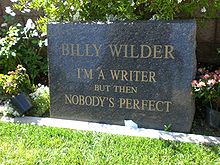
Billy Wilder"s grave

Wilder died in 2002 of pneumonia at the age of 95 after battling health problems, including cancer, in Los Angeles and was interred in the Westwood Village Memorial Park Cemetery in Westwood, Los Angeles near Jack Lemmon and Walter Matthau. Marilyn Monroe’s crypt is located in the same cemetery. Wilder died the same day as two other comedy legends: Milton Berle and Dudley Moore. The next day, French newspaper Le Monde titled its first-page obituary, “Billy Wilder dies. Nobody’s perfect”, quoting the final gag line in “Some Like It Hot”.


The Five Heartbeats 🎶


In honor of Black History Month, I’ll be featuring films either starring or representing African American themes.

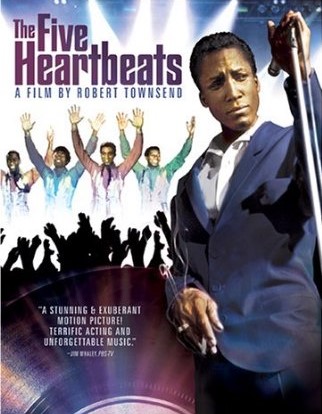
My second film, “The Five Heartbeats” (1991) is a rousing, slice of 60’s R&B music and reminiscent of groups like The Temptations and the Four Tops. Growing up in the 60’s in Motown, this film speaks to me and brings back wonderful memories of the times and the music. Another Robert Townsend production which he wrote directed and starred, it does not disappoint in energy or the drama of the music industry.


Inspired by the R&B group The Dells, it is co-written by Keenan Ivory Wayans and Robert Townsend. The movie also features 40’s tap dance icon Harold Nicholas (Nicholas Brothers) as Ernest “Sarge” Johnson in his final film as the group’s spunky choreographer.

After extensive research with R&B singing group The Dells, who were renowned for their four-decade career, Townsend used his film to depict a similar story, following the lives of five friends who aspire to musical stardom. Given the setting of the film, he was able to tie in other elements, such as race relations, as well.

The Five Heartbeats

The music (by Stanley Clarke) is phenomenal and a soundtrack for the film was released by Virgin Records, featuring original music by various artists. Both “Nights like This” and “A Heart Is a House for Love” became top 20 hits on the U.S. Billboard Hot R&B Singles chart. The film received an ASCAP award for Most Performed Songs in a Motion Picture for the song “Nights Like This.”

The Five Heartbeats:

For an evening of great R&B music and entertainment, grab some snacks and fire up “The Five Heartbeats”.


Hollywood Shuffle

Hollywood Shuffle

(1987)

In honor of Black History Month, I’ll be featuring films either starring or representing African American themes.

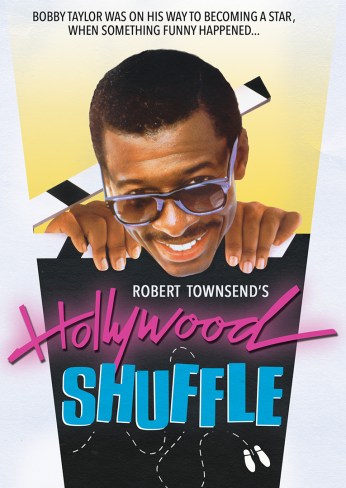
My first film for the month is “Hollywood Shuffle” (1987) directed by and starring Robert Townsend. More than 25 years ago, this small, low-budget movie caught the fascination of movie viewers across the country. And it just happens to be one of my favorite films.

The story revolves around aspiring actor Bobby Taylor (Robert Townsend) trying to break into Hollywood. His troubles lie not with his talent, but the stereotypical roles that he’s asked to play. “Hollywood Shuffle” takes a satiric look at African American actors in Hollywood.

Accepting the lead role in a typical blaxploitation movie, Bobby dreams about what it would be like if African Americans were respected as legitimate actors in roles from Sam Spade to Shakespeare to superheroes. He just has to convince Hollywood that gangstas, slaves and “Eddie Murphy-types” aren’t the sum of his talents.

With his little brother looking up to him and his grandmother proclaiming “there’s work at the post office”, Bobby faces the dilemma of, art or dignity.

For me, I have to go along with grandma, “there’s work at the post office”.

We’ve come a long way in 29 years but as I always say: “We’ve come a long way but we’ve still got a long way to go”!

In Robert Townsend’s own words:

https://soundcloud.com/taketwoshow/robert-townsend-on-paying-for-hollywood-shuffle-with-a-credit-card

https://soundcloud.com/taketwoshow/robert-townsend-on-auditioning-for-terrible-roles


Pioneering Women Filmmakers – A Series – Part 3

The Contemporary Visionaries of American Film

stars

A long time ago in a galaxy far, far away…Women were the driving force behind Hollywood and the movies. This is the third part of a series paying homage to contemporary women filmmakers who broke the glass ceiling and wrote and directed the films that took 86 years from pioneer Lois Weber’s day to achieve. Hollywood is still run by men but these women prove that it may be a man’s world but it would be nothing without a woman or a girl. Thanks, James Brown for the lyric.

  • In 86 years, only four women have been nominated for the Best Director Oscar. Only one, Kathryn Bigelow, has won.

  • Women filmmakers nominated for the Best Director: Lina Wertmüller for Seven Beauties (1976), Jane Campion for The Piano (1993), Sofia Coppola for Lost in Translation (2003), and Kathryn Bigelow for The Hurt Locker (2009).

  • Sofia Coppola was the first American woman to ever be nominated for Best Director for the 2003 movie, “Lost in Translation.”

◊◊◊◊◊◊

Kathryn Ann Bigelow ( born November 27, 1951) is an American director, producer, and writer. Her films include the vampire Western horror film Near Dark (1987), the action crime film Point Break (1991), the controversial science fiction action thriller Strange Days (1995), the mystery thriller The Weight of Water (2000), the submarine thriller K-19: The Widowmaker (2002), the war film The Hurt Locker (2009), the action thriller war film Zero Dark Thirty (2012), and the short film Last Days of Ivory (2014). The Hurt Locker won the 2009 Academy Award for Best Picture, won the BAFTA Award for Best Film, and was nominated for the 2009 Golden Globe Award for Best Drama.

Kathryn Bigelow

Kathryn Ann Bigelow

Bigelow’s trilogy of action films — Blue Steel, Point Break, and Strange Days —  are looked at by critics as rethinking the conventions of action cinema while exploring gendered and racial politics. In her career, Bigelow has become recognizable as both a Hollywood brand and an auteur.

Married to director James Cameron from 1989-1991, she and Cameron were both nominated for Best Director at the 2010 82nd Academy Awards, which Bigelow won. Yay, Kathryn!

Sofia Coppola

Sofia Coppola

Sofia Carmina Coppola (born May 14, 1971) is an American screenwriter, director, producer, and actress. In 2003, she received the Academy Award for Best Original Screenplay for the comedy-drama Lost in Translation and became the third woman to be nominated for an Academy Award for Best Director. Her nomination for Best Director made her the first American woman in history to be nominated in that category, and the third woman overall, after Lina Wertmüller and Jane Campion. In 2010, with the drama Somewhere, she became the first American woman (and fourth American filmmaker) to win the Golden Lion, the top prize at the Venice Film Festival. Her father is the director, producer, and screenwriter Francis Ford Coppola.

She made her feature film directing debut with The Virgin Suicides (1999). It received critical acclaim upon its premiere in North America at the 2000 Sundance Film Festival and was released later that year. If you haven’t seen it, check it out. It’s brilliant and makes you think about parenting skills or the lack thereof.

◊◊◊◊◊◊

African American Women Filmmakers

Zora Neale Hurston

Zora Neale Hurston

(January 7, 1891 – January 28, 1960)

Better known for her work as a novelist, Zora Neale Hurston could be, according to an essay by academic Gloria Gibson, the first African-American woman filmmaker. The film footage, which includes Children’s Games (1928), Logging (1928), and Baptism (1929), appears to be from her work as a student of anthropology under the guidance of famed anthropologist, professor, and mentor, Dr. Franz Boas of Columbia University.

A graduate of Barnard College (B.A. in anthropology in 1928) and a Guggenheim fellow, Hurston traveled back to a South similar to her hometown of Eatonville, Florida (one of the first all-black towns to be incorporated in the United States) to capture a variety of short takes of African-American life. Ethnographic in nature, the films reflect a focus of folklorists of that time period who believed that “…cultural performance and beliefs must be expeditiously collected and documented because they would soon be gone forever” (Gloria Gibson).

During a period of financial and medical difficulties, Hurston was forced to enter St. Lucie County Welfare Home, where she suffered a stroke. She died of hypertensive heart disease on January 28, 1960, and was buried at the Garden of Heavenly Rest in Fort Pierce, Florida. Sadly, her remains were in an unmarked grave until 1973 when novelist Alice Walker and literary scholar Charlotte Hunt found an unmarked grave in the general area where Hurston had been buried and decided to mark it as hers.

Our future:

Ava DuVernay – Current/future generation screenwriter/director – She would have been the first black woman nominated for best director in Oscar history, and just the fifth woman, following Lina Wertmüller for Seven Beauties, Jane Campion for The Piano, Sofia Coppola for Lost in Translation, and Kathryn Bigelow for The Hurt Locker. Instead, she’s been added to the list of female directors who have seen their films get nominated while they’ve been snubbed.

Ava DuVernay

Ava DuVernay

Ava Marie DuVernay (born August 24, 1972) is an American director, screenwriter, film marketer, and film distributor. At the 2012 Sundance Film Festival, DuVernay won the Best Director Prize for her second feature film Middle of Nowhere, becoming the first African-American woman to win the award. For her work in Selma, DuVernay is the first black woman director to be nominated for a Golden Globe Award. With Selma, she is also the first black woman director to have their film nominated for the Academy Award for Best Picture.

In 2015, it was announced that DuVernay would be writing, producing, and directing her next project, Queen Sugar which is an upcoming American drama television series, created, directed and executive produced by Ava DuVernay alongside Oprah Winfrey. The series is based on the novel of the same name by Natalie Baszile.The series is set to air on the Oprah Winfrey Network. 

Women filmmakers are essential to the stories and voices of Hollywood. We’ve made some progress but we still have a long way to go!