For a comprehensive and what I consider a definitive history of one of the original Hollywood Studios – Universal, check out the Documentary – “Universal Horror.” Universal was founded in 1912 by Carl Laemmle and is the world’s fourth oldest major film studio.
Originally airing on Turner Classic Movies in 1998, “Universal Horror” showcases the golden age of 1930’s movie monsters. The film also highlights Carl Laemmle’s family and Carl Laemmle, Jr’s game-changing vision of producing films based on classic horror tales.
Casting for the film became problematic initially since Laemmle was not at all interested in Lugosi, in spite of good reviews for his stage portrayal. Laemmle instead considered other popular actors of the day, including Paul Muni and Chester Morris.
In 1991, the Library of Congress selected Frankenstein for preservation in the United States National Film Registry as being “culturally, historically, or aesthetically significant.
Also affectionately called “Forry,” Ackerman was central to the formation, and spread of science fiction fandom, and a key figure in the wider awareness of science fiction as a literary, art and film genre. Famous for his wordplay he coined the genre nickname “sci-fi”.
Universal Monsters Tribute
The end of Universal’s first run of horror films came in 1936 as the Laemmles were forced out of the studio after financial difficulties and a series of box office flops due partly to censorship and a temporary ban on American horror films in Britain. The release of MGM’s Mad Love and The Raven (both 1935) were the final nail in the coffin for monster movies, being too strong for 1935 tastes, with its themes of torture, disfigurement, and grisly revenge.
The monster movies were dropped from the production schedule altogether and would not re-emerge for another three years. In the meantime, a theater owner revived Dracula and Frankenstein as a double feature, resulting in an immediate smash hit and leading to the original movies being re-released by the studio to surprising success.
Be sure to checkout these films and experience the original horror classics from the original horror classics studio – Universal!
“Listen to them, children of the night; what music they make.” Count Dracula
Dracula is the immortal 1897 Gothic horror novel by Irish author Bram Stoker. It introduced the famous character Count Dracula and established many conventions of subsequent vampire fantasy.
The first edition cover of Dracula
Of all the film adaptations of the classic novel, the 1931 Dracula directed by Tod Browning and starring Bela Lugosi is most synonymous with Stoker’s legendary character, Count Dracula of Transylvania.
The film was produced by Universal and is based on the 1924 stage play Dracula by Hamilton Deane and John L. Balderston, which in turn is loosely based on the novel Dracula by Bram Stoker. The 1924 stage play was substantially revised in 1927 and was the first authorized adaptation of Bram Stoker‘s novel Dracula, and has influenced many subsequent adaptations.
The 1927 Broadway production starred Bela Lugosi in his first major English-speaking role, which he reprised in the 1931 film adaptation of the play. A 1977 Broadway revival designed by Edward Gorey, starring Frank Langella, won the Tony Award for Best Revival.
Bram Stoker’s novel had already been filmed without permission as Nosferatu in 1922 by German expressionist filmmaker F. W. Murnau. Bram Stoker’s widow sued for plagiarism and copyright infringement, and the courts decided in her favor, essentially ordering that all prints of Nosferatu be destroyed.
Nosferatu
Enthusiastic young Hollywood producer Carl Laemmle, Jr. also saw the box office potential in Stoker’s gothic chiller, and he legally acquired the novel’s film rights. Initially, he wanted Dracula to be a spectacle on a scale with the lavish silent films The Hunchback of Notre Dame (1923) and The Phantom of the Opera (1925). (Wikipedia)
The decision on casting the title role proved problematic. Initially, Laemmle was not at all interested in Lugosi, in spite of good reviews for his stage portrayal. Laemmle instead considered other actors, including Paul Muni, Chester Morris, and Ian Keith.
Today, Dracula is widely regarded as a classic of the era and of its genre. In 2000, it was selected for preservation in the United States National Film Registry by the Library of Congress as being “culturally, historically, or aesthetically significant”.
To many film lovers and critics alike, Lugosi’s portrayal is widely regarded as the definitive Dracula. Lugosi had a powerful presence and authority on-screen. The slow, deliberate pacing of his performance (“I bid you… welcome!” and “I never drink… wine!”) gave his Dracula the air of a walking, talking corpse, which terrified 1931 movie audiences.
He was just as compelling with no dialogue, and the many close-ups of Lugosi’s face in icy silence jumped off the screen. With this mesmerizing performance, Dracula became Bela Lugosi’s signature role, his Dracula a cultural icon, and he himself a legend in the classic Universal Horror film series.
Stoker’s visit to the English coastal town of Whitby in 1890 is said to be part of the inspiration for Dracula. He began writing novels while a manager for Henry Irving, as well as, director of London’s Lyceum Theatre, beginning with The Snake’s Pass in 1890 and Dracula in 1897.
During this period, Stoker was part of the literary staff of the The Daily Telegraph in London, and he wrote other fiction, including the horror novels The Lady of the Shroud (1909) and The Lair of the White Worm (1911). (Wikipedia)
Stoker was bedridden with an unknown illness until he started school at the age of seven when he made a complete recovery. Of this time, Stoker wrote, “I was naturally thoughtful, and the leisure of long illness gave the opportunity for many thoughts which were fruitful according to their kind in later years.”
Before writing Dracula, Stoker met Ármin Vámbéry, a Hungarian writer, and traveler. Dracula likely emerged from Vámbéry’s dark stories of the Carpathian mountains. Stoker then spent several years researching European folklore and mythological stories of vampires.
Dracula is an epistolary novel, written as a collection of realistic but completely fictional diary entries, telegrams, letters, ship’s logs, and newspaper clippings, all of which added a level of detailed realism to the story, a skill which Stoker had developed as a newspaper writer.
At the time of its publication, Dracula was considered a “straightforward horror novel” based on imaginary creations of supernatural life.”It gave form to a universal fantasy . . and became a part of popular culture.” (Wikipedia)
After suffering a number of strokes, Stoker died at No. 26 St George’s Square, London on 20 April 1912. He was cremated, and his ashes were placed in a display urn at Golders Green Crematorium in north London.
For a comprehensive and what I consider a definitive history of one of the original Hollywood Studios – Universal, check out the Documentary – “Universal Horror.” Universal was founded in 1912 by Carl Laemmle and is the world’s fourth oldest major film studio.
Originally airing on Turner Classic Movies in 1998, “Universal Horror” showcases the golden age of 1930’s movie monsters. The film also highlights Carl Laemmle’s family and Carl Laemmle, Jr’s game-changing vision of producing films based on classic horror tales.
Casting for the film became problematic initially since Laemmle was not at all interested in Lugosi, in spite of good reviews for his stage portrayal. Laemmle instead considered other popular actors of the day, including Paul Muni and Chester Morris.
In 1991, the Library of Congress selected Frankenstein for preservation in the United States National Film Registry as being “culturally, historically, or aesthetically significant.
Also affectionately called “Forry,” Ackerman was central to the formation, and spread of science fiction fandom, and a key figure in the wider awareness of science fiction as a literary, art and film genre. Famous for his wordplay he coined the genre nickname “sci-fi”.
Universal Monsters Tribute
The end of Universal’s first run of horror films came in 1936 as the Laemmles were forced out of the studio after financial difficulties and a series of box office flops due partly to censorship and a temporary ban on American horror films in Britain. The release of MGM’s Mad Love and The Raven (both 1935) were the final nail in the coffin for monster movies, being too strong for 1935 tastes, with its themes of torture, disfigurement, and grisly revenge.
The monster movies were dropped from the production schedule altogether and would not re-emerge for another three years. In the meantime, a theater owner revived Dracula and Frankenstein as a double feature, resulting in an immediate smash hit and leading to the original movies being re-released by the studio to surprising success.
As I celebrate this Halloween, my film line-up would not be complete without those original horror classics from the original horror classics studio – Universal!
October holds a special place in my holiday heart because I get to celebrate my favorite day of the year, Halloween. Just picture it. A darkened theater, a bucket of popcorn, sitting terrified and curled up in a ball; just for the scare of it!
‘Cause this is thriller, thriller night.’
An essential part of the ritual is breaking out my awesome Halloween decorations and filling up the trick or treater candy bowl with first-class, yummy confections. Envisioning kid’s faces as I proudly hand out M&M’s, Reese Cups, Skittles and no candy bowl would be complete without my personal choice – Snickers! As a seasoned Halloween aficionado, the mood wouldn’t be complete without a spooktacular horror classic marathon streaming on the big screen TV!
The ultimate Halloween night experience would include waiting in line with fellow enthusiasts to enjoy a horror classic on the big screen. The first scary movie I remember seeing as a kid is William Castle’s “House on Haunted Hill” and man was I thrilled to be able to re-live my first time when a friend told me a neighborhood theater had a special Halloween presentation of my beloved “House on Haunted Hill”. Cherry on the top was that they also sponsored a Best Costume competition and Best Scream Award. It was everything I could hope for; even performing the movie’s gimmick, the flying skeleton!
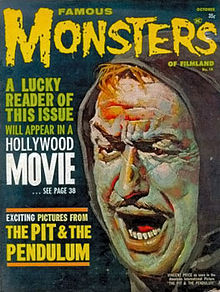
Vincent Price in ‘House on Haunted Hill’
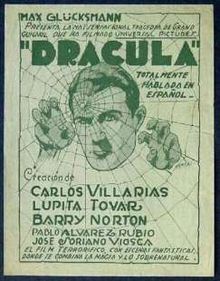
This Halloween, movie friends, Turner Classic Movies and Fathom Events is presenting in select theaters nationwide, a special double feature screening of the 1931 Universal Horror Classic, Dracula starring Bela Lugosi and Helen Chandler as Mina Harker. Based on the novel Dracula by Bram Stoker. In addition to the original, moviegoers will also enjoy the added treat of the Spanish version starring Carlos Villarías as Conde Drácula and Lupita Tovar as Eva Seward.
Long thought lost, a print of Spanish Dracula was discovered in the 1970s and restored. I own and love my Legacy Collection DVD which was released in 2004 and contains both versions. The collection also includes – Dracula’s Daughter (1936) Son of Dracula (1943) starring Universal’s Wolfman, Lon Chaney, Jr. and House of Dracula (1945). A must-own addition for every classic horror movie fan’s collection. For ticket information about the Dracula Double Feature, check out Fathom Events or your local theater.
Trivia: For a period of time in Hollywood, studios would produce Spanish language version films for overseas distribution, using the same sets. Tod Browning directed the English production which was shot during the day. George Melford (who did not speak Spanish) was the director for the Spanish version, filming during the evening. The Spanish crew had the advantage of watching the English dailies when they came in for the evening, and they would figure out better camera angles and more effective use of lighting in an attempt to “top” it. There are critics who believe the Spanish production was better, incorporating more interesting and varied camera angles and perspective. I agree with the critics point that this production explored more visual dimensions and created more overall excitement. It also had a sexier edge.
Dracula 1931 – Spanish Version
So, if you have the opportunity, I highly recommend adding this special event to your calendar. If you do attend, let me know your reaction in the comments.
This site is about how to live our life in a meaningful way by accepting complete surrender to the Almighty with purity of mind and character. It is about the eternal religion of the world i.e. Hinduism which is very liberal to anyone because there are many branches or methods to get the divinity to turn our life into an ever blissful one.
Free listening and free download (mp3) chill and down tempo music (album compilation ep single) for free (usually name your price). Full merged styles: trip-hop electro chill-hop instrumental hip-hop ambient lo-fi boombap beatmaking turntablism indie psy dub step d'n'b reggae wave sainte-pop rock alternative cinematic organic classical world jazz soul groove funk balkan .... Discover lots of underground and emerging artists from around the world.





 iheartfilm