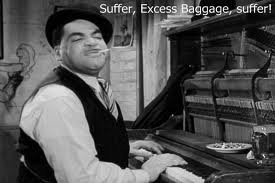
The title sums it up. “Jam, Jive and Everything!.” Thomas Wright “Fats” Waller is one of the most charming, talented and prolific artists to ever tickle the ivories of a stride piano.
We share a birthday – May 21st. His last recording session was in Detroit, Michigan – home of my birth. I guess it was destiny that his music and spirit would come to bring me such joy!
What excites me about Fats?
When I was a kid and first saw the groundbreaking musical Stormy Weather (1943) I was familiar with its star Lena Horne because my father loved him some Miss Lena. But for me, the wonderful surprise of the film was Fats Waller.
Fats Waller and Lena Horne
When you see him you’re totally invested. His personality jumps off the screen. People talk about presence. Fats created “presence!”
Fats is credited with advancing the musical style – stride piano. Although known for his two most famous compositions: “Ain’t Misbehavin'” and “Honeysuckle Rose”, he penned many more uncredited hits such as “I Can’t Give You Anything but love, Baby” and “On the Sunny Side of the Street”.
Waller copyrighted over 400 songs and began his professional career as a pianist at the age of 15, working in cabarets and theaters.
His life and artistry became the Broadway musical revue “Ain’t Misbehavin‘ produced in 1978. (The show and star Nell Carter won Tony Awards.)
Recordings of Fats Waller were inducted into the Grammy Hall of Fame which is a special Grammy Award established in 1973 to honor recordings that are at least 25 years old and that have “qualitative or historical significance”.
Here ’tis, a tribute to Fats’ brilliance and charm:
Despite performing poorly at the box office, the film was nominated for several awards, including Golden Globes for Best Director and Best Picture (Drama) and Oscars for Best Art Direction (Richard Sylbert, George Gaines) and Film Editing. (Wikipedia)
Francis Ford Coppola (R)
Diane Lane
Richard Gere
Gregory Hines and Lonette McKee
Maurice and Gregory Hines
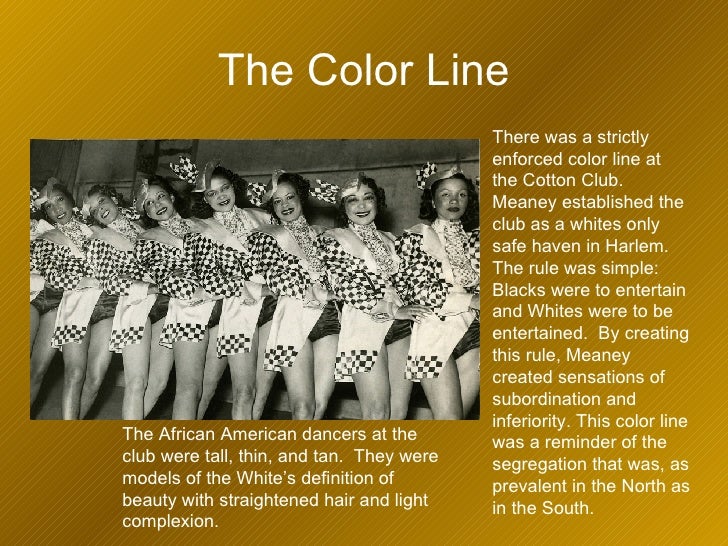
I remember looking forward to screening this film. I understood the significance of The Cotton Club during the Harlem Renaissance of the 20’s and 30’s and wanted the 1980’s audience to be curious about the history of the real club and incredible level of talent that appeared there between 1923 – 1940.
Some of the original performers at The Cotton Club included:
The movie is intense. Producer Robert Evans originally wanted to direct the project but later asked Coppola. There are definite similarities to “The Godfather” in the film due to its violent nature and also the fact that Mario Puzo (author of The Godfather) wrote the original story and screenplay.
Gangsters, racism and love, this film exposes them all. I do, however, wish more of the movie focus was on The Cotton Club itself and the lives of those characters.
The story centers around the dangerous love affair of Dixie Dwyer (Richard Gere) and Vera Cicero (Diane Lane). She “belongs” to mobster Dutch Schultz (James Remar). Dutch is a straight up psychopath We also follow the budding romance between Sandman Williams (Gregory Hines) and Lila Rose Oliver (Lonette McKee). He wants to get married. She wants to be a “Star.” (She’s also hiding a secret about her “other life.”)
Watch and listen as Lonette McKee, also from the movie (“Sparkle”), delivers a taste of the film’s 1930’s Harlem.
One of the most memorable scenes is between the real life and onscreen brothers – Maurice and Gregory Hines. Clay (Maurice Hines) and Sandman (Gregory Hines) have had a major falling out and at this moment we get to share in their reunion.
Growing up, this old school tap dancing duo was compared to The Nicholas Brothers. Gregory Hines remarked in an interview that after seeing The Nicholas Brothers perform that “nobody was going to be the next Nicholas Brothers, least of all my brother and I.”
Explore the 1984 film but more importantly explore the controversial history of The Cotton Club and the entertainers and music that fueled the Jazz generation.
“Lady Sings the Blues” (1972) is the biopic of the troubled life and career of the legendary Jazz singer, Billie Holiday. Loosely based on her 1956 autobiography which, in turn, took its title from one of Holiday’s most popular songs. It was produced by Motown Productions for Paramount Pictures and directed by Sidney J. Furie.
When I first heard Diana Ross had been cast as Billie Holiday I thought, she can’t act and will never pull it off. I wasn’t a big Diana Ross fan but when I saw the movie I had to give her credit for her phenomenal, Oscar-nominated performance. She lost to Liza Minnelli in “Cabaret”, but I thought Ross deserved the award.
The opening sequence (which was shot in black and white in still pictures) made me sit up and go, whoa, she’s serious. Diana Ross, the glamorous diva wore no makeup and looked the part of a heroin addict. The movie overall was a triumph not only for Ross but the incredible cast including – Billy Dee Williams as Holiday’s boyfriend Louis McKay, and Richard Pryor as Piano Man.
(In 1936, New York City, Billie Holiday (Diana Ross) is arrested on a drugs charge.)
The story takes us from Billie’s tumultuous youth when in 1928 she is raped in the Baltimore brothel where she works as a housekeeper. She runs away to her mother who proceeds to get her a job in another brothel in the Harlem section of New York where she becomes a prostitute. Seeing that her life is going nowhere, she quits and heads to a local nightclub to become a showgirl. Billie has always had a love of music and has a remarkable voice. After “Piano Man” (Richard Pryor) accompanies Billie on the song”All of Me“, Jerry, the club owner, books her as a singer in the show.
Billie Holiday
Eleanora Fagan (April 7, 1915 – July 17, 1959), professionally known as Billie Holiday lived a life that was an American tragedy full of turmoil, racism, and drug abuse. Despite all this we are left with her incredible song catalog and heartfelt performances.
Holiday had a tremendous influence on jazz music and pop singing. Her vocal style, strongly inspired by jazz instrumentalists, pioneered a new way of manipulating phrasing and tempo. “God Bless the Child” became Holiday’s most popular and covered record. It reached number 25 on the charts in 1941 and was third in Billboard’s songs of the year, selling over a million records. In 1976, the song was added to the Grammy Hall of Fame.
Billie Holiday died of cirrhosis of the liver in 1959 when she was 44. The biggest triumph of her career was her sold-out, standing ovation performance at Carnegie Hall.
Awards and Honors
“Lady Sings the Blues” was nominated for five Academy Awards. The nominations were for Best Actress in a Leading Role (Diana Ross), Best Art Direction-Set Decoration (Carl Anderson and Reg Allen), Best Costume Design (Norma Koch), Best Music, Original Song Score and Adaptation (Gil Askey & Michel Legrand) and Best Writing, Story and Screenplay Based on Factual Material or Material Not Previously Published or Produced.The film was also screened at the 1973 Cannes Film Festival but was not entered into the main competition.
Soundtrack
Motown released a hugely successful soundtrack double-album of Ross’ recordings of Billie Holiday songs from the film, also titled Lady Sings the Blues. The album went to number one on the Billboard Hot 200 Album Charts, for the week-ending dates of April 7 and 14, 1973.
Title sums it up. “Jam, Jive and Everything!.” Thomas Wright “Fats” Waller is one of the most charming, talented and prolific artists to ever tickle the ivories of a stride piano.
We share a birthday – May 21st. His last recording session was in Detroit, Michigan – home of my birth. I guess it was destiny that his music and spirit would come to bring me such joy!
What excites me about Fats?
When I was a kid and first saw the ground breaking musical Stormy Weather (1943) I was familiar with its star Lena Horne because my father loved him some Miss Lena. But for me, the wonderful surprise of the film was Fats Waller.
Fats Waller and Lena Horne
When you see him you’re totally invested. His personality jumps off the screen. People talk about presence. Fats created “presence!”
Fats is credited with advancing the musical style – stride piano. Although known for his two most famous compositions: “Ain’t Misbehavin'” and “Honeysuckle Rose”, he penned many more uncredited hits such as “I Can’t Give you Anything but love, Baby” and “On the Sunny Side of the Street”.
Waller copyrighted over 400 songs and began his professional career as a pianist at the age of 15, working in cabarets and theaters.
His life and artistry became the Broadway musical revue “Ain’t Misbehavin‘ produced in 1978. (The show and star Nell Carter won Tony Awards.)
Recordings of Fats Waller were inducted into the Grammy Hall of Fame which is a special Grammy Award established in 1973 to honour recordings that are at least 25 years old and that have “qualitative or historical significance”.
Here ’tis, a tribute to Fats’ brilliance and charm:
I remember looking forward to screening this film. I understood the significance of The Cotton Club during the Harlem Renaissance of the 20’s and 30’s and wanted the 1980’s audience to be curious about the history of the real club and incredible level of talent that appeared there between 1923 – 1940.
Some of the original performers at The Cotton Club included:
The movie is intense. Producer Robert Evans originally wanted to direct the project but later asked Coppola. There are definite similarities to “The Godfather” in the film due to it’s violent nature and also the fact that Mario Puzo (author of The Godfather) wrote the original story and screenplay.
Gangsters, racism and love, this film exposes them all. I do, however, wish more of the movie focus was on The Cotton Club itself and the lives of those characters.
The story centers around the dangerous love affair of Dixie Dwyer (Richard Gere) and Vera Cicero (Diane Lane). She “belongs” to mobster Dutch Schultz (James Remar). Dutch is a straight up psychopath We also follow the budding romance between Sandman Williams (Gregory Hines) and Lila Rose Oliver (Lonette McKee). He wants to get married. She wants to be a “Star.” (She’s also hiding a secret about her other life.)
Watch and listen as Lonette McKee, also from the movie (“Sparkle”), delivers a taste of the film’s 1930’s Harlem.
One of the most memorable scenes is between the real life and onscreen brothers – Maurice and Gregory Hines. Clay (Maurice Hines) and Sandman (Gregory Hines) have had a major falling out and at this moment we get to share their reunion. Growing up, this old school tap dancing duo was compared to The Nicholas Brothers. Gregory Hines remarked in an interview that after seeing The Nicholas Brothers perform that “nobody was going to be the next Nicholas Brothers, least of all my brother and I.”
Explore the 1984 film but more importantly explore the controversial history of The Cotton Club and the entertainers and music that fueled the Jazz generation.
This site is about how to live our life in a meaningful way by accepting complete surrender to the Almighty with purity of mind and character. It is about the eternal religion of the world i.e. Hinduism which is very liberal to anyone because there are many branches or methods to get the divinity to turn our life into an ever blissful one.
Free listening and free download (mp3) chill and down tempo music (album compilation ep single) for free (usually name your price). Full merged styles: trip-hop electro chill-hop instrumental hip-hop ambient lo-fi boombap beatmaking turntablism indie psy dub step d'n'b reggae wave sainte-pop rock alternative cinematic organic classical world jazz soul groove funk balkan .... Discover lots of underground and emerging artists from around the world.



.jpg)




 iheartfilm