iheartfilm is dedicating the month of November to the lesson of Gratitude in films; the quality of being thankful.
“Run Forrest, Run!”
Every time I think of the movie “Forrest Gump”, that’s the first quote I hear. Then, “Life’s like a box of chocolates, you never know what you’re gonna get.”
Forrest Gump’s (Tom Hanks) life is a testimony to gratitude. He understands his challenges but is not hesitant to live his life to the fullest, including telling his childhood love, Jenny (Robin Wright) how he feels about her.
He gets it. Life gives you what you get, so don’t whine, go for it and make the most of your journey. Thank God for his mother, (Sally Field), she didn’t listen to what the”experts” had to say. She did whatever she had to do to provide Forrest with the foundation that he could do anything. With his braces, he had “magic” legs. Turn every so-called obstacle into an advantage. Once again, attitude is everything!
Forrest is a true inspiration and proof that with support and love we can overcome adversity. Love and compassion make the difference.
Forrest and Bubba
Forrest – Lieutenant Dan
Lieutenant Dan, Bubba, Forrest
Jenny
Little Jenny
Forrest Life Quote
“Run Forrest, Run!”
Little Forrest/Little Jenny
Mama, Jenny, Bubba, and Lieutenant Dan. Forrest loved and was deeply loved by those whose lives he touched.
The Wizard of Oz (1939) – “There’s No Place Like Home”
iheartfilm is dedicating the month of November to the lesson of Gratitude in films; the quality of being thankful.
To quote author Melody Beattie:
“Gratitude turns what we have into enough, and more. It turns denial into acceptance, chaos into order, confusion into clarity…it makes sense of our past, brings peace for today, and creates a vision for tomorrow.”
My first pick, “The Wizard of Oz”, is overflowing with gratitude! Dorothy (Judy Garland) accompanied by her little dog Toto, seeking a better place in the world comes to understand what home really means and her compatriots – The Scarecrow (Ray Bolger), Tin Man (Jack Haley), and The Cowardly Lion (Bert Lahr) wishing to be more than they perceive themselves to be, learn to appreciate their unique gifts. The Great and Powerful Oz (Frank Morgan) realizes the blessing and value of truth and in his case the truth truly does set him free.
It all starts with a wish to be “Somewhere Over the Rainbow” and results in unexpected consequences – the terror of being caught up in a twister, inadvertently dropping a house on the sister of the Wicked Witch of the West (oops) and inheriting both the wrath of said Witch (Margaret Hamilton) and a pair of coveted ruby slippers.
Sadly, “Over the Rainbow” doesn’t materialize into the idyllic place of which Dorothy sings, which becomes her vision quest. Dorothy’s longing for home dovetails with the wishes of The Scarecrow, Tin Man, and The Cowardly Lion. These three, also wishing for what they believe they don’t have – a brain, a heart, and courage – join the quest to the Emerald City to finally have their dreams realized through the power of the omnificent Wizard of Oz.
The trio’s perilous journey to get Dorothy home leads to the self-realization that they possessed the traits they sought all along and didn’t really need the wizard to bestow these attributes upon them.
Dorothy also learns a valuable lesson we all tend to forget, “there’s no place like home” and if we can’t find what we’re looking for there, then we won’t be able to find it anywhere. Home exists within us and it’s our outlook and attitude that dictates whether it’s a black and white existence filled with worries and that ole Gulch “heifer” or a technicolor world filled with musical munchkins and the love of three very special friends.
With Gratitude, we can appreciate and give thanks for the joys and blessings in our lives because the truth is we could be far worse off. My spiritual goal every day is to be mindful and thankful for the bounty which I’ve already received.
For a comprehensive and what I consider a definitive history of one of the original Hollywood Studios – Universal, check out the Documentary – “Universal Horror.” Universal was founded in 1912 by Carl Laemmle and is the world’s fourth oldest major film studio.
Originally airing on Turner Classic Movies in 1998, “Universal Horror” showcases the golden age of 1930’s movie monsters. The film also highlights Carl Laemmle’s family and Carl Laemmle, Jr’s game-changing vision of producing films based on classic horror tales.
Casting for the film became problematic initially since Laemmle was not at all interested in Lugosi, in spite of good reviews for his stage portrayal. Laemmle instead considered other popular actors of the day, including Paul Muni and Chester Morris.
In 1991, the Library of Congress selected Frankenstein for preservation in the United States National Film Registry as being “culturally, historically, or aesthetically significant.
Also affectionately called “Forry,” Ackerman was central to the formation, and spread of science fiction fandom, and a key figure in the wider awareness of science fiction as a literary, art and film genre. Famous for his wordplay he coined the genre nickname “sci-fi”.
Universal Monsters Tribute
The end of Universal’s first run of horror films came in 1936 as the Laemmles were forced out of the studio after financial difficulties and a series of box office flops due partly to censorship and a temporary ban on American horror films in Britain. The release of MGM’s Mad Love and The Raven (both 1935) were the final nail in the coffin for monster movies, being too strong for 1935 tastes, with its themes of torture, disfigurement, and grisly revenge.
The monster movies were dropped from the production schedule altogether and would not re-emerge for another three years. In the meantime, a theater owner revived Dracula and Frankenstein as a double feature, resulting in an immediate smash hit and leading to the original movies being re-released by the studio to surprising success.
As I celebrate this Halloween, my film line-up would not be complete without those original horror classics from the original horror classics studio – Universal!
Let me start by saying, I absolutely love William Castle! His “effects”, and his campy, “spooky” movies made him the “Master of the Movie Gimmick”! He financed his first movie, Macabre (1958), by mortgaging his house and came up with the brilliant idea to give every movie-goer a certificate for a $1,000 life insurance policy from Lloyd’s of London in case they should die of fright during the film. He also stationed nurses in the lobbies with parked hearses outside the theaters. Macabre was a hit!
Each of his films featured an “effect” or gimmick. With “House on Haunted Hill,” it was “Emergo”, the “flying skeleton.” It didn’t always work, but the kids in the audience had a good time anyway trying to knock it down. (kids will be kids:) Trivia Fact: William Castle produced the Roman Polanski horror hit “Rosemary’s Baby.”
“House on Haunted Hill” Skelton
“13 Ghosts” is jammed packed with “effects” and filmed in “Illusion-O”. Knife-wielding ghosts, headless ghosts, and murderous ghost Emilio, who has a thing for totally destroying the kitchen. As Buck Zorba (Charles Herbert) tells the story, seems Emilio killed not only his wife but his mother-in-law as well. Whack, whack! (nice sound effect Buck)
The “13 Ghosts'” storyline begins with Dr. Plato Zorba dying and leaving his broke nephew, Professor Cyrus Zorba (Donald Woods), an old, rundown LA mansion. The catch is Cyrus, his wife Hilda,(Rosemary DeCamp), daughter Madea (Jo Morrow) and son Buck can’t sell the house so are forced to share the joint with the 13 ghosts. “They come with the house.”
Ghosts or not the family is so broke that it’s common place for their furniture to be repossessed on a regular basis. In fact, the night they receive a telegram (from a little person in the dark) to meet with Uncle Zorba’s attorney Benjamin Rush (Martin Milner), they’re sitting on the floor exchanging gifts and slicing birthday cake for their youngest son, Buck – Once again, the furniture’s been repossessed.
Cyrus and wife Hilda
Attorney Benjamin Rush
Madea Zorba
The House
furniture’s gone
William Castle
Buck
Emilio’s knife
Emilio’s kitchen
14th Ghost?
Move-in day at their new digs includes meeting their Uncle’s housekeeper who turns out to be the green one herself, the Wicked Witch of the West! (Margaret Hamilton)
Margaret Hamilton (Elaine the housekeeper)
The best is yet to come as attorney Benjamin Rush goes to extremes trying to find the supposed fortune in cash Uncle Zorba stashed somewhere in the house. Ghosts run wild and the ghost viewer lets you catch all the action. Here’s where Illusion-O comes in:
“Aahhhhh!”
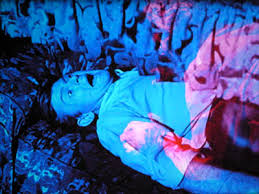
Audiences received viewers with red and blue cellophane filters. Choosing to look through the red filter intensified the images of the ghosts while the blue filter “removed” them. Being brave or coward, the choice was up to you.
Put ’em on!
Emilio’s kitchen
Emilio’s knife
Cyrus and wife Hilda
Attorney Benjamin Rush
Madea Zorba
furniture’s gone
Buck
The House
“13 Ghosts” is the fourth collaboration from director William Castle and writer Robb White and lives up to the Castle touch. Two of his films were remade by his daughter Terry Ann Castle, who co-produced House on Haunted Hill in 1999, and Thirteen Ghosts in 2001 (the latter retitled Thir13en Ghosts).
A documentary focusing on Castle’s life, Spine Tingler! The William Castle Story, directed by Jeffrey Schwarz, had its premiere at AFI FEST 2007 in Los Angeles on November 8, 2007. It won the Audience Award for Best Documentary.
In my opinion, John Carpenter’s “Halloween” is the quintessential All Hallows Eve movie. It still freaks me out to the point where I can only watch it during the daytime. So sad:(
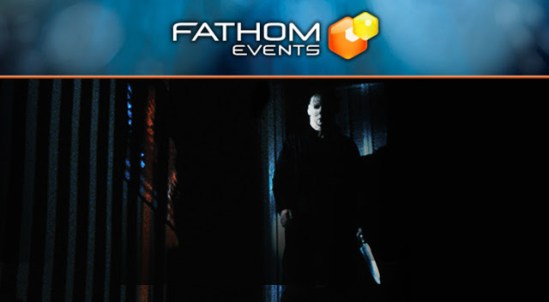
Fathom Events and SpectiCast is presenting this special screening of “Halloween” on October 29th at 7:30 pm. Go, Go, Go, see it on the big screen! It’s frightening enough on the small screen and in the theater, I bet it’ll have you curled up in a ball! My favorite lines from the film are – Tommy: “What’s the Boogey Man?” Dr. Loomis: “As a matter of fact… it was.”
This movie is credited with the first strong female in a slasher film and redefines the genre. Jamie Lee Curtis, in her film debut, plays the title role of Laurie Strode. Laurie is not only book smart but has a strong sense of survival. She’s the ‘I’m gonna fight you tooth and nail’ type babysitter who doesn’t just scream and lay there making easy pickings for the killer. Watch out Michael Meyers, she’s no easy win.
A classic film all the way! A must see for every true horror fan.
“It’s Halloween, everyone’s entitled to one good scare.”
Michael Meyers returns to Haddonfield, and the big screen, for one terrifying night on Thursday, October 29th with John Carpenter’s HALLOWEEN. One of the most successful independent movies of all time, the original HALLOWEEN redefined the horror genre as we know it and has spawned a horror franchise of seven sequels.
In 1963, six-year-old Michael stabbed his 15-year-old sister to death. Institutionalized for the next 15 years, Michael manages to escape and heads for his hometown of Haddonfield the day before Halloween. Meanwhile Laurie Strode, a serious student, is spending Halloween night babysitting for the neighbors. Little does she know the danger she and her friends are in with Michael on the prowl.
This special one-night event will also feature an introduction with director John Carpenter, providing exclusive insights into his iconic horror indie.
Maureen O’Hara, ‘The Queen of Technicolor,’ Dies at 95
(August 17, 1920 – October 24, 2015)
I loved the feisty Irish attitude she embodied in the characters created starring opposite John Wayne, but my sentiments will always go to her role as 8-year old Natalie Wood’s mother in the Christmas Classic, “Miracle on 34th Street.” R.I.P. Maureen O’Hara
Maureen O’Hara, the Irish beauty whose striking red hair, crystal green eyes, and porcelain skin was so dazzling on the silver screen that she was dubbed “The Queen of Technicolor,” has died. She was 95.
O’Hara, who played the feisty wife to onscreen husband John Wayne in five films — three of them directed by John Ford — died Saturday at her home in Boise, Idaho, Johnny Nicoletti, her longtime manager, told the Associated Press.
“She passed peacefully surrounded by her loving family as they celebrated her life listening to music from her favorite movie, The Quiet Man,” said a statement from her family.
She moved to Idaho in 2013 to be closer to her relatives after spending four decades in Glengarriff, Ireland.
Although she was memorable in so many great Hollywood films — including The Hunchback of Notre Dame (1939), How Green Was My Valley (1941), Miracle on 34th Street (1947), Rio Grande (1950), The Quiet Man (1952), Our Man in Havana (1959) and The Parent Trap (1961) — the Dublin native never won an Academy Award, much less received an Oscar nomination.
That oversight was rectified when the Academy presented her with an honorary Oscar at the Governors Awards in November 2014.
Musing about what made her a star, O’Hara wrote: “I have always believed my most compelling quality to be my inner strength, something I am easily able to share with an audience. I’m very comfortable in my own skin. I never thought my looks would have anything to do with becoming a star. Yet it seems that in some ways they did.”
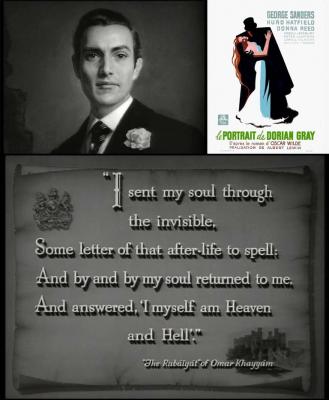
“I am jealous of everything whose beauty does not die. I am jealous of the portrait you have painted of me. Why should it keep what I must lose? Every moment that passes takes something from me and gives something to it. Oh, if it were only the other way! If the picture could change, and I could be always what I am now! Why did you paint it? It will mock me some day — mock me horribly!” The hot tears welled into his eyes; he tore his hand away and, flinging himself on the divan, he buried his face in the cushions, as though he was praying.”
“Dorian Gray” – Oscar Wilde’s -“The Picture of Dorian Gray”
Dorian Gray
If you could, would you? Sell your soul for eternal youth.
That was the choice made by Dorian Gray. His story is a classic cautionary tale. Be careful what you wish for.
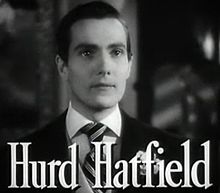
Dorian Gray (Hurd Hatfield) is a striking and wealthy young man living in 19th century London. While posing for his portrait with his artist friend Basil Hallward (Lowell Gilmore), he meets the cynical and audacious Lord Henry Wotton (George Sanders) who tells him that youth and beauty are fleeting and while he’s young he should entertain every worldly pleasure. Dorian is naive and in the presence of an enchanted Egyptian cat wishes he would stay forever young and only his portrait would age.
While visiting a local pub, The Two Turtles, he meets the beautiful and demure Sybil Vane. She sweetly sings “Goodbye Little Yellow Bird” and Dorian is totally enamored. Falling in love, he asks Miss Vale for her hand in marriage and invites both Basil and Lord Wotton to the pub to meet his love.
Sybil Vane
When Dorian informs Lord Wotton of his intention to marry Sybil, Wotton suggests he tests her virtue by inviting her to spend the evening with him. If she rebukes him then she’s chaste if she accepts she’s a tramp and as the saying goes “why pay for the cow when you can have the milk for free.” Dorian buys into this plan thus beginning his downward spiral into narcissism and pleasures of the flesh.
Sybil accepts Dorian’s request to stay with him and the following day Dorian sends her a breakup letter expressing his disappointment in her. Heartbroken, Sybil is devastated and Dorian becomes aware of the first signs of cruelty to appear upon his portrait’s face.
Years pass with his peers aging, but Dorian’s youth remains. Gossip swirls and his friends begin to shun him; questioning why his appearance is the same. Dorian goes full tilt debauchery until he finally reaches rock bottom.
There are people today who could benefit from heeding the lesson in the “Picture of Dorian Gray.” The evil you do comes back to bite. Karma is a bitch.
Getting closer to All Hallows Eve! Continuing my series of film recommendations for Turner Classic Movies Horror Fridays at 8:00 pm. This week’s DVR choice is “The Bad Seed” (1956). Talk about scary kids! This flick is a cult classic that is truly shocking and begs the question – Is evil inherited? “The Bad Seed’s mother – Christine Penmark (Nancy Kelly) must confront that possibility as she begins to suspect that all is not quite right with Rhoda (Patty McCormack), her perpetually well-mannered child. Mom is finally forced to confront the possibility that her daughter may actually be a murderous sociopath after circumstances become too real to ignore.
“The Bad Seed” (1956)
Let’s start with our angelic, eight-year-old darling – Rhoda Penmark who oh so sweetly plays the French song “Au Clair de la lune” on her piano while screams emanate from the basement. Don’t ever threaten to narc on her. Looks like they’re going to be needing a new caretaker.
This child is cold blooded! In her case, trinkets are a girl’s best friend. So, when an old woman promises to leave Rhoda a gem, she – the old woman – apparently couldn’t die fast enough so our little darling volunteers to help the process along. Oh boy, a Penmanship Medal, a very tasty trinket indeed. But Rhoda loses out to classmate Claude Daigle and feels cheated so of course she takes matters into her own hands to acquire what she feels she deserves. Oh well, poor little Claude Daigle.
This film was the first of its kind since the censors forbade movies that featured children as killers. But Warner Bros.’ Studio was able to get away with it by adding an “adults only” tag to the film’s advertising and altering the original ending. The film is based upon a play (of the same name) by Maxwell Anderson, which in turn is based upon William March’s 1954 novel The Bad Seed. The play was adapted by John Lee Mahin for the screenplay of the film.
The play’s principal players, Nancy Kelly (Christine Penmark), Eileen Heckart (Mrs. Daigle), Henry Jones (LeRoy the caretaker) and Patty McCormack (Rhoda Penmark) all revised their roles in the film adaptation.
“The Bad Seed” was one of Warner Bros.’ biggest hits of the year, grossing $4.1 million and one the year’s top 20 at the box office. Academy Award Nominations were given to Nancy Kelly: Best Actress, Eileen Heckart: Best Actress in a Supporting Role, Patty McCormack: Best Actress in a Supporting Role and Best Cinematography (Black-White) Hal Rosson. Eileen Heckart won a Golden Globe Award for her performance.
Since I always follow the film fan rule, I won’t divulge the ending. Plus I promised Warner Bros.’ at the end of the movie.
Most people think of Cary Grant as a suave leading man, but he is also an incredible physical comic. The dark comedy “Arsenic and Old Lace”(1944) directed by Frank Capra is the perfect vehicle for his slapstick comedic style. Grant plays Mortimer Brewster who, to his horror, discovers that his two darling elderly aunts (Abby (Josephine Hull) and Martha (Jean Adair) are in fact serial killers, bumping off those who they perceive as “lonely bachelor” men.
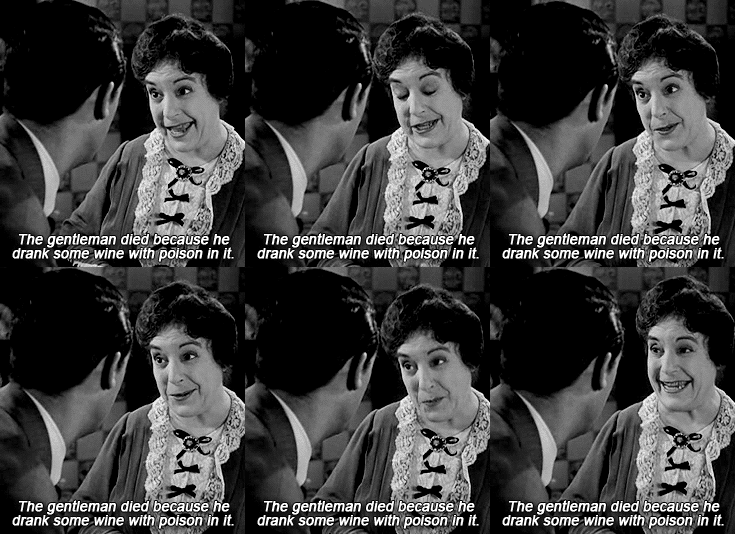
Mortimer’s aunts epitomize the idea of sweet little old ladies. They can preserves, donate toys to the policeman’s children’s fund, make Elderberry wine. The problem is that their tasty Elderberry wine is spiked with arsenic, strychnine and “just a pinch of cyanide”.
After Mortimer discovers a dead body hidden in the window seat he assumes that Teddy (John Alexander) – Abby and Martha’s brother – has committed murder under some delusion, (he believes he’s Theodore Roosevelt).
But the aunts are quite sincere when they explain to Mortimer that they are responsible (“It’s one of our charities”).
The look on Cary’s face when he discovers one of the bodies in the window seat is priceless. The classic double take.
Abby and Martha have the perfect set-up. The cellar of the family home becomes the burial ground for their victims with their brother Teddy aka Theodore Roosevelt digging the graves convinced he’s digging locks for the Panama Canal and burying yellow fever victims.
And, as if his murderous aunts weren’t enough on Mortimer’s plate, enter long, lost brother Jonathan (Raymond Massey). Jonathon is a psychotic killer looking to stash a body of his own (Mr. Spenalzo). Also, to his annoyance, Jonathan is in need of another plastic surgery because his face bears a striking resemblance to Frankenstein thanks to his alcoholic plastic surgeon and accomplice Dr. Herman Einstein (Peter Lorre).
Oh, did I mention the reason why Mortimer was actually visiting his aunts? Well, despite having written several books ridiculing marriage as an “old-fashioned superstition”, Mortimer has fallen in love and has just married the irresistible next door neighbor, Elaine Harper (Priscilla Lane). The wedding took place that morning which is (and this is too perfect) Halloween day.
When Jonathan discovers his aunts’ secret, he threatens to expose them if they try to turn him into the police. When the police come to the house to pick up Abby and Martha’s donation to the policeman’s children’s fund, Mortimer tries to hip them to Jonathan’s identify but it doesn’t go as smoothly as he’d planned. Chaos and hilarity ensue and this is where the monster mash fun begins.
And with that, I’ll let the opening credits speak for itself…
In my countdown to Halloween, I’ve already started watching my Friday night fright movies with help from my favorite classic film channel Turner Classic Movies. Fridays in October at 8:00 pm, they’re featuring theme-based horror flicks. The theme for Friday, October 9th is ‘Rogue Body Parts’. (sounds like fun!) To help other fans with fright flick selections, I’ll be recommending my DVR worthy choices for the TCM Horror Fest. So fire up the DVR, grab your favorite go-to snack and settle into the Halloween spirit!
“Mad Love” was so disturbing for the time that the studio released the film with an opening disclaimer that began, “Ladies and Gentlemen, Metro-Goldwyn-Mayer feels that it would be a little unkind to present this picture without just a word of friendly warning….” The Hays censorship office had objections to the showing of the train wreck or any “gruesome” images. It also had issues with the torture scenes and a shot of Dr. Gogol fondling the wax replica of Yvonne. Oops!
This movie is Lorre’s American film debut and he portrays the strange Dr. Gogol – his name alone evokes an unsettling mood. Well, Gogol seems to have a thing for sadomasochism which he enjoys at the ‘Théâtre des Horreurs’. Actress Yvonne Orlac (Frances Drake) is the object of Dr. Gogol’s obsession as she embodies his fantasy on stage in the theater company’s latest torture production.
Torture
Theater of Horrors
Inquisition
So sorry Dr. Gogol but Yvonne is married to Stephen Orlac (Colin Clive) – accomplished concert pianist – but anyway, she is so NOT into this creepy little man who has a standing box seat and has attended every performance. Gogol is so obsessed with Yvonne that he buys the wax figure of her after the show’s final performance. Mind you this is a life-size replica that he enshrines in his home so he can “always possess her.” Told you he was creepy.
Yvonne Orlac in wax – Dr. Gogol
The brilliant Dr. Gogol is a renowned surgeon with whom Yvonne, in desperation, must plead with to save her successful pianist husband’s hands and career after a gruesome train wreck. Well, of course, he’ll help his love but during emergency surgery on Stephen he comes up with the twisted idea to graft the hands of a knife-wielding killer who has just been put to death on the guillotine. (And of course, Gogol attended the decapitation.) However, soon afterward Stephen begins to suspect that something is seriously wrong with his new found extremities.
Dr. Gogol w/ assistant in Surgery
Operation complete
Stephen Orlac – Colin Clive
This is where we add another level of freaky to the plot. I’m not going to give anything away – that goes against every film fan rule. So, check it out and let me know on a scale of 1 – 10 the creep/freak factor in the comments. Also, be sure to stay tuned for next week’s DVR worthy fright flick. Theme – ‘Scary Kids’.
This site is about how to live our life in a meaningful way by accepting complete surrender to the Almighty with purity of mind and character. It is about the eternal religion of the world i.e. Hinduism which is very liberal to anyone because there are many branches or methods to get the divinity to turn our life into an ever blissful one.
Free listening and free download (mp3) chill and down tempo music (album compilation ep single) for free (usually name your price). Full merged styles: trip-hop electro chill-hop instrumental hip-hop ambient lo-fi boombap beatmaking turntablism indie psy dub step d'n'b reggae wave sainte-pop rock alternative cinematic organic classical world jazz soul groove funk balkan .... Discover lots of underground and emerging artists from around the world.



















 iheartfilm