Some Like it Hot! (1959)

Billy Wilder is one of my favorite directors because he’s not afraid to tackle controversial subject matters like alcoholism, adultery, and sexuality. His 1959 film Some Like it Hot is a fantastic example!  I love this film not only because it’s hilarious and Marilyn Monroe is at the height of her sexiness, but it addresses the issues of gender roles, cross-dressing and gay marriage head on!

United Artists released Wilder’s Prohibition-era farce Some Like It Hot without a Production Code seal of approval, withheld due to the film’s unabashed sexuality including a central cross-dressing theme.


Okay, so here’s the set-up:

2 speakeasy musicians (Joe and Jerry) in 1920’s Chicago witness the infamous St. Valentine’s Day Massacre. Obviously  – that’s a problem. Busted by the hitmen they try to talk their way out of the situation. However, the gangsters ain’t havin’ it so they do the next best thing – Run!

Okay, so now what? Go drag, book a gig with the all-girl band Sweet Sue and her Society Syncopaters. Hey, it could happen.


Introducing Josephine and Daphne


Now, let’s meet Joe and Jerry

somelikeithotjoeandgerry

Jerry: You’d bet my money on a dog? Joe: He’s a shoo-in. Max the waiter knows the electrician that wires the rabbit.


Joe ( Tony Curtis) is a saxophone playing womanizer who’s borrowed money from every girl on the chorus line at the speakeasy. Jerry (Jack Lemmon) plays the upright bass and is Joe’s best friend. Although tired of Joe’s crap, he covets his prowess with women while simultaneously desiring a stable relationship of his own.

Their bond is put to the test when Joe (as Josephine) zeros in on Sugar Kane (Marilyn Monroe) and her strut when they arrive at the train station. Sugar plays ukulele and sings with Sweet Sue (Joan Shawlee) and the Syncopaters. By the time they arrive at their destination in Florida, Joe has sweet talked his way into Sugar’s life and is bound and determined to have a taste. Daphne (Jerry) on the other hand has a different experience; dealing with his jealousy of Joe and Sugar’s relationship while maneuvering the advances and courtship of much-married and aging millionaire, Osgood Fielding III (Joe E. Brown).

First of all, Joe E. Brown is a scream! Second of all, check out his career along with this performance.


And here we go – into the land of whoa, stuff we don’t talk about in 1959 and are really just scratching the surface of today:

Cross Dressing: Designer Orry-Kelly won an Oscar for Best Costume Design for his work. Seeing Marilyn’s gowns, Curtis and Lemmon insisted on wearing Kelly’s designs as well to make them look good as females. They played it straight as Josephine and Daphne which I believe gave weight and merit to the film. They may have looked good, but Marilyn was hot! As a young girl, I went, yes – one day I wanna rock a dress like that!


Gender Roles: Challenging what is deemed to be male/female expectations. By embracing their personas, Joe and Jerry learn from Sugar and Osgood what it means to walk in another woman’s shoes and deal with the complexities of being a woman in a man’s world.


Gay Marriage: The right to love for love’s sake. This is undoubtedly my favorite scene!

Joe to Jerry/Daphne – “It’s just not being done.”

“I’m a Boy”


This final scene is pure – Subversive Brilliance!

Despite Joe’s argument to Jerry and Jerry’s argument to Osgood about how outrageous their marriage would be – in the end, love will not be denied.


Billy Wilder, the Austrian-born American filmmaker is regarded as one of the most brilliant and versatile filmmakers of Hollywood’s golden age. Wilder is one of only five people to have won Academy Awards as a producer, director and screenwriter for the same film (The Apartment). The American Film Institute has ranked these four Wilder films among their top 100 American films of the 20th century:

In 2001, AFI selected Some Like It Hot as the number one comedy film of all time.

BillyWilderParamountPubPhoto1942

Billy Wilder


Thank you, Billy Wilder for directing, producing and writing this screenplay. Art should be provocative, revolutionary; pushing the conversation forward. Humor and politics are not mutually exclusive. Question what is accepted. Fight for what is right.
R.I.P “Live Long and Prosper”

Leonard nimoy

Leonard Nimoy (March 26, 1931 – February 27, 2015)


Leonard Nimoy, best known for playing the character Spock in the Star Trek television shows and films, died at 83.

Feeling the loss from today’s news of the passing of Leonard Nimoy – forever Mr. Spock.

I am from that generation, the Baby Boomers and yes, James T. Kirk (William Shatner) is my Captain, Uhura (Nichelle Nichols), Bones (DeForest Kelley), Scotty (James Doohan), Chekov (Walter Koenig ) and Sulu (George Takei ) the crew on the Starship Enterprise.

Gene Roddenberry had a vision of a time and space where all races, nationalities and creeds would work together with a common purpose. “…to explore strange new worlds, to seek out new life and new civilizations, to boldly go where no man has gone before.” He set precedence with an African-American woman, and Asian not only a part of the crew, but officers on a Starship.  Roddenberry also tackled issues of class warfare, economics, racism, religion, human rights, sexism, feminism, and the role of technology.

Gene Roddenberry also imagined Spock. Half human, half Vulcan. Although Spock embraces his Vulcan, void of emotion logical side, he at times also has to deal with his less logical, emotional, human side. These are some of his best episodes. My favorite is “Amok Time.” Spock goes straight up “anger man” slamming dishes, changing ship’s course and going into blind “kill mode” against Kirk in the “koon-ut-kal-if-fee” fight. Awesome!

I saw an interview with Leonard Nimoy talking about his stint as The Great Paris on “Mission Impossible” and how that experience made him appreciate the complexity of Mr. Spock. As Paris, his character didn’t have those layers. As Spock, he had to balance keeping that stoic face and rational demeanor with storylines that required his ability to convey love, compassion and occasionally frustration in what I like to call his “Menage a trois” relationship with Kirk and Bones. A much more complicated approach to storytelling than the usual TV fare of 1966.

Thankfully we have the Star Trek series, the movies and his body of work to continue to revisit and enjoy. But the fact still remains, we’ll miss you Spock.

R.I.P –  You’ll forever “Live Long and Prosper” in our hearts.


Souls of 2014

white roses

It’s hard for me to believe we’re at the end of another year. Looking back at 2014 and the artistic souls we’ve lost, I re-live joy, sorrow, wonderment, and childhood. Lost a little of my soul in 2014 but gained a new appreciation for what those souls gave to my life and the lives of others.

This retrospect is a beautiful reminder of the dedication, love and craftsmanship that goes into the creation of a film and the experiences we share sitting in a darkened theater. I love the movies (even built a website to celebrate) and the honesty of great actors.

Thank you so much for sharing your gift.


Souls of 2014 shared here at iheartfilmblog.com

Robin Williams

Ruby Dee

Maya Angelou

Lauren Bacall

white roses star yes

Legendary Director of “The Birdcage” Dies

  Mike Nichols, Acclaimed Director of ‘The Graduate,’ Dies at 83

mike nichols-master675

(November 6, 1931 – November 19, 2014)

New York (AP) Mike Nichols, one of America’s most celebrated directors, died on Wednesday from cardiac arrest. He was married to ABC’s news anchor Diane Sawyer. The family will hold a private service this week; a memorial will be held at a later date.

Dryly urbane, Mr. Nichols had a gift for communicating with actors and a keen comic timing, which he honed early in his career as half of the popular sketch comedy team Nichols and May. In films like “The Graduate,” “Who’s Afraid of Virginia Woolf?” and “Carnal Knowledge” and in comedies and dramas on stage, he accomplished what Orson Welles and Elia Kazan but few if any other directors have: achieving popular and artistic success in both film and theater. He was among the most decorated people in the history of show business, one of only a dozen or so to have won an Oscar, a Tony, an Emmy and a Grammy.

For more of his legacy click here:

READ MORE »

http://www.nytimes.com/2014/11/21/obituaries/mike-nichols-celebrated-director-dies-at-83.html?emc=edit_na_20141120


R.I.P.


My absolute favorite of his films!


The Birdcage (1996)


What’s not to love about this film? Starring Robin Williams and Nathan Lane the pairing is perfect and the performances are brilliant!

Here’s the plot:

Meet Armand, Albert and their son Val who’s engaged to Barbara Keeley and the rip-roaring evening when their families meet.

Val’s father, Armand, owns The Birdcage, a drag club in South Beach. His domestic partner is Albert, who appears regularly as “Starina”, the show’s star drag queen. Barbara’s father is ultraconservative Republican Senator Kevin Keeley of Stow, Ohio. He is up for reelection and is also co-founder of the “Coalition for Moral Order”.

Fearing the Keeleys reaction if they learn the truth about Val’s parents, Barbara tells her parents that Armand is a cultural attaché to Greece, that Albert is a housewife, and that they divide their time between Greece and Florida; she also changes the family’s last name from Goldman to Coleman to hide their Jewish background.

What could go wrong?

Based on the 1973 stage play by Jean Poiret and the 1978 French-Italian film la Cage aux Folles co-written and directed by Édouard Molinaro; it starred Ugo Tognazzi and Michel Serrault. In Italian, it is known as Il vizietto. An excellent flick definitely worth checking out.


Love the scene with Renaldo teaching Albin to act “straight.”  La Cage vs. Birdcage. What do you think?

(Sorry, no subtitles for the trailer but they are available on the DVD)


The Birdcage pays homage but definitely brings its own attitude and flair.


the Birdcage_imp


And Hank Azaria as Agador Spartacus is too hilarious!!!!


Directed by

Mike Nichols

Produced by

Mike Nichols

Neil A. Machlis

Screenplay by

Elaine May

Based on

La Cage aux Folles

by Jean Poiret

Francis Veber

Starring

Robin Williams

Gene Hackman

Nathan Lane

Dianne Wiest

Music by

Stephen Sondheim

Cinematography

Emmanuel Lubezki

Edited by

Arthur Schmidt

Production

company

Nichols Film Company

Distributed by

United Artists

Release dates

  • March 8, 1996


Boo! Don’t Turn Off the Lights

halloween boo 1

Happy Halloween!


In anticipation of the big day, I thought I’d share some of my Halloween Day viewing quirks. “Boo, Don’t Turn off the Lights” reveals what films I can watch only while it’s still light outside.

My top 2 are Psycho (1960) and Halloween (1978). If you haven’t experienced them you should and here’s why:


Psycho (1960)

Psycho_(1960)

Directed by the “Master of Suspense”, Sir Alfred Hitchcock, it turned the audience perception of a movie plot on its head. There were lines wrapped around the block and absolutely NO ADMISSION after the movie began. Sir Alfred, such a tease. For more on Al, please click here. A previous post tribute.


Starring Anthony Perkins and Janet Leigh, the screenplay is by Joseph Stefano and based on the 1959 novel of the same name by Robert Bloch. To fully appreciate the creepy effect of the film understand that the character of Norman Bates is loosely inspired by the crimes of Wisconsin murderer and grave robber Ed Gein.

Norman Bates

Norman Bates (Anthony Perkins)

I can’t give anything away, but the shower scene is legendary and a reason to watch with the lights on!

Janet Leigh Marion

Marion Crane (Janet Leigh)


Halloween (1978)

Halloween_1978

Directed by John Carpenter and the debut of Jamie Lee Curtis (Janet Leigh’s daughter), this film is inspired by and born from the masterwork Psycho (1960) bringing a fresh, 1978 twist on the horror genre. Void of a lot of blood and gore the focus becomes a child’s question: “What’s the “boogeyman?” and the response, “I believe that was.”

OMG, I add extra lighting when watching this definitive Halloween classic!


The unrelenting Michael Myers character is the scariest psycho of all time! 

Michael myers2007

This quote sums up Michael:

Dr. Sam Loomis: (Donald PleasenceI met him, fifteen years ago; I was told there was nothing left; no reason, no conscience, no understanding; and even the most rudimentary sense of life or death, of good or evil, right or wrong. I met this six-year-old child, with this blank, pale, emotionless face, and the blackest eyes… the devil’s eyes. I spent eight years trying to reach him, and then another seven trying to keep him locked up because I realized that what was living behind that boy’s eyes was purely and simply… evil.

Michael Myers young

6-year-old Michael Myers

The cinematic significance of this film is unlike other slasher movies of the day, the heroine is intelligent and continually devising ways to get away from the killer. Jamie Lee as Laurie is sweet, compassionate and determined to save the kids she’s babysitting and herself from death and live through Halloween night.


Shout out to the first horror “Scream Queen! (for you trivia buffs check-out Wes Craven’s Scream (1996) for a movie reference). Halloween (1978) was the film’s inspiration.

Laurie strong

Laurie Strode (Jamie Lee Curtis)


Halloween’s opening sequence is disturbing and reason for exclaiming:


Boo! Don’t Turn Off the Lights!


iheart Halloween!

Halloween is my favorite holiday! It’s a day for self-expression. A day for fun and fantasy. A day for taking control of phobias and fears and turning your back on Freddy Krueger from A Nightmare on Elm Street (1984). Where’s your power now Fred? Way to shut that mess down.

It’s also a day to indulge in all your favorite classic, creepy, monster, sci-fi horror films.

Therefore, in the spirit of Halloween, let’s pay homage to the original man of horror. The “Man of a Thousand Faces”- Lon Chaney.

 Man of a Thousand Faces – Lon Chaney

lon chaney man of a

Lon Chaney (April 1, 1883 – August 26, 1930), born Leonidas Frank Chaney

Born to deaf parents, Lon learned to express himself and communicate visually. He took his desire to become an actor and created an art form and space for himself that was revolutionary to the motion picture industry. His makeup artistry allowed him to transform and become grotesque characters in films like The Hunchback of Notre Dame (1923) and The Phantom of the Opera (1925). He’s regarded as one of the most important character actors of the silent film era.

lon chaney headshot

The original “monster maker”, he would scout out the daily call sheets for a studio finding out what types of extras were needed for that day’s shoot. He created a make-up toolbox of possibilities for him to achieve the look and characterizations needed to be chosen for a role. This talent was the impetus for his unparalleled reputation in the burgeoning film industry.

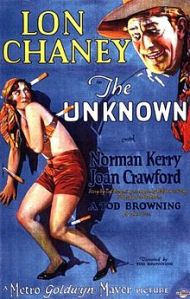
 lon unknown poster

This flick is by far my favorite Lon Chaney! 

Chaney’s alliance with Director Tod Browning was inspired! Browning was into the macabre and best known for his films Dracula (1931) and the cult classic Freaks (1932) and Lon Chaney had the acting and makeup skills to realize any twisted character the director could come up with.

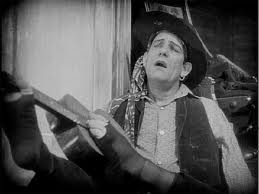
My favorite movie line is from their 1927 silent film The Unknown – “crack of your ass”. (okay, I can’t swear that’s what he said) But, seriously, as Alonzo the Armless, he threatened his co-star Joan Crawford with bodily harm if she did not bend to his will. Remember Grandma Klump from Eddie Murphy’s The Nutty Professor(1996)? “You might walk over, but you limpin’ back! “Chaney totally went there. Check it out:

Let’s talk about the level of twisted in this movie:

A word of advice, if you’ve got a thing about someone that’s all consuming and you’d do anything to get with that person, forget about it!

Plot: This crazy man, Alonzo the Armless (Lon Chaney) has a knife throwing act using only his feet and is in love with Nanon (Joan Crawford) who”can’t bear to be touched.” He has arms but pretends not to for his act and so Nanon will talk to him. When it’s discovered that he indeed has arms, he blackmails a low-rent surgeon to amputate them. Sick!

Nanon and Alonzo

lon and nanon

After his surgery, Alonzo returns to the circus and his knife throwing act. Hoping to rekindle his relationship, he strolls over to Nanon’s circus wagon to see his rival Malabar, the circus strongman, (Norman Kerry) with his hands all over his love. Holy crap, it’s on! Alonzo schemes to get his girl back by rigging the speed of Malabar’s horses in his act which will dislocate and sever his arms during the live circus performance.

Alonzo

lon feet

Alonzo’s sick plan is working until Nanon realizes what is happening and tries to stop the performance. And then boom! The”crack of your ass” line. As you saw in the clip, things didn’t really work out the way he saw it play out in his mind.

Malabar

lon malabar stretch

This documentary, Lon Chaney: A Thousand Faces is a great biography for more in-depth background information and presents a great opportunity to discover your own Lon Chaney gem.

Here it is, Lon Chaney: A Thousand Faces


Lon Chaney is also the father of Lon Chaney, Jr best known for his role in Universal’s The Wolfman (1941).

If it’s Saturday it must be The Blob!

Maybe I’m just a wee bit anal but the day of the week dictates the genre that I watch. Monday thru Friday are pretty wide open, however, Saturday and Sunday must stick to my criteria. Saturday afternoon is definitely B-horror/Sci-fi flicks and Sunday is reserved for Melodrama film classics.

If you’ve read my About Page you know that as a kid the Saturday Matinee had a big influence on my love of B-horror/Sci-fi movies and William Castle.

The Blob, The Incredible Shrinking Man and The Tingler. Now that’s good stuff!


The_Blob_poster

 The Blob (1958)

The Blob, directed by Irvin Yeaworth, was Steve McQueen’s first leading role before he got his own TV series – Wanted: Dead or Alive (1959). McQueen was called “The King of Cool” and starred in such popular films as The Magnificent Seven and The Thomas Crown Affair. He received an Academy Award nomination for his role as Jake Holman in The Sand Pebbles.

The Blob plot revolves around what happens when an old man pokes a stick at a piece of meteor and it cracks open releasing an oozy substance that starts to crawl up the stick. He tries to shake it off but ends up with “the blob” all over his hand. (This is why you don’t poke at things that drop from the sky. Yeesh!)

Steve (also his character name) and his girl Jane, after almost hitting the old man who has run onto the road, take him to the local doctor. Cutting to the chase: while Steve and Jane ( Aneta Corsaut, who eventually plays Andy Griffith’s TV girlfriend Helen) leave the doc’s office to look for clues to what’s on the old man’s hand, The Blob absorbs the old man, the doc and his nurse. Next thing you know it’s at the midnight horror movie. Cue the fleeing and screaming and holy crap how do we stop it. Phew, that was exhausting.

The theme song, written by Burt Bacharach and Mack David (who wrote some of the top hits of the sixties) is a catchy little gem. “It creeps and leaps and glides and slides across the floor…beware of the blob.” Here it is:


The Incredible Shrinking Man (1957) 

The Incredible Shrinking Man

Directed by Jack Arnold

I’ve watched this movie a hundred times and the ending always makes me cry. This thought provoking Science Fiction classic taps into an anxiety of meaning in life and what exactly is the meaning of life. Scott Carey (Grant Williams) is dusted by a radioactive mist while on a boating vacation with his wife Louise (Randy Stuart). A few weeks later he starts to notice his clothes are fitting more loose and he also appears to be losing height. After visiting a specialist, it is confirmed that he is indeed shrinking.

Reduced to living in a dollhouse and eventually fighting for his life against the cat and then a tarantula living in the basement of the family home, Scott finally shrinks to an infinitesimal size, entering the realm of the unknown.

For me this movie is so much more than just another Saturday afternoon B-Movie flick. The closing monologue makes the point by concluding that no matter how small, we still matter in the universe because, to God, “there is no zero.”

The film won the first Hugo Award for Best Dramatic Presentation in 1958 by the World Science Fiction Convention. In 2009 it was named to the National Film Registry by the Library of Congress for being “culturally, historically or aesthetically” significant and will be preserved for all time.


The Tingler

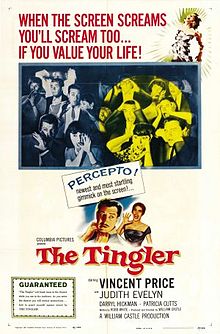
Producer/Director William Castle delivers his finest in The Tingler (1959), his third collaboration with writer Robb White. The film stars the incomparable Vincent Price as Pathologist, Dr. Warren Chapin who researches and discovers the existence of The Tingler.

Percepto is my favorite William Castle gimmick. There comes a time in the movie when the Tingler (a parasite that feeds on fear) is loose in the theater and to save your life you need to scream! For grins, in select seats in the theaters, Castle placed the Percepto system which made the seat vibrate to simulate the feeling of fear you feel in your body when The Tingler strikes.

Man do I wish I could have been there in 1959 when The Tingler attacks the projectionist, the film strip breaks and The Tingler appears on the screen. If that’s not enough, the lights go out and you hear the voice of Vincent Price declaring that The Tingler is loose in the theater so scream, scream for your life! Awesome!!

Just think of it, being in the movie theater watching The Tingler scene and ending up participating in the experience in your Percepto seat, with lights out and the sound of Price’s voice. I love it!!!


Break out the popcorn and let me know your faves in the comments.

And be sure to stay tuned for my next post:

Melodrama Sunday Movie Classics

To Remake or Not To Remake. That is the Question.

I’m on the record saying I hate remakes. If it was genius in the first place, why mess with it? If it stunk, why bring it back? Are you so ego driven Mr. Director that you feel your “version” outshines, oh say, Alfred Hitchcock‘s Psycho? Or Mr. Director, do you so lack creatively that you cop-out and warm over some – why was it made in the first place (Teenage Mutant Ninja Turtles) flick?

That being said, there are those exceptions. Websters’ definition of a remake is: to make again or anew as in a new form or manner. If a film can pay homage and capture the essence of the original but also bring freshness, I consider that film to be a great remake!


This classic has a great remake:


Invasion of the Body Snatchers (1956)


Directed by Don Siegel and Produced by Walter Wanger, the film starred Kevin McCarthy and Dana Wynter. This 1956 sci-fi thriller taps into a hideous nightmare, what if we went to sleep and awoke as a “pod person?” (Our physical self but void of emotion.) This movie in and of itself is an update of the 1950’s fear of space, atomic energy, and aliens. However, instead of giant mutated spiders, this tale is of an invasion from within.


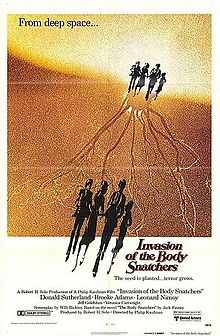
Invasion of the Body Snatchers (1978)

Invasion_of_the_body_snatchers_movie_poster_1978

“From deep space the seed is planted.”

Directed by Philip Kaufman and starring Donald Sutherland and Brooke Adams, this remake ups the ante. It honors the original sense of foreboding but the degree of terror is raised to a pandemic level.

There’s a scene in the original involving a dog that alerts the “pod people” that “Becky” (Dana Wynter) isn’t one of them. In this version they remake the dog scene but takes it to a much freakier place.   Outstanding!

I won’t give away the ending but, holy crap, that was frigging frightening!  Totally fresh update!


A box office success, Invasion of the Body Snatchers was well received by critics and is considered by some (myself included) to be among the greatest film remakes.

To Remake or not to Remake. That is the Question.

In this instance – YES!

Master of Suspense?

Master of Suspense

Sir Alfred Joseph Hitchcock  (August 13, 1899 – April 29,  1980)

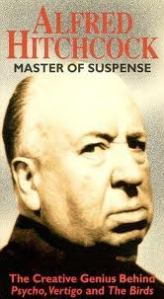
Sir Alfred Joseph Hitchcock aka “Master of Suspense” was a British born director known for his mastery of the suspense and psychological thriller.  He was an innovator using film editing (cuts) as the basis to construct a film. He poked, stabbed and forced us to face our fears, obsessions and compulsions.

Hitch is one of my favorite directors because of his fearlessness. He used a voyeuristic style and cuts to let you see inside the head of his leading characters. Rear Window (1954) is a classic example of his style as the audience becomes the voyeur along with James Stewart’s character. We go along with Hitch and peer through the windows of Stewart’s neighbors and cross a line we otherwise wouldn’t.

In Psycho (1960) we peer through the peephole with “Norman Bates” (Anthony Perkins) and end up rooting for this very troubled individual. Not allowing patrons to enter the theater after Psycho started was a great gimmick. His most fearless move was what occurred in the first 45 minutes of the film. Now that’s risk and genius!

In 1992, the US Library of Congress deemed the film “culturally, historically, or aesthetically significant” and selected it for preservation in the National Film Registry.

Now, meet Hitchcock as he takes us through the Bates Motel and the events that occurred. This is Sir Alfred in all his shocking glory.

Although Hitchcock is legendary for his film editing genius, Rope (1948 ) proved to be his ultimate experiment. Instead of using film editing, he would shoot the movie in one long sequence. Stopping only to change the camera role. Like filming a play. Each role of camera film holds about 10-12 minutes of film.

The set was insane with flying walls and furniture. Jimmy Stewart once remarked about placing his drink on a table, turning back around and not only was the drink gone but the table it was sitting on. Everyone had to be on their mark and not drop a line because if anything went wrong they had to do everything  all over again. Hitchcock said the film just about killed him!

A Little Hitchcock History:

His first directing assignment, Number 13, began in 1922 but unfortunately wasn’t finished due to financial issues. His big break came in 1927 with the completion of his thriller The Lodger: A Story of the London Fog.  The plot revolved around a search for a Jack the Ripper type of serial killer and mistaken identity. Hitchcock’s first thriller is ripe with mood and the German Expressionist influence. A taste of things to come in Hitch’s repertoire, it was a commercial and critical success.

Hitchcock-The_Lodger_1927_Poster

Hitchcock’s tenth film, Blackmail was released in 1929 and considered Britain’s first talkie. It also starts his usage of landmarks as a tradition and appears in the longest cameo of all his films.

Hitchcock-Blackmail_1929_Poster

The 39 Steps (1935) is widely considered the best of Hitchcock’s early films and made him a star in the U.S.  It also branded Hitch’s obsession with the cold blonde, sophisticated leading lady which Grace Kelly would come to epitomize. Then there’s the infamous “MacGuffin.”  A reoccurring plot device that actually had no real significance to the story-line. A decoy. Just another Hitch thing.

The 39 Steps

Alfred Hitchcock’s films were produced in Britain until in 1939. When David O. Selznick signed him to a seven year contract, Hitch relocated to the United States with his wife Alma Reville (his closest collaborator) and his daughter Patricia Hitchcock.

Alma Reville was an accomplished director, writer, editor and producer in Britain before she met Hitch while working  at Paramount‘sFamous Players-Lasky studio in London, during the early 1920s. Patricia Hitchcock appeared in several of her dad’s films including: Psycho, Strangers on a Train and Stage Fright.

Rebecca (1940) was Hitchcock’s first American film. It won the Academy Award for Best Picture and Hitchcock was nominated for Best Director but did not win. In fact, although nominated five times, he would never be afforded that honor.

Alfred Hitchcock  became an American citizen in 1956 and was a multiple nominee and winner of a number of prestigious awards. Hithcock was the recipient of  two Golden Globes, eight Laurel Awards, and five lifetime achievement awards including the first BAFTA Academy Fellowship Award.

Hitchcock received a knighthood in 1980 when he was appointed a Knight Commander of the Most Excellent Order of the British Empire (KBE) by Queen Elizabeth II.

What’s your quintessential Hitchcock film?

  • Stage Fright (1950)
  • Saboteur (1942)
  • Strangers on a Train (1951)
  • The Birds (1963)
  • Spellbound (1945)
  • Shadow of a Doubt (1943)
  • Rebecca (1940)
  • Foreign Correspondent (1940)
  • The 39 Steps (1935)
  • Rope (1948)
  • Vertigo (1958)

Not here? Voice Your choice in the comments.

Check out Alfred Hitchcock’s substantial catalog.

The quintessential “Master of Suspense.”

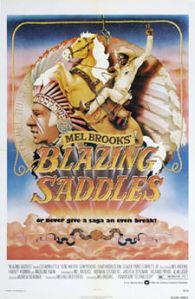
Too”Blazing”Hot?

Blazing Saddles_movie_poster

I’ll never forget the day my boyfriend (now husband) came to me super excited about, in his words, “the funniest movie he’s seen” and there’s another showing in half an hour!.  Okay I say, skeptical, but I’m game.  He couldn’t stop talking about his favorite “moment” – the “campfire and beans scene.”  As the end credits rolled I agreed, this was the funniest movie I’d ever seen and my favorite “moment” was — holy crap — I can’t name just one.  Lili von Shtupp “I’m Tired”, “The sheriff is near” or “Mongo only pawn in game of life.”   Awwh, it’s too hard to pick just one!  Blazing Saddles is probably one of the most quotable movies of all time.

The movie was nominated for three Academy Awards, and is ranked No. 6 on the American Film Institute‘s 100 Years…100 Laughs list.

“Mongo only pawn in game of life”

Mongo


But, I wonder, how would Blazing Saddles be received by audiences today?

This film was released in 1974 but reflecting today on the welcoming scene for Sheriff Bart, it could just as well have been President Obama’s Inaugural Reception.  In the western town of Rockridge the women clutched their purses and the men drew their guns.  A Black Sheriff, no way!  For some, The President’s election and re-election evoked some of those same feelings.  A Black man in the White House, no way!   Yes, it’s 2014 but yes for some, the stereotypes still exist.  There are those who wish the country could go back to the “good ole days” when if you were white it’s alright, but, if you’re black get back.  It’s irrational and built on fear, but racism has always been apart of the fabric of this country.

Mel nig


Directed by: Mel Brooks

Written by: Mel Brooks, Richard Pryor, Andrew Bergman, Norman Steinberg and Al Unger

Songs: Mel Brooks

Starring Cleavon Little
Gene Wilder
Harvey Korman
Slim Pickens
Madeline Kahn
Mel Brooks

It’s a brilliant film!  The writing, the acting, the concept.  And what a concept.  A Black sheriff in an all white 1874 small western town.  What could possibly go wrong?

The film is an in your face satire about racism in the old west as opposed to the Hollywood cowboy myth.  Liberal uses of the N word and plenty of references to black men being sexually”gifted.”  Lili: “Is it true what they say about you people?”  Also, you know black men all want white women.

Lili von Shtupp goes there:


“Where the white women at?”


I’m not really sure how Blazing Saddles would touch people today, but in 1974 I got the feeling that black and white laughed at the jokes and understood their own truth within the satire.   Have the voices of hate overshadowed our ability to laugh and rebuke racism or are the hate filled voices of today outliers?  Is the majority of the country trying to go backwards or are we embracing progress and the commitment it takes?

Harvey Mel

 Blazing Saddle Quotes:

  • Jim: [consoling Bart] What did you expect? “Welcome, sonny”? “Make yourself at home”? “Marry my daughter”? You’ve got to remember that these are just simple farmers. These are people of the land. The common clay of the new West. You know… morons.
  •  Bart: I better go check out this Mongo character.

[Bart reaches for his gun]

Jim: Oh no, don’t do that, don’t do that. If you shoot him, you’ll just make him mad.

  • Mexican Bandit: Badges? We don’t need no stinking badges.
  •  Lili Von Shtupp: Hello, handsome, is that a ten-gallon hat or are you just enjoying the show?

If you have seen the movie give it a revisit and let me know what you think.  Or if you haven’t, check it out and let me know your thoughts in the comments.