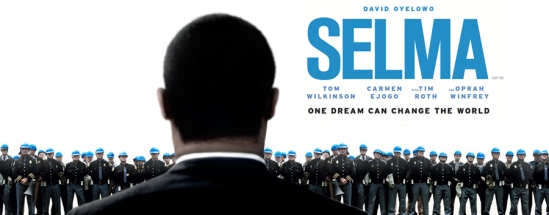
At first, I was skeptical on how this history would be portrayed. I didn’t want a melodrama about Bloody Sunday and those on the front lines of the Civil Rights Movement. But, Director, Ava DuVernay did an incredible job and for me, the film should be included as part of the historical record.
Selma was a turning point in the Civil Rights Movement. In your living room. In your face. The first march took place on March 7, 1965, organized locally by SCLC Director of Direct Action James Bevel, who was directing SCLC’s Selma Voting Rights Movement. State troopers and county posse men attacked the unarmed marchers with billy clubs and tear gas after they passed over the county line, and the event became known as Bloody Sunday. Law enforcement beat activist Amelia Boynton unconscious, and the media publicized worldwide a picture of her lying wounded on the bridge.
Selmahad four Golden Globe Award nominations, including Best Motion Picture – Drama, Best Director, and Best Actor, and won for Best Original Song. It was also nominated for Best Picture and won Best Original Song at the 87th Academy Awards.
Whether you know the history or just learning, I consider the film Selma essential viewing for a pivotal moment in the Civil Rights Movement. A Movement which we must always remember and never forget as …
The loss of David Bowie truly touched my heart. I’ve followed and loved his music since 1972 with the release of the album – “The Rise and Fall of Ziggy Stardust and the Spiders from Mars”.
“Starman” from the 1972 album The Rise and Fall of Ziggy Stardust and the Spiders from Mars.
“If you’re sad today, just remember the world is over 4 billion years old and you somehow managed to exist at the same time as David Bowie”. – Dean Podesta
I’m appreciative of this tweet because I found it calming and it put Bowie’s passing in perspective. A true innovator. He will be missed.
A sweet little, probably lesser known Jim Henson (Muppets creator) gem – “Emmet Otter’s Jug-Band Christmas.”
One of my favorite Christmas joys is watching and sharing my favorite animated Christmas specials. This month will be dedicated to these wonderful specials and films.
The story is based on the children’s story of the same name which was written by Russell and Lillian Hoban. Jim Henson’s production of Emmet Otter’s Jug-Band Christmas premiered on HBO on December 17, 1978, as an hour long TV presentation. It’s the charming tale of Emmet Otter and his loving mom’s dream of presenting each other with the perfect Christmas gift. But unfortunately, Emmet and his Mom, a widow, scrape by on the small amount of money she gets from doing laundry and that Emmet gets from doing odd jobs around their home in the town of Frogtown Hollow.
As Christmas approaches, they hear of a talent contest in the nearby town of Waterville and separately decide to enter to afford that perfect present: the guitar Emmet dreams of, and a beautiful piano for Ma. However, in a twist on The Gift of the Magi by O. Henry, they must sacrifice each other’s livelihood for the talent contest. Mom hocks Emmet’s tools for dress fabric while Emmet turns Ma’s washtub into a washtub bass for a jug band.
Ma Otter
Emmet Otter
The special received a very positive review in The New York Times on December 15, 1980: “Jim Henson and the Muppets are on a dazzling winning streak these days… Mr. Henson has produced and directed one of the most charming Christmas specials of the last several years.
Emmet rehearses diligently for the contest with his bandmates and mom secretly practices her solo, However, a local band, Rivertown Nightmare Band enters the contest as well. I won’t spoil it, but the Nightmare Band is awesome!
The songs by singer/songwriter Paul Williams are wonderful and Jerry Juhl’s story is simple and sweet. I loved Jim Henson and miss him and his talent for capturing the imagination of not only children but of us all!
One of my favorite Christmas joys is watching and sharing my favorite animated Christmas specials. This month will be dedicated to these wonderful specials and films.
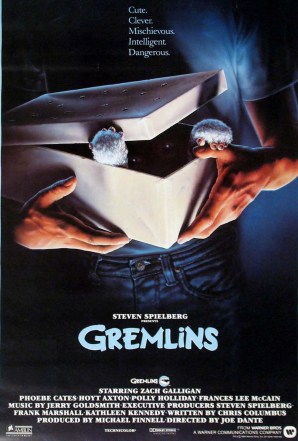
I have to start off by saying I know, “Gremlins” isn’t technically an animated film, but it is animated with Gizmo and some scary Mogwai.😊
I couldn’t resist featuring “Gremlins” because Gizmo is too darn sweet and Stripe and his cohorts are out of their minds. The story revolves around Billy, (Zach Galligan) a young man who spends his days working in a bank owned by the tyrannical, elderly Mrs. Deagle, (Polly Holliday) but he’s really an artist. A couple of days before Christmas, his father (Hoyt Axton) brings him a very special Christmas gift he purchased in Chinatown – a Mogwai – Gizmo. (voiced by Howie Mandel) His father explains there are 3 rules by which he must abide:
Don’t get Gizmo wet.
Don’t feed him after midnight
Keep him out of bright light
Unfortunately, Rulenumber 1(Don’t get Gizmo wet) is broken soon after when Pete (Cory Feldman) a neighbor friend accidently spills a cup of water on Gizmo while Billy is at his drawing desk. Immediately Gizmo begins to shake and convulse as furry looking balls eject off his back. We then find out why Rule number 1 is so important because the furry looking balls turn into other Mogwai lead by the villainous Stripe.
Stripe
Rule number 2 (don’t feed after midnight) is just as powerful as number 1 because as a result of Stripe tricking Billy into the feeding the Mogwai after midnight, (except Gizmo) they turn into a bunch of “crazy Mogwai.” Yikes!
The “crazy Mogwai” begin their reign of terror at the local bar where Billy’s girlfriend Kate (Phoebe Cates) works as a barmaid. She barely makes it out of the bar by flashing them with a camera as the “crazies” proceed to get drunk, destroy the bar, and start shooting at each other, The bar scene even includes a flasher Mogwai. Too much!😄
My favorite scene is when the “crazy Mogwai” take over a local theater to watch “Snow White and the Seven Dwarfs.” And just like regular people, they’re enjoying popcorn and snacks while singing “Hi Ho” along with the Seven Dwarfs. What a crack-up!
Crazy Mogwai Theater
Fun at the theater
Rule number 3 (No bright light) is really crucial because the light kills Mogwai. Momentarily exposed, Gizmo cries out in the sweetest little voice, – “bright light, bright light.” Too cute.
Finally, Billy and Gizmo are charged with finding and eliminating the “crazy Mogwai” especially Stripe because he’s now creating more “crazies” by purposely getting himself wet.
Billy, Kate, Gizmo
The fight with Billy and Gizmo forces Stripe – “crazy Mogwai” in charge, to pull out all the stops to keep up his goal of taking over the town. But Gizmo is no easy win and proceeds to give Stripe his money’s worth!
Gizmo’s car
The puppetry is great and the blend of human and puppets is totally fun! Steven Spielberg (Executive Producer) explained: “It’s one of the most original things I’ve come across in many years, which is why I bought it.” Because of the effects and original storyline, (by Chris Columbus), I include “Gremlins” as holiday worthy and recommend checking it out or revisiting if it’s been a while.
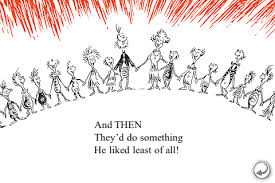
“Every Who down in Whoville liked Christmas a lot, But the Grinch, who lived just north of Whoville, did not. The Grinch hated Christmas — the whole Christmas season. Oh, please don’t ask why, no one quite knows the reason. It could be, perhaps, that his shoes were too tight. It could be his head wasn’t screwed on just right. But I think that the most likely reason of all May have been that his heart was two sizes too small.”
One of my favorite Christmas joys is watching and sharing my favorite animated Christmas specials. This month will be dedicated to these wonderful specials and films.
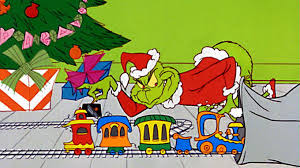
On December 18, 1966 “How the Grinch Stole Christmas” premiered as a television special and has continued to entertain and touch my life and the lives of countless children both young and old. It relates the tale of the Christmas plot of the mean ole Mr. Grinch to steal the joy of celebration from the residents of Whoville; it’s Seuss’ spiritual lesson for the true meaning of Christmas.
Print ad of Dr. Seuss’ How the Grinch Stole Christmas! 1966
Narrated by the legendary Boris Karloff – also the voice of The Grinch – we are introduced to the world of Whoville and that nasty wasty Grinch.
Boris Karloff and The Grinch
You’re a foul one, Mr. Grinch. You’re a nasty, wasty skunk. Your heart is full of unwashed socks, your soul is full of gunk. Mr. Grinch! [spoken] The three words that best describe you are as follows and I quote: [sung] “Stink! Stank! Stunk!”
In this version of the story, we don’t really know why The Grinch hates Christmas and the residents of Whoville. Just that his heart is 2 sizes too small. However in the Jim Carrey movie version of Dr. Seuss “How the Grinch Stole Christmas,”we see the flashback of The Grinch as a child and how because he looks different: green and hairy as an eight-year-old he is taunted and teased by his classmates.
“Little Grinch” makes a Christmas present for his crush and tries to shave his face for the presentation but ends up with toilet paper stuck all over. Everyone laughs at him, so he storms out the room climbing up to his mountain exile. Not seen for years, he becomes an urban legend. Flashing forward to The Grinch and his now adult classmates, it isn’t hard to understand why Whoville isn’t his favorite town and additionally, the Whos love of Christmas has become a major thorn in his side.
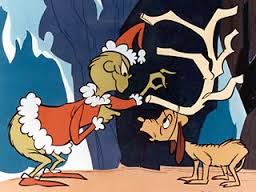
So, The Grinch gets this inspired idea after seeing his dog Max get snow on his face that sort of looks like a beard. The plan becomes to dress up as Santa, sneak into Whoville and rip off all the houses of presents, toys and even a piece of cheese from a mouse. So low down. Hence “stink, stank, stunk!”
Poor Max wasn’t really down with the plan but was forced to play his part as a reindeer.
Enter my favorite resident of Whoville, Cindy Lou Who. I’ve loved her all my life. Her innocence and open heart are a testament to – as John Lennon once wrote: “All you need is love.”
“Santy Claus”
“Why?”
Ah, but not even the innocence of Cindy Lou could discourage The Grinch from following thru with his wicked plan.
However, The Grinch would come to realize that Whoville is no ordinary town. Even without presents, toys or roast beast, Christmas would still come.
Joyful Grinch
This timeless message of appreciating what you have in friends and family is a gift often lost in this world of envy and greed. Matthew 16:26 “For what will it profit a man if he gains the whole world and forfeits his soul?” Let’s remember the true meaning of Christmas not only during the holidays but every day of the year.
The trailer for the upcoming peanuts gang film “The Peanuts Movie” started me thinking that not everyone may be into scary Halloween movies, so I decided to share a favorite TV special from childhood, “It’s the Great Pumpkin, Charlie Brown”.
“The Peanuts Movie” opens November 6th and is from the genius imagination of Peanuts/Charlie Brown creator, Charles M. Schultz. In this trailer, we hear from the creators of “The Peanuts Movie” about Schultz’s drawing style and concepts. This film will be the Peanut gang’s big screen debut.
Now, without further adieu, let’s find out what the gang’s up to in -“It’s the Great Pumpkin, Charlie Brown.”
The plot revolves around Charlie’s best friend Linus’ belief in the Great Pumpkin who supposedly comes to the pumpkin patch to reward faithful boys and girls. Despite everyone telling Linus what a fool he is for his conviction, he still keeps the faith. Unfortunately, the night is a complete bust for Charlie who with his bad luck always gets a rock (Maybe it’s because of his jacked up ghost costume with eight million holes in it.) and Linus who never meets the elusive Great Pumpkin.
As a child, I remember one of the most important decisions of Halloween being the selection of just the right costume so you can proudly walk up to your neighbors doors screaming, “trick or treat!” Opening up your bag and gleefully anticipating scoring one of your favorite Halloween treats. For me, it was always Snickers, hands down.
There’s nothing worse than the wrong costume coupled with lousy treats. And in Charlie Brown’s case, a stupid rock. Great, thanks a lot!
Another crucial choice of the Halloween tradition is picking and carving just the right pumpkin. This is how Miss Lucy Van Pelt handles a pumpkin and her little brother, Linus. Plus, the gang gets a little fright in the pumpkin patch. But, how much fun would the evening be without a little ghosts and goblins scare.
We were first introduced to Charlie and the gang in the television premiere of “A Charlie Brown Christmas” which still remains a perennial favorite. In my house, to this day, “Charlie Brown” and “How the Grinch Stole Christmas” are required viewing as part of the official Christmas season. The television special was based on the comic stripPeanuts, by Charles M. Schulz. Produced by Lee Mendelson and directed by Bill Melendez, the program made its debut on CBS on December 9, 1965.
With the success of “A Charlie Brown Christmas”, other specials were developed featuring the lovable Peanuts Gang. “It’s the Great Pumpkin, Charlie Brown” was the third Peanuts special and its’ initial broadcast took place on October 27, 1966.
For me, “It’s The Great Pumpkin, Charlie Brown” brings back fond memories of those magical childhood days and offers up a laugh or two along the way.
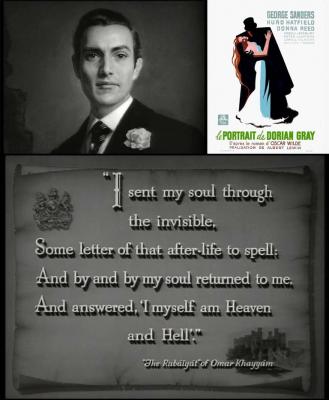
“I am jealous of everything whose beauty does not die. I am jealous of the portrait you have painted of me. Why should it keep what I must lose? Every moment that passes takes something from me and gives something to it. Oh, if it were only the other way! If the picture could change, and I could be always what I am now! Why did you paint it? It will mock me some day — mock me horribly!” The hot tears welled into his eyes; he tore his hand away and, flinging himself on the divan, he buried his face in the cushions, as though he was praying.”
“Dorian Gray” – Oscar Wilde’s -“The Picture of Dorian Gray”
Dorian Gray
If you could, would you? Sell your soul for eternal youth.
That was the choice made by Dorian Gray. His story is a classic cautionary tale. Be careful what you wish for.
Dorian Gray (Hurd Hatfield) is a striking and wealthy young man living in 19th century London. While posing for his portrait with his artist friend Basil Hallward (Lowell Gilmore), he meets the cynical and audacious Lord Henry Wotton (George Sanders) who tells him that youth and beauty are fleeting and while he’s young he should entertain every worldly pleasure. Dorian is naive and in the presence of an enchanted Egyptian cat wishes he would stay forever young and only his portrait would age.
While visiting a local pub, The Two Turtles, he meets the beautiful and demure Sybil Vane. She sweetly sings “Goodbye Little Yellow Bird” and Dorian is totally enamored. Falling in love, he asks Miss Vale for her hand in marriage and invites both Basil and Lord Wotton to the pub to meet his love.
Sybil Vane
When Dorian informs Lord Wotton of his intention to marry Sybil, Wotton suggests he tests her virtue by inviting her to spend the evening with him. If she rebukes him then she’s chaste if she accepts she’s a tramp and as the saying goes “why pay for the cow when you can have the milk for free.” Dorian buys into this plan thus beginning his downward spiral into narcissism and pleasures of the flesh.
Sybil accepts Dorian’s request to stay with him and the following day Dorian sends her a breakup letter expressing his disappointment in her. Heartbroken, Sybil is devastated and Dorian becomes aware of the first signs of cruelty to appear upon his portrait’s face.
Years pass with his peers aging, but Dorian’s youth remains. Gossip swirls and his friends begin to shun him; questioning why his appearance is the same. Dorian goes full tilt debauchery until he finally reaches rock bottom.
There are people today who could benefit from heeding the lesson in the “Picture of Dorian Gray.” The evil you do comes back to bite. Karma is a bitch.
In a previous post I talked about maybe being a little anal about the rules for Saturday and Sunday afternoon movie watching. I shared my rules for Saturday afternoon movie viewing which is B-horror and science fiction. I also shared 3 of my favorite flicks. The Blob (1958), The Incredible Shrinking Man (1957) and The Tingler (1959). (hope you check ’em out)
So, for Part 2 I’m showcasing Sunday and my criteria for some great classic melodrama.
I love melodramas because they can be so over the top and cathartic (think movie therapy) and there’s no better day to indulge than on a lazy Sunday, vegging on the couch, better yet if it’s a rainy day.
According to dictionary.com:
Melodrama – Exaggerated and emotional or sentimental, sensational or sensationalized: over dramatic.
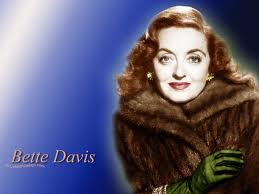
Bette Davis is my favorite Melodrama Diva! Talk about emotional and dramatic, she had those attitudes down pat. With her I find myself either talking back to my TV screen or weeping. (this is why rain helps) So, let’s find out about “The First Lady of the American Screen:
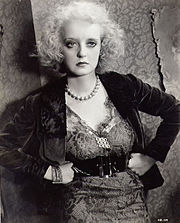
Bette was known for her no-nonsense, no-holds barred personality and wasn’t afraid to take on unsympathetic character roles. In the RKO film Of Human Bondage (1934), she played such a character as Mildred, the cruel and vicious waitress. A film adaptation of the 1915 novel of the same name by W. Somerset Maugham. This melodramatic adaptation about a crippled doctor’s destructive and compulsive passion for this coarse waitress was advertised with the tagline on one of its posters: “The Love That Lifted a Man to Paradise…and Hurled Him Back to Earth Again.”
In her 1st major, critically acclaimed part she insisted on looking hideous to depict the ravages of the disease tuberculosis on the human body. She wasn’t nominated for an Oscar but so impressed fellow artists that they insisted she be a write-in on the ballot.
Let’s take a look at her 10 Oscar nominations and 2 wins:
1935: Won for Dangerous, as a self-destructive, alcoholic actress (really a make-up for not winning Of Human Bondage)
1938: Won for Jezebel, as a self absorbed 1850’s southern belle whose insistence on wearing a red-dress to a formal affair (white = chaste) brings scandal and disapproval. Her man “Pres” Henry Fonda was too through with her.
1939: Nominated for Dark Victory, as Judith Traherne, an impetuous, terminally ill Long Island socialite. (yes that’s Bette with a drunken Ronald Reagan) Big time tear-jerker! – Bette’s favorite!
1940: Nominated for The Letter, as a low-down, adulterous murderer who has absolutely no remorse for blowing her lover away. However, karma is a bitch.
1941: Nominated for The Little Foxes, as Southern aristocrat Regina Giddens – that girl put the cold in cold-blooded.
1942: Nominated for Now, Voyager, as Charlotte Vale – a dowdy, overweight, spinster, abused by her mother but fights back and achieves a starling transformation in body and spirit. An incredible performance! My absolute favorite Bette Davis role!
Charlotte on the edge of a well deserved nervous breakdown:
Charlotte’s journey:
1944: Nominated for Mr. Skeffington, as Fanny Skeffington, a woman so conceited that she tries to steal her daughter’s boyfriend, loses her looks after an illness but still has the nerve to treat her husband like dirt and still believe she can have any man – no way. In the end she learns the hard way that “a woman is beautiful when she’s loved and only then.” (too bad it’s after her husband goes blind in a concentration camp)
1950: Nominated for All About Eve, as Margo Channing an insecure Broadway star challenged by the younger, conniving Eve – “Fasten your seat-belts, it’s going to be a bumpy night.” It was selected in 1990 for preservation in the United States National Film Registry and was among the first 50 films to be registered.
1952: Nominated for The Star, as Maggie, a washed-up actress trying to revive her career. Notably, at this time in Bette Davis’ career, she was struggling for roles despite her body of work. Bette’s ego was blamed.
1962: Nominated for What Ever Happened to Baby Jane?, as the demented Baby Jane Hudson who tortures and terrorizes her sister Blanche (Joan Crawford) Much like their real life rivalry. This role renewed her success and paved the way for other deranged characters in such films as: Hush, Hush Sweet Charlotte (1964) and The Nanny (1965)
♦♦♦♦
Bette continued to perform in film and on television in the 70’s and 80’s. In 1983 at the age of 75 she had a mastectomy as a result of breast cancer. Nine days later she suffered a stroke. Despite her failing health she continued to work until her death in 1989.
This is an in-depth retrospect of “The First Lady of the American Screen”
The Early Visionaries of American Film: A Series – Part 1
A long time ago in a galaxy far, far away…Women were the driving force behind Hollywood and the movies. This is the first part in a series paying homage to the women who broke the glass ceiling and wrote and directed the films that gave birth to the “Golden Age” of cinema and the motion picture industry. Unfortunately, when the men realized the gold mine films were becoming, the women faded away thanks to the Hollywood studio system. Well, as the saying goes, “that’s the way they do you.”
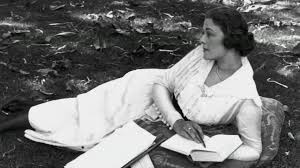
Frances Marion 1918
Frances Marion was a trailblazer. becoming one of the most powerful screenwriters of the 20th century. With a career that spanned decades, she became the first female to win an Academy Award for Best Adapted Screenplay in 1930 for the prison life film The Big House, starring Robert Montgomery, Wallace Beery and Chester Morris. Her research included visiting San Quentin for the atmosphere and lingo of the inmates. The movie gave audiences their first experience of hearing prison doors slam shut, tin cups clanking on mess-hall tables and prisoners’ feet shuffling down corridors.
Frances also received the Academy Award for Best Story for The Champ in 1932. The tearjerker chronicled the relationship between a washed out boxer (Wallace Beery) and his young son (Jackie Cooper). Marion was credited with writing 300 scripts and producing over 130 films.
Born Marion Benson Owens (November 18, 1888) in San Francisco, California, she worked as a journalist and served overseas as a combat correspondent during World War I. On her return home in 1910, she moved to Los Angeles and was hired as a writing assistant, an actress by “Lois Weber Productions”, a film company owned and operated by pioneer female film director Lois Weber. (more on Lois Weber in Part 2 of the series)
Lois Weber – Film Director
Frances was quite beautiful and could have been an actress but preferred to work behind the camera. She learned screenwriting from Lois Weber and went on to become the highest paid screenwriter, woman or man. Hollywood moguls competed for her stories and stars of the day Mary Pickford, Lilian Gish, Greta Garbo and Rudolph Valentino brought her characters to life on the screen. From 1919 – 1939 her star was ascendant, born at the right place and the right time, honing her craft during one of the most liberating eras for women in film.
Mary Pickford
Lillian Gish
Greta Garbo
Rudolph Valentino
When Marion met Mary Pickford (actress, producer, screenwriter) they became best friends with Marion writing screen adaptations of Rebecca of Sunnybrook Farm and The Poor Little Rich Girl for Pickford. As a result of the commercial success of “The Poor Little Rich Girl” in 1917 Marion was signed as Pickford’s “exclusive writer” at the salary of $50,000 a year, an unprecedented arrangement for that time.
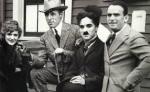
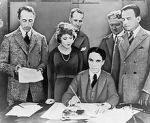
Pickford was the celebrated “America’s Sweetheart” and in 1919 together with her swashbuckler actor husband Douglas Fairbanks, Sr., director D.W. Griffith (Birth of a Nation) and “The Tramp” Charlie Chaplin established “United Artists” pictures. These four were the leading figures in early Hollywood and this was their stand for independence against the powerful studio system. Mary was also one of the original 36 founders of the Academy of Motion Picture Arts and Sciences.
Mary Pickford, D.W. Griffith, Charlie Chaplin, Douglas Fairbanks
United Artists Logo 1919
Contract Signing 1919
In 1921, Frances Marion directed a film for the first time with Just Around the Corner. That same year, she directed her friend Mary Pickford in one of her own scripts entitled The Love Light. Their relationship was more than just writer and star, they were collaborators and the friendship between Pickford and Marion lasted more than 50 years.
Married four times, Frances Marion had two children with third husband, actor Fred Thomson. This was her longest marriage, lasting from 1919 until Thomson’s sudden and tragic death from a Tetanus infection in 1928. Frances’ great friend Mary Pickford had introduced them. Frances said it was love at first sight.
Fred Thomson and Frances Marion
For many years she was under contract to MGM Studios, but, independently wealthy, she left Hollywood in 1946 to devote more time to writing stage plays and novels. Frances Marion published a memoir Off With Their Heads: A Serio-Comic Tale of Hollywood in 1972.
Frances died on May 12, 1973 leaving a legacy of innovation, independence and inspiration for future aspiring female writers. The documentary, Frances Marion: Without Lying Down,” is an insightful profile of her life and achievements in Hollywood.
Mary Pickford and Frances Marion
Narrated by “Pulp Fiction” actress Uma Thurman and Oscar-winner Kathy Bates, who gives voice to the screenwriter’s own words taken from her letters, diaries. and memoirs. The documentary also features footage from more than twenty of Marion’s movies, with commentary by silent film historian Kevin Brownlow, and film critic Leonard Maltin.
I was fortunate enough to catch it on Turner Classic Movies recently and great news, it will be replayed on June 10th at 6:00 am (est). It’s also available for purchase at Amazon.com. I highly recommend checking it out!
“I’ve spent my life searching for a man to look up to without lying down.” Frances Marion
It’ll take more than 60 years before women are once again present in meaningful numbers at every level of film production.
Billy Wilder is one of my favorite directors because he’s not afraid to tackle controversial subject matters like alcoholism, adultery, and sexuality. His 1959 film Some Like it Hot is a fantastic example! I love this film not only because it’s hilarious and Marilyn Monroe is at the height of her sexiness, but it addresses the issues of gender roles, cross-dressing and gay marriage head on!
United Artists released Wilder’s Prohibition-era farce Some Like It Hot without a Production Code seal of approval, withheld due to the film’s unabashed sexuality including a central cross-dressing theme.
Okay, so here’s the set-up:
2 speakeasy musicians (Joe and Jerry) in 1920’s Chicago witness the infamous St. Valentine’s Day Massacre. Obviously – that’s a problem. Busted by the hitmen they try to talk their way out of the situation. However, the gangsters ain’t havin’ it so they do the next best thing – Run!
Okay, so now what? Go drag, book a gig with the all-girl band Sweet Sue and her Society Syncopaters. Hey, it could happen.
Introducing Josephine and Daphne
Now, let’s meet Joe and Jerry
Jerry: You’d bet my money on a dog? Joe: He’s a shoo-in. Max the waiter knows the electrician that wires the rabbit.
Joe ( Tony Curtis) is a saxophone playing womanizer who’s borrowed money from every girl on the chorus line at the speakeasy. Jerry (Jack Lemmon) plays the upright bass and is Joe’s best friend. Although tired of Joe’s crap, he covets his prowess with women while simultaneously desiring a stable relationship of his own.
Their bond is put to the test when Joe (as Josephine) zeros in on Sugar Kane (Marilyn Monroe) and her strut when they arrive at the train station. Sugar plays ukulele and sings with Sweet Sue (Joan Shawlee) and the Syncopaters. By the time they arrive at their destination in Florida, Joe has sweet talked his way into Sugar’s life and is bound and determined to have a taste. Daphne (Jerry) on the other hand has a different experience; dealing with his jealousy of Joe and Sugar’s relationship while maneuvering the advances and courtship of much-married and aging millionaire, Osgood Fielding III (Joe E. Brown).
First of all, Joe E. Brown is a scream! Second of all, check out his career along with this performance.
And here we go – into the land of whoa, stuff we don’t talk about in 1959 and are really just scratching the surface of today:
Cross Dressing: Designer Orry-Kelly won an Oscar for Best Costume Design for his work. Seeing Marilyn’s gowns, Curtis and Lemmon insisted on wearing Kelly’s designs as well to make them look good as females. They played it straight as Josephine and Daphne which I believe gave weight and merit to the film. They may have looked good, but Marilyn was hot! As a young girl, I went, yes – one day I wanna rock a dress like that!
Gender Roles: Challenging what is deemed to be male/female expectations. By embracing their personas, Joe and Jerry learn from Sugar and Osgood what it means to walk in another woman’s shoes and deal with the complexities of being a woman in a man’s world.
Gay Marriage: The right to love for love’s sake. This is undoubtedly my favorite scene!
Joe to Jerry/Daphne – “It’s just not being done.”
“I’m a Boy”
This final scene is pure – Subversive Brilliance!
Despite Joe’s argument to Jerry and Jerry’s argument to Osgood about how outrageous their marriage would be – in the end, love will not be denied.
Billy Wilder, the Austrian-born American filmmaker is regarded as one of the most brilliant and versatile filmmakers of Hollywood’s golden age. Wilder is one of only five people to have won Academy Awards as a producer, director and screenwriter for the same film (The Apartment). The American Film Institute has ranked these four Wilder films among their top 100 American films of the 20th century:
In 2001, AFIselectedSomeLikeIt Hot as the number one comedy film of all time.
Billy Wilder
Thank you, Billy Wilder for directing, producing and writing this screenplay. Art should be provocative, revolutionary; pushing the conversation forward. Humor and politics are not mutually exclusive. Question what is accepted. Fight for what is right.
This site is about how to live our life in a meaningful way by accepting complete surrender to the Almighty with purity of mind and character. It is about the eternal religion of the world i.e. Hinduism which is very liberal to anyone because there are many branches or methods to get the divinity to turn our life into an ever blissful one.
Free listening and free download (mp3) chill and down tempo music (album compilation ep single) for free (usually name your price). Full merged styles: trip-hop electro chill-hop instrumental hip-hop ambient lo-fi boombap beatmaking turntablism indie psy dub step d'n'b reggae wave sainte-pop rock alternative cinematic organic classical world jazz soul groove funk balkan .... Discover lots of underground and emerging artists from around the world.
























 iheartfilm