Everyone pretty much knows that I’m a movie junkie and often look at my life like a movie. I believe we see ourselves in the films we connect with the most.
That worldview started me thinking, what movie best represents you or your life philosophy?
For me, it’s “The Matrix”. Why? The reason is most of the time I feel like we live in some sort of twilight zone. That “The Matrix” deludes us into believing what is projected on us and some of us choose to be in blissful ignorance rather than deal with the truth.
Which pill would you take; the Red or The Blue?
If presented with the knowledge you seek to change your life, would you?
For me, movies aren’t just movies. They represent a belief, vision, or point of view. Does art imitate life or vice versa? Cinema itself is a projection of a journey the filmmaker wants us to take.
Written and directed by The Wachowskis, and starring Keanu Reeves,“The Matrix” (1999) depicts a dystopian future in which reality, as perceived by most humans is actually a simulated reality called “The Matrix”. It was created by machines endowed with feelings and unstructured consciousness to subdue the human population, while their bodies’ heat and electrical activity are used as an energy source.
Computer programmer “Neo” learns this truth and is drawn into a rebellion against the machines, which involves other people who have been freed from the “dream world”. (Wikipedia)
With this premise, the filmmakers have set up and manipulated us to absorb and confront the possibilities of this hellish world. This alternate space is really a metaphor for the choices we are faced with daily. Knowing the truth, what do we do? Use that information to change what is or choose to be a sleepwalker through life?
This is the reason why I love film. The good ones provoke introspective thought and conversation. Something we are in desperate need of today.
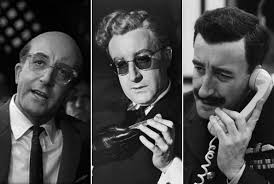
Peter Sellers is at his over the top best with his performance as nutcase Dr. Strangelove.(and a few other characters) A wheelchair-bound nuclear scientist with bizarre ideas about man’s future. The entire war room scene totally represents the lunacy of nuclear war.
Columbia Pictures agreed to finance the film if Peter Sellers played at least four major roles. The condition stemmed from the studio’s opinion that much of the success of Kubrick’s previous film Lolita (1962) was based on Sellers’s performance in which his single character assumes a number of identities.
Peter Sellers as – President Merkin Muffley, Dr. Strangelove, and Captain Lionel Mandrake
Sellers is said to have improvised much of his dialogue, with Kubrick incorporating the ad-libs into the written screenplay so the improvised lines became part of the official screenplay.
Dr. Strangelove is a 1964 political satire black comedy film that satirizes the Cold War fears of a nuclear conflict between the USSR and the USA. The film was directed, produced, and co-written by Stanley Kubrick, stars Peter Sellers and George C. Scott, and features Sterling Hayden, Keenan Wynn, and Slim Pickens. The film is loosely based on Peter George‘s thriller novel Red Alert. (Wikipedia)
Awards and honors
The film was nominated for four Academy Awards and also seven BAFTA Awards, of which it won four.
Kubrick won two awards for best director, from the New York Film Critics Circle and the Italian National Syndicate of Film Journalists, and was nominated for one by the Directors Guild of America.
In 1989 the United States Library of Congress included it in the first group of films selected for preservation in the National Film Registry. It was listed as number three on AFI’s 100 Years…100 Laughs list.
Ye Ha! Slim Pickens as Aircraft commander Major T. J. “King” Kong riding the bomb down.
Check with your local theater for showtimes or click here to buy tickets online.
What do you get when you pair a bored housewife and a straight-laced waitress at a coffee shop who are best friends sick of what they’ve settled for in a moment of spontaneity deciding to escape the tedium of their everyday lives?
◊◊◊◊◊◊
Fathom Events, Metro-Goldwyn-Mayer, and Park Circus invite you to celebrate the 25th Anniversary of Thelma & Louise when it returns to select cinemas nationwide for a special two-day event on Sunday, August 21 and Wednesday, August 24 – 2:00 p.m. and 7:00 p.m. (local time)
Featuring a special introduction from film critic Ben Lyons talking about the legacy of Thelma & Louise and why, after 25 years, it is still considered the ultimate road trip movie.
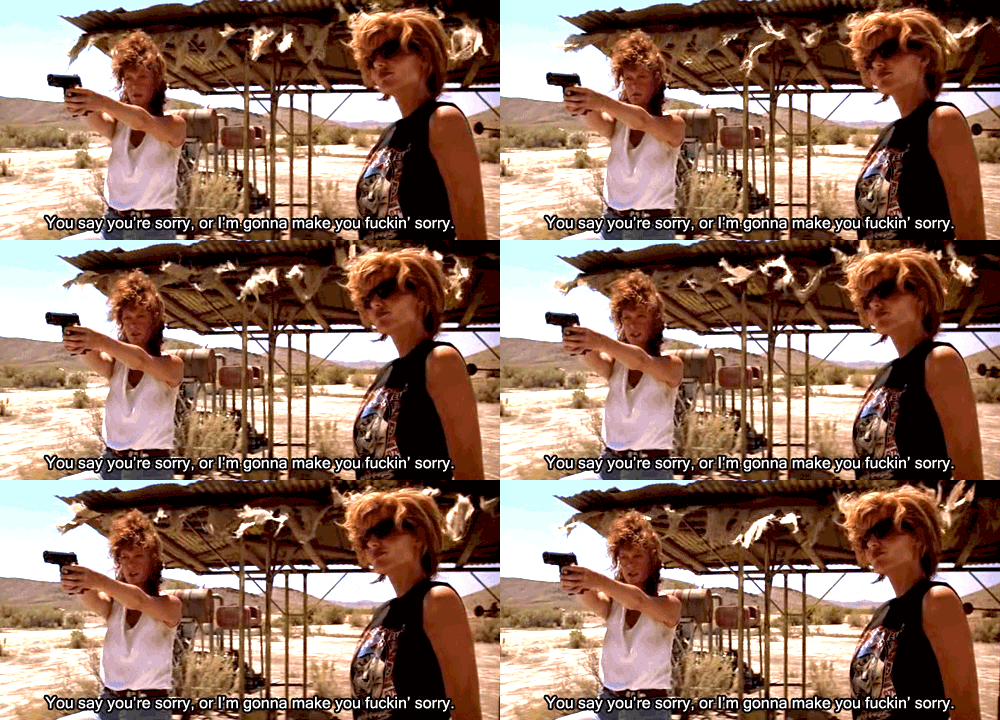
Thelma & Louise is a 1991 American road film directed by Ridley Scott and written by Callie Khouri. It’s a story about best friends taking control of their lives and accepting the consequences; changing the outcome of the two-day vacation intended to take a break from their dreary lives.
When you think about it, Thelma (Susan Sarandon) and Louise (Geena Davis) invented the selfie. Susan Sarandon explained she thought her character would be the type to keep a record of their travels, so she improvised the moment. And what about Brad Pitt? What a way to make a splash on the movie scene!
Simon says everybody down on the floor!
Although power hasn’t really changed in Hollywood, Thelma and Louise was a very empowering female liberation film. I never give away endings but at the time I felt wow, finally a real kickass conclusion versus the candy coated type we usually get.
The film became a critical and commercial success, receiving six Academy Award nominations and winning one for Best Original Screenplay for Khouri. Scott was nominated for Best Director, and both Sarandon and Davis were nominated for Best Actress.
At its release, the movie stirred controversy. At the intersection of several genres, it is now considered a classic, influenced other films and artistic works, and became a landmark of feminist film. (Wikipedia)
It’s a perfect movie for an ultimate girl’s night out so grab your friends and don’t miss seeing this classic on the big screen!
This collection of the works of America’s legendary first African-American filmmakers is the only one of its kind. Funded in part by a highly successful Kickstarter campaign, the packaged set includes no fewer than a dozen feature-length films and nearly twice as many shorts and rare fragments. Subject matter includes race issues that went unaddressed by Hollywood for decades.
Spencer Williams (July 14, 1893 – December 13, 1969) was an American actor and filmmaker. He was best known for playing Andy in the Amos ‘n Andy television show and for directing the 1941 race film “The Blood of Jesus”. Williams was a pioneer African-American film producer and director. (Wikipedia)
The Pioneers of African-American Cinema collection includes new digital restorations of over a dozen feature films, plus shorts, fragments, trailers, documentary footage, archival interviews, and audio recordings.
This clip is a scene from Richard Maurice’s ELEVEN P.M. (circa 1928). It is regarded by historian Henry T. Sampson as one of the most outstanding black films of the silent era and is Maurice’s second and only surviving film.
Eleven P. M is one of more than a dozen feature films showcased in Kino Lorber’s five-disc collection PIONEERS OF AFRICAN-AMERICAN CINEMA, now available at KinoLorber.com and Amazon.com. Music is by Rob Gal. Mastered from 35mm film elements preserved by the Library of Congress.
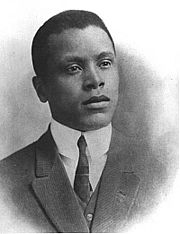
Oscar Micheaux
Oscar Devereaux Micheaux(January 2, 1884 – March 25, 1951) was an African American author, film director and independent producer of more than 44 films. Although the short-lived Micheaux Book & Film Company produced some films, he is regarded as the first major African-American feature filmmaker, the most successful African-American filmmaker of the first half of the 20th century and the most prominent producer of race films. He produced both silent films and sound films when the industry changed to incorporate speaking actors. (Wikipedia)
These films and filmmakers deserve to be remembered, honored and explored. Their contributions play a significant role in the development of the American cinema.
For more on the history of African-American Cinema:
Today we celebrate two very special birthdays; Harry James Potter, born in England on July 31, 1980, and the creator of this beloved wizard, J.K Rowling. This gifted writer created a magical world, a wizarding world that changed our culture forever. Following the saga of Harry and his best friends, Ron Weasley and Hermoine Granger, Rowling energized a generation of children to read.
J. K Rowling
I am a Harry Potter head for sure. I celebrated my 60th birthday last year at The Wizarding World of Harry Potter at Universal Studios in Florida. I was also one of the millions who visited Universal upon the inauguration of the “Wizarding World.” I’ve read all of the books 3 times over and love the overarching message of the power of love and friendship in this best-selling series.
As I write on my About page, I’ve loved movies ever since I was a kid at the Saturday matinees. When the VCR was developed, I was in heaven. The ability to view my favorite films whenever I wanted was a day I had envisioned since childhood.
I have two children and raised them to be movie junkies, as well. We frequently have conversations laced with film quotes like – “It doesn’t have to be gold” from the Billy Wilder classic, “Some Like it Hot!” or “Do or do not. There is no try.” from the wise Yoda in “Empire Strikes Back”.
This post features some of my favorite, most notable quotes from my best-loved movies. There are way too many to name, but here goes:
Trivia: Marlon Brando boycotted the Academy Awards and turned down his Oscar for Best Actor in protest of the treatment of Native Americans in film and on television. Al Pacino also was a no-show for being nominated as Best Supporting Actor and not Best Actor. He had more screen time so didn’t appreciate the slight.
This Jack Lemmon, Tony Curtis, Marilyn Monroe comedy vehicle has always been close to my heart because, for its time, was the most subversive film I’d ever seen. And I mean that in a good way! Cross-dressing, gay marriage, it’s brilliant! In my top 5.
Tom Hanks “made his bones” to quote The Godfather in this remarkable cinematic triumph. Forrest Gump will probably go down as one of the most quotable films of all time! “Mama always said life was like a box of chocolates, you never know what you’re gonna get”.
1939 is considered to be the most amazing year in the motion picture industry for the quality of films and audience attendance. “Gone With the Wind”, “Mr. Smith Goes to Washington” and “The Wizard of Oz”, which is one of the most beloved works of our time. It continues to tug at our heart strings with every generation.
“Some people without brains do an awful lot of talking.” Scarecrow
This group is just a sampling of some of the best. Stay tuned for Part Two of the Most Quotable Films. In the meantime:
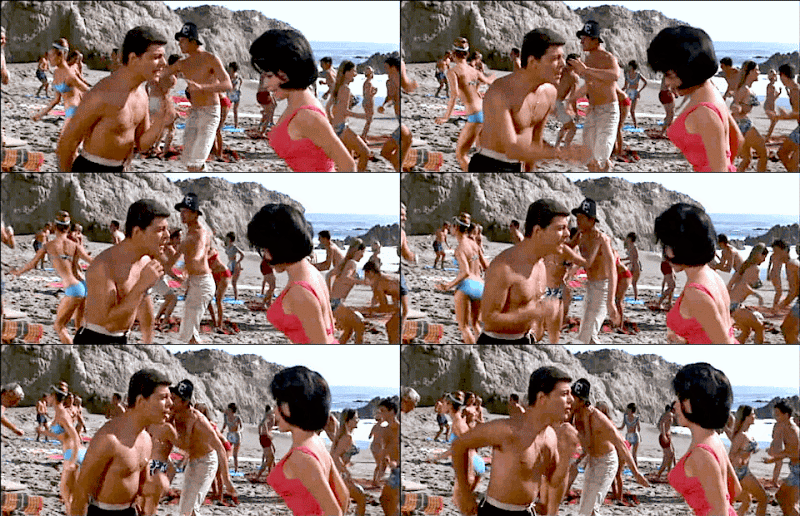
I’ve loved musicals my entire life. Going back to Frankie and Annette in the beach movies when a mandatory song would break out and a beach full of teenagers would get busy doing the watusi.
Frankie and Annette
Some musical numbers stand out more than others. This is Part Two of a glimpse into some of my favorites.
I’ve written about Streets of Fire before as my guilty pleasure. It’s a rock ‘n roll tale about gangs, ex- lovers (Diane Lane and Michael Pare) and some fantastic music! I give mad props to Fire, Inc. featuring Holly Sherwood (on lead vocals), Rory Dodd, and Eric Troyer for their music in the song “Nowhere Fast”. (Diane Lane did not sing) First, because it’s the right thing to do and second, they kicked butt!!
I got into the film primarily because of the musical sequences even though it failed critically and commercially. Its musical score, however, by Jim Steinman, Ry Cooder, and others, as well as the hit Dan Hartman song “I Can Dream About You”, from the film’s soundtrack, helped it attain a cult following.
I’ll round out this post with one of my favorite inspiring films, Fame. Produced by David De Silva and directed by Alan Parker, its screenplay is by Christopher Gore, choreography by Louis Falco and musical score by Michael Gore.
Starring Irene Cara, it’s a peek into a year of study at a New York school of performing arts. As a result of being fired up by this movie, I took my love of musicals and turned it into a path as an actress in community theater.
“Fame, I’m gonna live forever, baby remember my name!”
I’ve loved musicals my entire life. Going back to Frankie and Annette in the beach movies when a mandatory song would break out and a beach full of teenagers would get busy doing the watusi.
Frankie and Annette
Some musical numbers stand out more than others. This is a glimpse into some of my favorites.
Technically not a musical, the plot involves young Olive’s (Abigail Breslin) pilgrimage to the “Little Miss Sunshine” Beauty Pageant. Of course, everything that could go wrong does which is both totally hilarious and sad. But, Olive’s dance performance at the competition is worth everything as she gives it her all with choreography conceived by her beloved grandfather, played brilliantly by Alan Arkin. Arkin won the Academy Award for Best Supporting Actor.
What warms my heart is the love and commitment of Olive’s family (Greg Kinnear, Steve Carell, Toni Collette, and Paul Dano) who support her and her dreams. Do your thing, Olive. Awesome!!
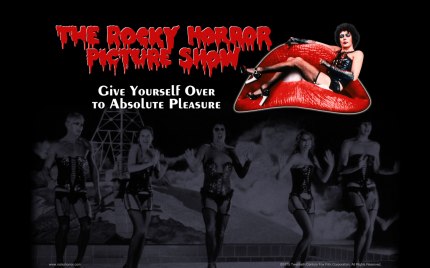
Truly a classic, this cult marvel became a must see and do experience when audiences began participating with the film at the Waverly Theater in New York City in 1976. Based on the 1973 musical stage production The Rocky Horror Show, the music, book, and lyrics are by Richard O’Brien. The production is a parody tribute to the science fiction and horror B movies of the 1930s through early 1970s.
The film stars Tim Curry, Susan Sarandon, and Barry Bostwick along with cast members from the original Royal Court Theatre, Roxy Theatre and Belasco Theatre productions. Tim Curry was magnificent as Dr. Frank N. Furter. (“I’m just a sweet transvestite…”) Love this number and the Dr.’s strut.
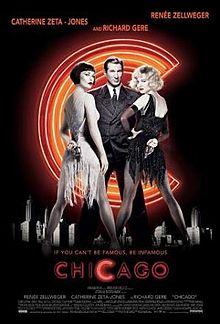
What’s hotter than Jazz, sex, scandal, and murder? The incredible dance numbers in the movie Chicago!
Chicago tells the story of Velma Kelly (Zeta-Jones) and Roxie Hart (Zellweger), two murderesses who find themselves in jail together awaiting trial in 1920s Chicago. Directed and choreographed by Rob Marshall, and adapted by screenwriter Bill Condon, Chicago won six Academy Awards in 2003, including Best Picture. The film was critically lauded and was the first musical to win Best Picture since Oliver! in 1968.
Let’s keep this party going by checking out Part Two of “I’ve Got the Music in Me!” in my next post to see more music favorites.
This controversial 1988 musical comedy-drama was written and directed by Spike Lee and is based in part on Lee’s experiences at Atlanta’s Morehouse College, Spelman College, and Clark Atlanta University. (Spike Lee also has a role as “Half-Pint”, a pledge for Gamma Phi Gamma) It is a story about fraternity and sorority members clashing with other students at a historically black college during homecoming weekend and also touches upon issues of colorism (discrimination based on skin color) and hair texture bias within the African-American community. The film stars Larry Fishburne, Giancarlo Esposito, and Tisha Campbell-Martin.
School Daze resonates with me for a couple of reasons, first, as a member of a sorority and second, because of my love of the musical genre, the well-produced dance sequences.
Spike went out on a limb challenging black colleges, politics, and internal racial relations. At the time, some people felt he was airing family business. Discussing subject matter usually not shared with the world at large. Good and bad hair, light skinned vs. dark skinned, social class. Spike touched a nerve on all these issues, garnering mixed revues from audiences.
As a black, sorority girl, I found that Spike was telling truths that I’ve experienced over the course of my life. Skin color, hair texture, and social standing. These are issues we still deal with today. As far as the politics, my college class was very political and our participation ranged from running for our dorm governing counsel to initiating the first black cheerleader. Because we grew up in the 60’s and the civil rights movement we understood that we benefited from the sacrifices of others and it was our responsibility to pay it forward.
But, the bottom line of my enjoyment of this movie is I absolutely loved the production numbers! When the film was made you didn’t see lots of musicals like in the 30’s, 40’s, and 50’s. More serious subjects were generally being portrayed due to the politics of the times. Remember, Nelson Mandela was still in prison and apartheid was full on in South Africa.
Now, let’s check out my very favorite performance – Gamma Rays!
These divas are working it in this dance piece! I can still perform this entire routine and it continues to make me smile. Absolutely fabulous!!
Roger Ebert of the Chicago Sun-Times noted School Daze’s significance as a film with a “completely black orientation. “All of the characters, good and bad, are black, and all of the character’s references are to each other.” (Wikipedia)
School Daze is relevant, witty, and worth viewing. Two Thumbs Up!
This site is about how to live our life in a meaningful way by accepting complete surrender to the Almighty with purity of mind and character. It is about the eternal religion of the world i.e. Hinduism which is very liberal to anyone because there are many branches or methods to get the divinity to turn our life into an ever blissful one.
Free listening and free download (mp3) chill and down tempo music (album compilation ep single) for free (usually name your price). Full merged styles: trip-hop electro chill-hop instrumental hip-hop ambient lo-fi boombap beatmaking turntablism indie psy dub step d'n'b reggae wave sainte-pop rock alternative cinematic organic classical world jazz soul groove funk balkan .... Discover lots of underground and emerging artists from around the world.


















 iheartfilm