“Every Who down in Whoville liked Christmas a lot, But the Grinch, who lived just north of Whoville, did not. The Grinch hated Christmas — the whole Christmas season. Oh, please don’t ask why no one quite knows the reason. It could be, perhaps, that his shoes were too tight. It could be his head wasn’t screwed on just right. But I think that the most likely reason of all May have been that his heart was two sizes too small.”
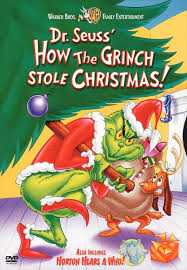
On December 18, 1966 “How the Grinch Stole Christmas” premiered as a television special and has continued to entertain and touch my life and the lives of countless children both young and old. It relates the tale of the Christmas plot of the mean ole Mr. Grinch to steal the joy of celebration from the residents of Whoville; it’s Seuss’ spiritual lesson for the true meaning of Christmas.
Print ad of Dr. Seuss’ How the Grinch Stole Christmas! 1966
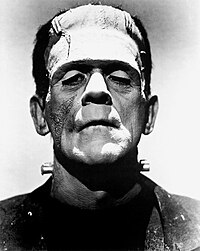
Narrated by the legendary Boris Karloff – also the voice of The Grinch – we are introduced to the world of Whoville and that nasty wasty Grinch.
Boris Karloff and The Grinch
You’re a foul one, Mr. Grinch. You’re a nasty, wasty skunk. Your heart is full of unwashed socks, your soul is full of gunk. Mr. Grinch! [spoken] The three words that best describe you are as follows and I quote: [sung] “Stink! Stank! Stunk!”
In this version of the story, we don’t really know why The Grinch hates Christmas and the residents of Whoville. Just that his heart is 2 sizes too small. However in the Jim Carrey movie version of Dr. Seuss “How the Grinch Stole Christmas, “we see the flashback of The Grinch as a child and how because he looks different: green and hairy as an eight-year-old he is taunted and teased by his classmates.
For his crush, he makes a Christmas present and tries to shave his face but ends up with toilet paper stuck all over. Everyone laughs at him – including his crush – so he storms out the room climbing up to his mountain exile. Not seen for years, he becomes an urban legend. Flashing forward to The Grinch and his now adult classmates it isn’t hard to understand why Whoville isn’t his favorite town and therefore the Whos love of Christmas has become a thorn in his side.
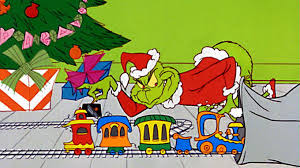
So, The Grinch gets this inspired idea after seeing his dog Max get snow on his face that sort of looks like a beard. The plan becomes to dress up as Santa, sneak into Whoville and rip off all the houses of presents, toys and even a piece of cheese from a mouse. So low down. Hence “stink, stank, stunk!”
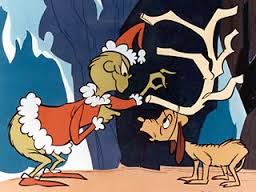
Poor Max wasn’t really down with the plan but was forced to play his part as a reindeer.
Enter my favorite resident of Whoville, Cindy Lou Who. I’ve loved her all my life. Her innocence and open heart is a testament to – as John Lennon once wrote: “All you need is love.”
“Santy Claus”
“Why?”
Ah, but not even the innocence of Cindy Lou could discourage The Grinch from following thru with his wicked plan.
However, The Grinch would come to realize that Whoville is no ordinary town. Even without presents, toys or roast beast, Christmas would still come.
Joyful Grinch
This timeless message of appreciating what you have in friends and family is a gift often lost in this world of envy and greed. Matthew 16:26 “For what will it profit a man if he gains the whole world and forfeits his soul?” Let’s remember the true meaning of Christmas not only during the holidays but every day of the year.
I joined the Turner Classic Movies Facebook group which I thoroughly enjoy. Talking about our favorite films, creepiest, classic vs. neoclassical films and which should be shown on TCM.
In our conversation on creepy movies, “The Black Cat”, Universal 1934, was mentioned and the fact that this member didn’t realize pre-code films had this type of content; mummified women’s bodies in the basement, the proposed torture of skinning Boris Karloff alive, etc. If you haven’t seen it, put it at the top of your must-see list.
In the comments, I suggested in addition to “The Black Cat” to also check out “Mad Love”, Universal, 1935. It stars Peter Lorre and is a total freak fest. Another must-see flick. It stars Peter Lorre as the mad Dr. Gogol who’s obsessed with the wife ( Frances Drake) of a renown pianist whose hands he’s transplanted after a train wreck. Gogol has a definite fetish side and will do anything to have Miss Frances Drake.
“Mad Love” – Peter Lorre (Dr. Gogol)
I love Pre-Code films because they had so much leeway in terms of subject matter, even wardrobe. I always recommend adding Pre-Code to your film history education. By definition Pre-Code films:
Refers to the brief era in the American film industry between the introduction of sound pictures in 1929 and the enforcement of the Motion Picture Production Code censorship guidelines, popularly known as the “Hays Code”, in mid-1934.
In 1922, after some risqué films and a series of off-screen scandals involving Hollywood stars, the studios enlisted Presbyterian elderWilliam H. “Will” Hays, a figure of “unblemished rectitude”, to rehabilitate Hollywood’s image. Hays, later nicknamed the motion picture “Czar”, was paid the then-lavish sum of $100,000 a year (equivalent to more than $1.4 million in 2015 dollars). (Wikipedia)
William “Will” Hays
As a result, films in the late 1920s and early 1930s included depictions of sexual innuendo, profanity, illegal drug use, promiscuity, prostitution, infidelity, abortion, intense violence, and homosexuality.
Film “Red Dust”
Myrna Loy
Jean Harlow
Unlike silent-era sex and crime pictures, silent horror movies, despite being produced in the hundreds, were never a major concern for censors or civic leaders. When sound horror films were released, however, they quickly caused controversy. Sound provided “atmospheric music and sound effects, creepy-voiced macabre dialogue and a liberal dose of blood-curdling screams” which intensified its effects on audiences, and consequently on moral crusaders.
The monster’s brutality, and the doctor’s declaration that “”Now I know what it feels like to be God!”, shocked many moviegoers. By the time of Bride of Frankenstein(1935), the Code was in full effect.
The Hays Code did not mention gruesomeness, and filmmakers took advantage of this oversight. However, state boards usually had no set guidelines and could object to any material they found indecent. Although films such as Frankenstein and Freaks caused controversy when they were released, they had already been re-cut to comply with censors. (Wikipedia)
So, the next time you or anyone else believes that black and white films are a bore, remember to check out “The Black Cat”, or “Mad Love”. If you do, leave a comment; I’d be intrigued to read your thoughts.
For a comprehensive and what I consider a definitive history of one of the original Hollywood Studios – Universal, check out the Documentary – “Universal Horror.” Universal was founded in 1912 by Carl Laemmle and is the world’s fourth oldest major film studio.
Originally airing on Turner Classic Movies in 1998, “Universal Horror” showcases the golden age of 1930’s movie monsters. The film also highlights Carl Laemmle’s family and Carl Laemmle, Jr’s game-changing vision of producing films based on classic horror tales.
Casting for the film became problematic initially since Laemmle was not at all interested in Lugosi, in spite of good reviews for his stage portrayal. Laemmle instead considered other popular actors of the day, including Paul Muni and Chester Morris.
In 1991, the Library of Congress selected Frankenstein for preservation in the United States National Film Registry as being “culturally, historically, or aesthetically significant.
Also affectionately called “Forry,” Ackerman was central to the formation, and spread of science fiction fandom, and a key figure in the wider awareness of science fiction as a literary, art and film genre. Famous for his wordplay he coined the genre nickname “sci-fi”.
Universal Monsters Tribute
The end of Universal’s first run of horror films came in 1936 as the Laemmles were forced out of the studio after financial difficulties and a series of box office flops due partly to censorship and a temporary ban on American horror films in Britain. The release of MGM’s Mad Love and The Raven (both 1935) were the final nail in the coffin for monster movies, being too strong for 1935 tastes, with its themes of torture, disfigurement, and grisly revenge.
The monster movies were dropped from the production schedule altogether and would not re-emerge for another three years. In the meantime, a theater owner revived Dracula and Frankenstein as a double feature, resulting in an immediate smash hit and leading to the original movies being re-released by the studio to surprising success.
Be sure to checkout these films and experience the original horror classics from the original horror classics studio – Universal!
“Every Who down in Whoville liked Christmas a lot, But the Grinch, who lived just north of Whoville, did not. The Grinch hated Christmas — the whole Christmas season. Oh, please don’t ask why, no one quite knows the reason. It could be, perhaps, that his shoes were too tight. It could be his head wasn’t screwed on just right. But I think that the most likely reason of all May have been that his heart was two sizes too small.”
One of my favorite Christmas joys is watching and sharing my favorite animated Christmas specials. This month will be dedicated to these wonderful specials and films.
On December 18, 1966 “How the Grinch Stole Christmas” premiered as a television special and has continued to entertain and touch my life and the lives of countless children both young and old. It relates the tale of the Christmas plot of the mean ole Mr. Grinch to steal the joy of celebration from the residents of Whoville; it’s Seuss’ spiritual lesson for the true meaning of Christmas.
Print ad of Dr. Seuss’ How the Grinch Stole Christmas! 1966
Narrated by the legendary Boris Karloff – also the voice of The Grinch – we are introduced to the world of Whoville and that nasty wasty Grinch.
Boris Karloff and The Grinch
You’re a foul one, Mr. Grinch. You’re a nasty, wasty skunk. Your heart is full of unwashed socks, your soul is full of gunk. Mr. Grinch! [spoken] The three words that best describe you are as follows and I quote: [sung] “Stink! Stank! Stunk!”
In this version of the story, we don’t really know why The Grinch hates Christmas and the residents of Whoville. Just that his heart is 2 sizes too small. However in the Jim Carrey movie version of Dr. Seuss “How the Grinch Stole Christmas,”we see the flashback of The Grinch as a child and how because he looks different: green and hairy as an eight-year-old he is taunted and teased by his classmates.
“Little Grinch” makes a Christmas present for his crush and tries to shave his face for the presentation but ends up with toilet paper stuck all over. Everyone laughs at him, so he storms out the room climbing up to his mountain exile. Not seen for years, he becomes an urban legend. Flashing forward to The Grinch and his now adult classmates, it isn’t hard to understand why Whoville isn’t his favorite town and additionally, the Whos love of Christmas has become a major thorn in his side.
So, The Grinch gets this inspired idea after seeing his dog Max get snow on his face that sort of looks like a beard. The plan becomes to dress up as Santa, sneak into Whoville and rip off all the houses of presents, toys and even a piece of cheese from a mouse. So low down. Hence “stink, stank, stunk!”
Poor Max wasn’t really down with the plan but was forced to play his part as a reindeer.
Enter my favorite resident of Whoville, Cindy Lou Who. I’ve loved her all my life. Her innocence and open heart are a testament to – as John Lennon once wrote: “All you need is love.”
“Santy Claus”
“Why?”
Ah, but not even the innocence of Cindy Lou could discourage The Grinch from following thru with his wicked plan.
However, The Grinch would come to realize that Whoville is no ordinary town. Even without presents, toys or roast beast, Christmas would still come.
Joyful Grinch
This timeless message of appreciating what you have in friends and family is a gift often lost in this world of envy and greed. Matthew 16:26 “For what will it profit a man if he gains the whole world and forfeits his soul?” Let’s remember the true meaning of Christmas not only during the holidays but every day of the year.
For a comprehensive and what I consider a definitive history of one of the original Hollywood Studios – Universal, check out the Documentary – “Universal Horror.” Universal was founded in 1912 by Carl Laemmle and is the world’s fourth oldest major film studio.
Originally airing on Turner Classic Movies in 1998, “Universal Horror” showcases the golden age of 1930’s movie monsters. The film also highlights Carl Laemmle’s family and Carl Laemmle, Jr’s game-changing vision of producing films based on classic horror tales.
Casting for the film became problematic initially since Laemmle was not at all interested in Lugosi, in spite of good reviews for his stage portrayal. Laemmle instead considered other popular actors of the day, including Paul Muni and Chester Morris.
In 1991, the Library of Congress selected Frankenstein for preservation in the United States National Film Registry as being “culturally, historically, or aesthetically significant.
Also affectionately called “Forry,” Ackerman was central to the formation, and spread of science fiction fandom, and a key figure in the wider awareness of science fiction as a literary, art and film genre. Famous for his wordplay he coined the genre nickname “sci-fi”.
Universal Monsters Tribute
The end of Universal’s first run of horror films came in 1936 as the Laemmles were forced out of the studio after financial difficulties and a series of box office flops due partly to censorship and a temporary ban on American horror films in Britain. The release of MGM’s Mad Love and The Raven (both 1935) were the final nail in the coffin for monster movies, being too strong for 1935 tastes, with its themes of torture, disfigurement, and grisly revenge.
The monster movies were dropped from the production schedule altogether and would not re-emerge for another three years. In the meantime, a theater owner revived Dracula and Frankenstein as a double feature, resulting in an immediate smash hit and leading to the original movies being re-released by the studio to surprising success.
As I celebrate this Halloween, my film line-up would not be complete without those original horror classics from the original horror classics studio – Universal!
“Every Who down in Whoville liked Christmas a lot, But the Grinch, who lived just north of Whoville, did not. The Grinch hated Christmas — the whole Christmas season. Oh, please don’t ask why, no one quite knows the reason. It could be, perhaps, that his shoes were too tight. It could be his head wasn’t screwed on just right. But I think that the most likely reason of all May have been that his heart was two sizes too small.”
On December 18, 1966 “How the Grinch Stole Christmas” premiered as a television special and has continued to entertain and touch my life and the lives of countless children both young and old. It relates the tale of the Christmas plot of the mean ole Mr. Grinch to steal the joy of celebration from the residents of Whoville; it’s Seuss’ spiritual lesson for the true meaning of Christmas.
Print ad of Dr. Seuss’ How the Grinch Stole Christmas! 1966
Narrated by the legendary Boris Karloff – also the voice of The Grinch – we are introduced to the world of Whoville and that nasty wasty Grinch.
Boris Karloff and The Grinch
You’re a foul one, Mr. Grinch. You’re a nasty, wasty skunk. Your heart is full of unwashed socks, your soul is full of gunk. Mr. Grinch! [spoken] The three words that best describe you are as follows and I quote: [sung] “Stink! Stank! Stunk!”
In this version of the story, we don’t really know why The Grinch hates Christmas and the residents of Whoville. Just that his heart is 2 sizes too small. However in the Jim Carrey movie version of Dr. Seuss “How the Grinch Stole Christmas,”we see the flashback of The Grinch as a child and how because he looks different: green and hairy as an eight-year-old he is taunted and teased by his classmates.
For his crush, he makes a Christmas present and tries to shave his face but ends up with toilet paper stuck all over. Everyone laughs at him – including his crush – so he storms out the room climbing up to his mountain exile. Not seen for years, he becomes an urban legend. Flashing forward to The Grinch and his now adult classmates it isn’t hard to understand why Whoville isn’t his favorite town and therefore the Whos love of Christmas has become a thorn in his side.
So, The Grinch gets this inspired idea after seeing his dog Max get snow on his face that sort of looks like a beard. The plan becomes to dress up as Santa, sneak into Whoville and rip off all the houses of presents, toys and even a piece of cheese from a mouse. So low down. Hence “stink, stank, stunk!”
Poor Max wasn’t really down with the plan but was forced to play his part as a reindeer.
Enter my favorite resident of Whoville, Cindy Lou Who. I’ve loved her all my life. Her innocence and open heart is a testament to – as John Lennon once wrote: “All you need is love.”
“Santy Claus”
“Why?”
Ah, but not even the innocence of Cindy Lou could discourage The Grinch from following thru with his wicked plan.
However, The Grinch would come to realize that Whoville is no ordinary town. Even without presents, toys or roast beast, Christmas would still come.
Joyful Grinch
This timeless message of appreciating what you have in friends and family is a gift often lost in this world of envy and greed. Matthew 16:26 “For what will it profit a man if he gains the whole world and forfeits his soul?” Let’s remember the true meaning of Christmas not only during the holidays but every day of the year.
This site is about how to live our life in a meaningful way by accepting complete surrender to the Almighty with purity of mind and character. It is about the eternal religion of the world i.e. Hinduism which is very liberal to anyone because there are many branches or methods to get the divinity to turn our life into an ever blissful one.
Free listening and free download (mp3) chill and down tempo music (album compilation ep single) for free (usually name your price). Full merged styles: trip-hop electro chill-hop instrumental hip-hop ambient lo-fi boombap beatmaking turntablism indie psy dub step d'n'b reggae wave sainte-pop rock alternative cinematic organic classical world jazz soul groove funk balkan .... Discover lots of underground and emerging artists from around the world.