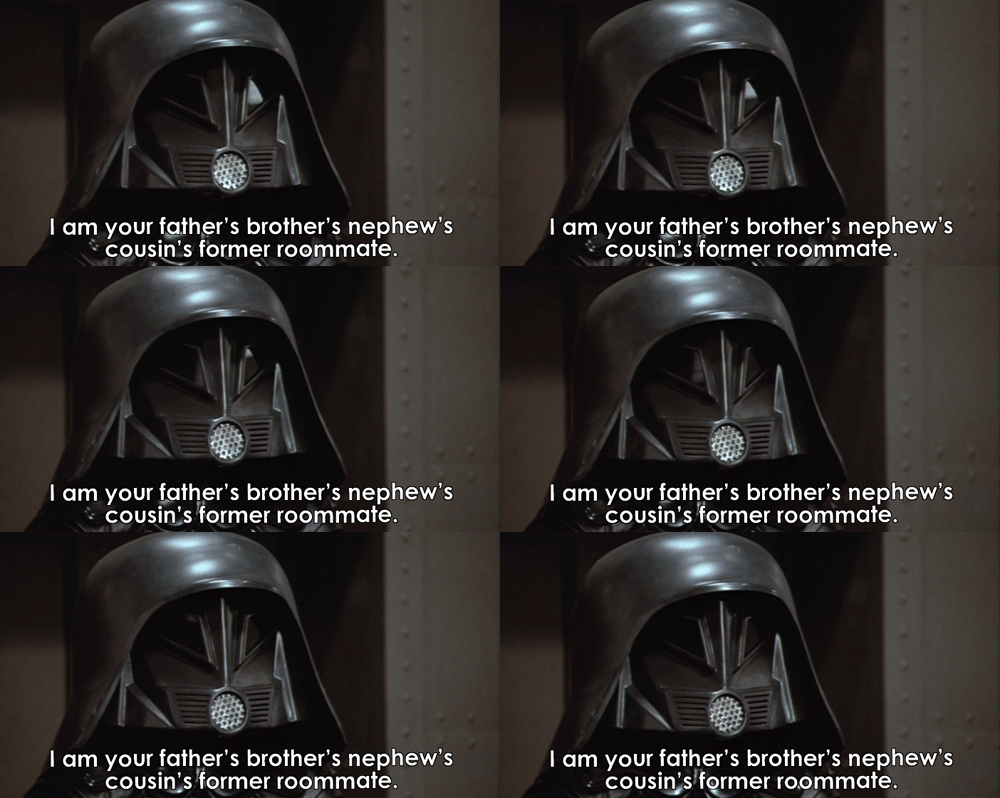
Like Galaxy Quest was an homage to Star Trek, Mel Brooks off-the-wall comedy Spaceballs (1987) was a send-off of Star Wars. Its setting and characters parody the original Star Wars trilogy, as well as other sci-fi franchises including Star Trek, Alien, and the Planet of the Apes films.
The plot is set in a distant galaxy, planet Spaceball which has depleted its air supply, leaving its citizens reliant on a product called “Perri-Air.” (See, I told you off-the-wall)
Mel Brooks
In desperation, Spaceball’s leader President Skroob (Mel Brooks) orders the evil Dark Helmet (Rick Moranis) to kidnap Princess Vespa (Daphne Zuniga) of oxygen-rich Druidia and hold her hostage in exchange for air.
Rick Moranis (Dark Helmet)
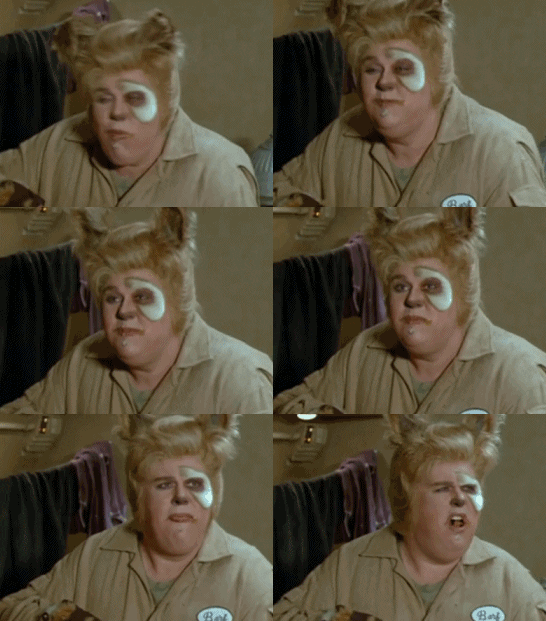
But help arrives for the Princess in the form of renegade space pilot Lone Starr (Bill Pullman) and his half-man, half-dog partner, Barf (John Candy). (IMDb)
Spaceballs is a 1987 American science fiction parody film co-written, produced and directed by Mel Brooks. Starring Brooks, Bill Pullman, John Candy, and Rick Moranis, the film also features Daphne Zuniga, Dick Van Patten, and the voice of Joan Rivers as Dot Matrix. (Wikipedia)
John Candy, Joan Rivers (Dot), Daphne Zuniga, Bill Pullman
Rick Moranis
John Candy – Barf
The film was met with a mixed reception but I think it can be classified as a cult classic, definitely an off the-wall-classic.
Going back and researching this film I almost forgot the funniest scene that had me on the floor. When I first saw this I literally screamed! Which I’m sure had the cleaning lady a the Residence Inn, where I was staying, shaking her head. (This chick is nuts!)
OMG, that was hilarious!! Who would have thought you could turn that incredibly terrifying moment in Alien into this “spit your milk out” moment.
Once again, Rick Moranis is absolutely brilliant! Just looking at him in that ginormous helmet, you can’t help but crack-up. Portraying the embodiment of the “Napoleon complex” his action playing with his dolls is too precious.
Trivia:
IT WASN’T THE FIRST STAR WARS PARODY FILM.
Amateur filmmaker, Ernie Fosselius was so enamored with Star Wars in 1977 that he cobbled together a 12-minute short, Hardware Wars, which he shot for just $8,000 in an abandoned laundromat. It was even declared a “cute little film” by George Lucas.
LUCAS GAVE HIS (CONDITIONAL) BLESSING.
Based on Brooks not doing any merchandising. The Lucas people were just upset about one aspect of Spaceballs,” Brooks told Starlog in 1987. “They didn’t think it was fair for us to do a take-off and then merchandise the characters.”
BILL PULLMAN WAS BROOKS’ THIRD CHOICE.
According to Pullman, the actor—who had not yet had a starring role—was approached by Brooks only after Tom Cruise and Tom Hanks turned down the role of Lone Starr, the Han Solo-esque lead of the film. Pullman said that hiring Rick Moranis and John Candy freed Brooks up to cast a relative unknown.
BARF’S EARS UPSTAGED THE ACTORS.
John Candy, who played half-dog/half-man Barf, was usually trailed on-set by Effects artist Rick Lazzarini and the effects crew, who had to control both his tail and his ears. At one point, Lazzarini was told by Brooks that he didn’t “have to move the ears so much!” They were too active in scenes focused on other characters. (Candy, incidentally, performed with a 40-pound battery backpack strapped to him to control the animatronics.)
(Jake Rossen-(mental_floss)
John Candy – Barf
So, if you’re looking for a good laugh and a total mind distraction, I recommend “Spaceballs” as the perfect gag-filled tonic.
I love quoting from my favorite movies. It’s like a secret language that only you and those who love that particular film can understand. The joy is one line can transport you back to that moment in time and creates an instant connection with fellow film lovers.
On a recent trip to visit family, watching the Michigan game and sharing stories, as usual, my cousin quipped, “the sheriff is near..” and we all broke out laughing visualizing the scene with Clevon Little from “Blazing Saddles”.
So, taking the secret language idea a little further, I decided to showcase some of my favorite monologues from some of my favorite films.
This was Ramis’ first feature film and was a major boost to Dangerfield’s film career; previously, he was known mostly for his stand-up comedy. Grossing nearly $40 million at the domestic box office (17th-highest of the year).
Caddyshack has garnered a large cult following and has been hailed by media outlets, such as Time and ESPN, as one of the funniest sports movies of all time. As of 2010, Caddyshack has been televised on the Golf Channel as one of its “Movies That Make the Cut.” (Wikipedia)
Chevy Chase, Bill Murray, Rodney Dangerfield, Ted Knight
In 2000, Caddyshack was placed at number 71 on the American Film Institute’s (AFI) list of the 100 funniest American films. In 2005, a line from the movie was chosen by AFI for their list of the top 100 movie quotes from U.S. films.
‘”Cinderella story. Outta nowhere. A former greenskeeper, now, about to become the Masters champion. It looks like a
mirac…
…It’s in the hole! It’s in the hole! It’s in the hole!”
Bill Murray
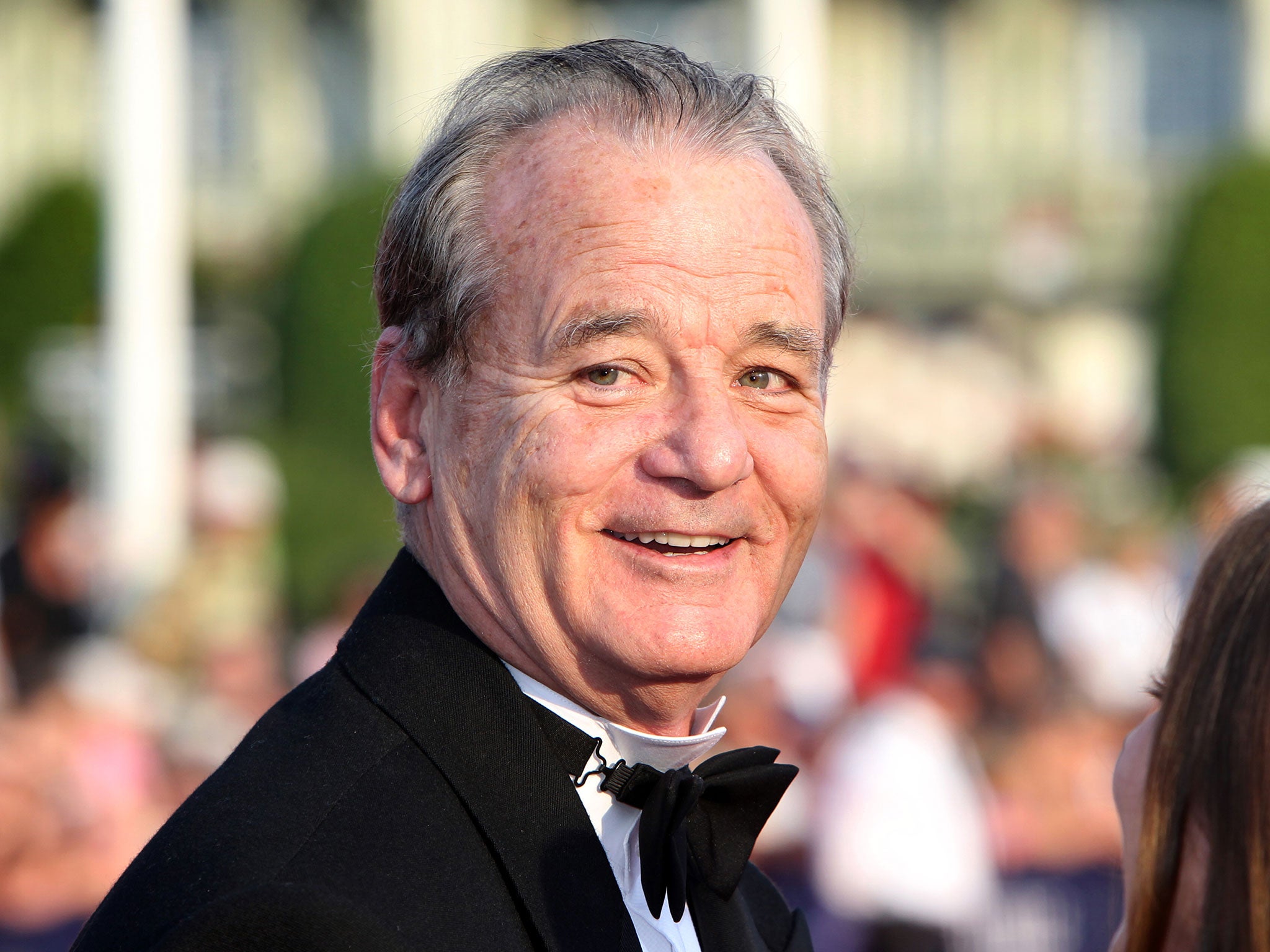
On October 23, 2016, Bill Murray was the recipient of The Kennedy Center Mark Twain Prize for American Humor. From the stage of The John F. Kennedy Center, a star-studded lineup saluted the achievements of this brilliant comedic trailblazer.
There is no doubt that Gene Wilder was a brilliant writer and one of the funniest actors of our time. His role as Victor Frankenstein is a standout. His timing is perfect and this monologue is priceless.
Mel Brooks, Kenneth Mars, Marty Feldman, Gene Wilder, Teri Garr
The film is an affectionate parody of the classic horror film genre, in particular, the various film adaptations of Mary Shelley’s novel Frankenstein produced by Universal in the 1930s.
Brooks adapted the film into a musical of the same name which premiered in Seattle at the Paramount Theatre and ran from August 7 to September 1, 2007. The musical opened on Broadway at the Foxwoods Theatre (then the Hilton Theatre) on November 8, 2007, and closed on January 4, 2009.
It was nominated for three Tony Awards and starred Tony winner Roger Bart, two-time Tony winner Sutton Foster, Tony & Olivier winner Shuler Hensley, two-time Emmy winner Megan Mullally (Will & Grace), three-time Tony nominee Christopher Fitzgerald, and two-time Tony & Emmy winner Andrea Martin (Saturday Night Live veteran).
Megan Mullally
A critical favorite and box office smash, Young Frankenstein ranks No. 28 on Total Film magazine’s readers’ “List of the 50 Greatest Comedy Films of All Time”, No. 56 on Bravo TV’s list of the “100 Funniest Movies”, and No. 13 on the American Film Institute’s list of the 100 funniest American movies.
In 2003, it was deemed “culturally, historically or aesthetically significant” by the United States National Film Preservation Board, and selected for preservation in the Library of Congress National Film Registry. On its 40th anniversary, Brooks considered it by far his finest (though not his funniest) film as a writer-director.
I still find myself holding my breath listening to Quint’s (Robert Shaw) story. His vivid recount of his nightmare of the death with his shipmates is absolutely riveting! Wow, one of the most frightening scenes in the film.
Jaws is the 1975 American thriller film directed by Steven Spielberg and based on Peter Benchley‘s 1974 novel of the same name. The film stars Roy Scheider as police chief Martin Brody, Robert Shaw as shark hunter Quint, and Richard Dreyfuss as oceanographer Matt Hooper. (Wikipedia)
Now considered one of the greatest films ever made, Jaws was the prototypical summer blockbuster, with its release regarded as a watershed moment in motion picture history.
Robert Shaw, Roy Scheider, Richard Dreyfuss
Jaws became the highest-grossing film of all time until the release of Star Wars (1977). It won several awards for its soundtrack and editing. In 2001, Jaws was selected by the Library of Congress for preservation in the United States National Film Registry, being deemed “culturally, historically, or aesthetically significant”. (Wikipedia)
This classic won three Academy Awards for Best Film Editing, Best Original Dramatic Score, and Best Sound (Robert Hoyt, Roger Heman, Earl Madery and John Carter). It was also nominated for Best Picture, losing to One Flew Over the Cuckoo’s Nest.
Spielberg greatly resented the fact that he was not nominated for Best Director. Along with the Oscar, John Williams’s score won the Grammy Award, the BAFTA Award for Best Film Music, and the Golden Globe Award. To her Academy Award, Verna Fields added the American Cinema Editors’ Eddie Award for Best Edited Feature Film.
This is the scene that not only features the memorable monologue but, introspection of just what it means. This reflection made the speech even more impactful for me. Stop and think about it.
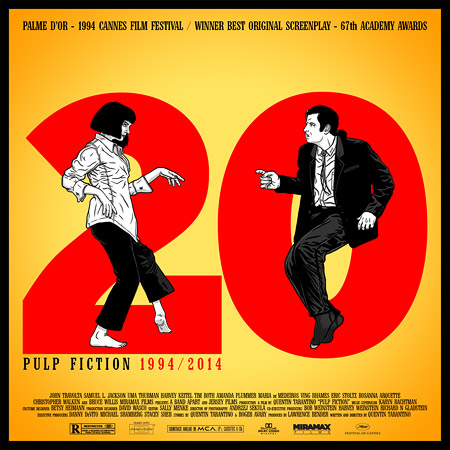
Pulp Fiction is the 1994 American neo-noir crime black comedy film written and directed by Quentin Tarantino, from a story by Tarantino and Roger Avary. Tarantino’s second feature film, it is iconic for its eclectic dialogue, ironic mix of humor and violence, nonlinear storyline, and a host of cinematic allusions and pop culture references.
Uma Thurman, John Travolta
The film was nominated for seven Oscars, including Best Picture; Tarantino and Avary won for Best Original Screenplay. It was also awarded the Palme d’Or at the 1994 Cannes Film Festival. A major critical and commercial success, it revitalized the career of its leading man, John Travolta, who received an Academy Award nomination, as did co-stars Samuel L. Jackson and Uma Thurman. (Wikipedia)
John Travolta, Samuel L. Jackson
The music is as much a character in the movie as the actors. No film score was composed for Pulp Fiction; Quentin Tarantino instead used an eclectic assortment of surf music, rock and roll, soul, and pop songs.
Dick Dale’s rendition of “Misirlou” plays during the opening credits. Tarantino chose surf music as the basic musical style for the film, but not, he insists, because of its association with surfing culture: “To me, it sounds like rock and roll spaghetti Western music.” (Wikipedia)
The soundtrack album, Music from the Motion Picture Pulp Fiction, was released along with the film in 1994. The album peaked on the Billboard 200 chart at number 21. The single, Urge Overkill’s cover of the Neil Diamond song “Girl, You’ll Be a Woman Soon”, reached number 59.
The film has been called a “terminally hip postmodern collage” and in 2013, selected for preservation in the United States National Film Registry by the Library of Congress as being “culturally, historically, or aesthetically significant”. (Wikipedia)
These are some of my top classic movie moments. In the Comments, let me know some of yours!
Originally this film was going to be part of a favorite monologues piece. However, after watching Howard Beale’s (Peter Finch) speech on the state of the world, I felt the need to turn it into a full blown post on its own.
This prophetic monologue is incredible! It could very well have been given today. His truth and passion still hit hard. Politically, I feel this way most days.
When I saw this movie at its premiere I thought it was pinpoint accurate as a representation of the industry and the direction it was going. Today’s corporate media has even surpassed the foretold death of true journalism that “Network” showcased.
Entertainment television was the news style of the film and parrots the absurdity of what passes for the Fourth Estate today.
As a journalism student in the ’70s, I’ve been outraged over time witnessing the demise and bastardization of the reason for journalism, to begin with. The news is supposed to inform the public of what is going on in Washington and globally. It’s supposed to be impartial, probing and take seriously the consequences of misleading and misinforming the American people of information needed to make informed decisions on our public servants and events.
I often think of the Watergate scandal and how very differently it would have emerged in today’s news environment. Bob Woodward and Carl Bernstein from the Washington Post represented the best of journalism and the importance of separating news from entertainment; digging deep and not letting up until all the facts had been revealed.
Chilling commentary and viewpoint from the Corporate Chairman (Ned Beatty)
Allegedly, part of the inspiration for Chayefsky’s script came from the on-air suicide of television news reporter Christine Chubbuck in Sarasota, Florida two years earlier. The anchorwoman was suffering from depression and battles with her editors, and unable to keep going, she shot herself on camera as stunned viewers watched on July 15, 1974. Chayefsky used the incident to set up his film’s focal point. As he would say later in an interview, “Television will do anything for a rating… anything!”
However, Dave Itzkoff’s book Mad as Hell: The Making of Network and the Fateful Vision of the Angriest Man in Movies disputes this, asserting that Chayefsky actually began writing “Network” months before Chubbuck’s death and already planned for Howard Beale to vow to kill himself on air; Chubbuck’s suicide was an eerie parallel. (Wikipedia)
Whatever the order of events, Paddy Chayefsky’s intuition and writing are inspired! Words we should never take lightly and always remember.
In 2000, the film was selected for preservation in the United States National Film Registry by the Library of Congress as being “culturally, historically, or aesthetically significant”. In 2002, it was inducted into the Producers Guild of America Hall of Fame as a film that has “set an enduring standard for U.S. American entertainment”. (Wikipedia)
In 2006, the two Writers Guilds of America voted Chayefsky’s script one of the 10 greatest screenplays in the history of cinema. In 2007, the film was 64th among the 100 greatest American films as chosen by the American Film Institute, a ranking slightly higher than the one AFI had given it ten years earlier.
The role of Howard Beale earned him a posthumous Academy Award for Best Actor, his fifth Best Actor award from the British Academy of Film and Television Arts, and a Best Actor award from the Golden Globes. He was the first person to win a posthumous Academy Award in an acting category.
Although Finch didn’t live to receive the Academy Award for Best Actor, his performance as Howard Beale will never leave the memories of those who witnessed it.
So, in honor of Howard Beale let’s all get up off our chairs, go to the window and yell – “I’m mad as hell and I’m not going to take this anymore!”
And, after you’re done, make sure you stay up and go out and VOTE!
A funny thing happened at my 6-month dental check-up. Sitting in the dentist’s chair a lightbulb came on and the idea for this post hit me square in the mouth, “The Little Shop of Horrors”(1960)!
The 1986 film is a remake of the hit Broadway stage production which was a remake of the 1960 movie. (Phew, that took the long way around)
I had the fantastic experience of performing in a stage production as one of the street urchins. Chiffon, Crystal, and Ronette are fashioned after girl groups from the 1960’s. It was one of my favorite shows and roles in my community theater career.
The original 1960 film was a black comedy horror film directed by Detroit-born (my hometown) and celebrated B-movie legend, Roger Corman and written by Charles B. Griffith. The film is a farce about an inadequate florist’s assistant (Jonathan Haze) who cultivates a plant that feeds on human flesh and blood.
The film stars Jonathan Haze (Seymour), Jackie Joseph (Audrey), Mel Welles (Mr. Mushnick), and Dick Miller, all of whom had worked for Corman on previous films. Produced under the title “The Passionate People Eater”. It was a lot creepier and darker than either the 1986 film or Broadway production.
The film’s concept is thought to be based on a 1932 story called “Green Thoughts”, by John Collier, about a man-eating plant. However, author Dennis McDougal in Jack Nicholson‘s biography suggests that Griffith may have been influenced by Arthur C. Clarke’s sci-fi short story ‘The Reluctant Orchid’. (Wikipedia)
The film also garnered attention as a movie that was made into a Broadway production; it’s usually the other way around.
Writer, Charles B. Griffith, was the voice of Audrey 2 in 1960 film.
Levi Stubbs (lead singer of The Four Tops-Motown group) was the voice of Audrey II in 1986 movie.
Ellen Greene played Audrey in the Off-Broadway Production.
The gleefully masochistic dental patient, originally played by Jack Nicholson, is not in the musical but is in the 1986 film, played by Bill Murray.
Off-Broadway Production of “Little Shop of Horrors” 1982 with Ellen Greene immediately right of Audrey 2
A young Jack Nicholson‘s small role as the masochistic dental patient in the 1960 film was a hysterical standout. At the time of filming, Jack Nicholson had appeared in two films and had worked with Roger Corman as the lead in “The Cry Baby Killer”.
Roger Corman
According to Nicholson, “I went into the shoot knowing I had to be very quirky because Roger originally hadn’t wanted me. In other words, I couldn’t play it straight. So I just did a lot of weird shit that I thought would make it funny.”
Even though this was only his third film you could see that his talent was something quite special.
Because I’m a big-time musical theater lover, my affinity is for the 1986 film. The musical numbers were fabulous, the performances outstanding, and the memories lasting.
I loved performing the opening “Urchin” musical number “Little Shop of Horrors” which was also from the Off-Broadway stage production:
The film, directed by Frank Oz (Muppets), differs only slightly from the stage play. The title song is expanded to include an additional verse to allow for more opening credits. The song “Ya Never Know” was re-written into a calypso-style song called “Some Fun Now”, although some of the lyrics were retained.
Four other songs (“Closed for Renovation”, “Mushnik and Son”, “Now (It’s Just the Gas)”, as well as “Call Back in the Morning”) were cut from the original production score. An original song was written by Ashman and Menken, “Mean Green Mother from Outer Space”, was created for the film.
For a fun and dark Halloween double feature, I highly recommend checking out “The Little Shop of Horrors” (1960) and the remake, “Little Shop of Horrors” (1986). A little something for everyone.
Charlie Chaplin is one of the greatest filmmakers in motion picture history. Robert Downey, Jr. brilliantly portrayed his tremendous talent and career in the 1992 film “Chaplin”. I’ve always loved Chaplin not just because of his comedic gifts but like myself, he stood firm in the belief that art is political. A position which caused him to be kicked out of the United States for “subversive” beliefs.
Sir Charles Spencer “Charlie” Chaplin, (16 April 1889 – 25 December 1977) was an English comic actor, filmmaker, and composer who rose to fame during the era of silent film. Chaplin became a worldwide icon through his screen persona “the Tramp” and is considered one of the most important figures in the history of the film industry.
His career spanned more than 75 years, from childhood in the Victorian era until a year before his death in 1977, and encompassed both adulation and controversy. (Wikipedia)
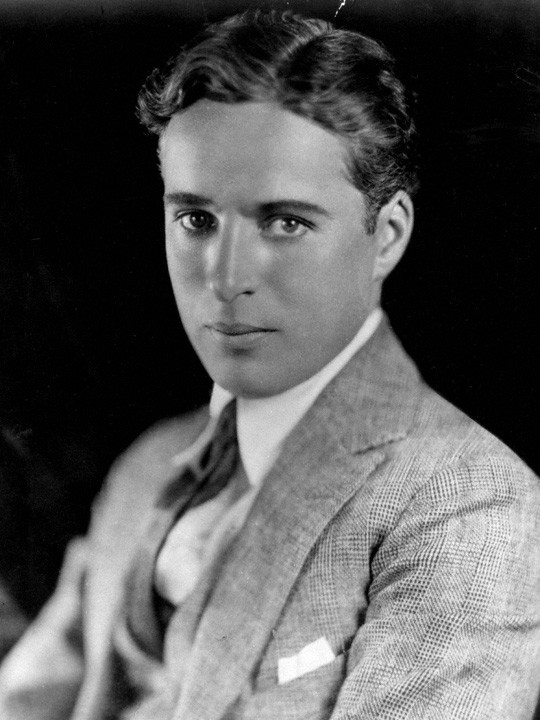
Charlie Chaplin
Probably the most prophetic film of his extraordinary career was “The Great Dictator” (1940). Chaplin’s final speech resonates at the core of what it means to be human today just as it did over 75 years ago. Written by Chaplin, it emphasizes just how vital it is to know your history because those who don’t are doomed to repeat it.
Created in direct opposition to Hitler’s reign of terror, Chaplin warns of the devastation of giving up our humanity and implores us to love each other.
The Great Dictator is the 1940 American political satire comedy-drama film written, directed, produced, scored by and starring Charlie Chaplin. Charlie Chaplin was unique because he was the only Hollywood filmmaker to continue to make silent films well into the period of sound films, this was Chaplin’s first true sound film.
This scene is so beautiful in its simplicity and elegance; while at the same time mocking the hubris of Hitler, the genocide, antisemitic dictator.
Language similar to a candidate running for President in 2016. Same delusional dream.
Chaplin’s film is a scathing and controversial condemnation of Adolf Hitler, Benito Mussolini, fascism, antisemitism, and the Nazis. At the time the film was released, the United States hadn’t entered into World War II and the fight against Nazi Germany.
After seeing this masterpiece, my respect and admiration for Chaplin grew even more. He spoke up when others wouldn’t. That’s the kind of morality and integrity that seems to be sorely lacking in today’s politics.
Chaplin was so talented, and for even more contrast, played both leading roles: a ruthless fascist dictator, and a persecuted Jewish barber.
Charlie Chaplin as Adenoid Hynkel (Hitler) and the Jewish Barber
The Great Dictator was popular with audiences, becoming Chaplin’s most commercially successful film. Modern critics have also praised it as a historically significant film and an important work of satire. (Wikipedia)
The Great Dictator was nominated for five Academy Awards – Outstanding Production, Best Actor, Best Writing (Original Screenplay), Best Supporting Actor for Jack Oakie, and Best Music (Original Score).
In his 1964 autobiography, Chaplin stated that he could not have made the film if he had known about the true extent of the horrors of the Nazi concentration camps at the time. (Wikipedia)
At the end of his life, Chaplin was finally awarded the respect and accolades befitting of his expansive career and achievements. This is Sir Charles accepting his honorary Academy Award in 1972. I watched this presentation and cried with admiration the entire time.
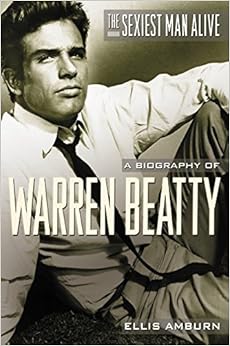
I may be dating myself, what am I saying, I KNOW I’m dating myself but there was a time back in the day when Warren Beatty (Bonnie & Clyde, Splendor in the Grass) was the finest dude, not just in Hollywood but dare I say the planet!
Warren Beatty and Natalie Wood
Beatty was gracing the covers of celebrity magazines back in the ’50’s, long before the current crop of “world’s sexiest man” covers and was dating star Natalie Wood (“Miracle on 34th” Street, “Rebel Without a Cause“) and other beautiful ingenues making women swoon with envy.
“Shampoo” (1975) is the story of George Roundy (Warren Beatty) the womanizing hairdresser who realizes too late that his life of philandering has cost him the love of his life. George’s case is that “he can’t help it, they smell so good.”
The film stars Warren Beatty, Julie Christie, and Goldie Hawn (Kate Hudson’s mom), with Lee Grant, Jack Warden, Tony Bill and in an early film appearance, Carrie Fisher. The movie is set on Election Day 1968, the day Richard Nixon was first elected as President of the United States, and was released soon after the Watergate scandal had reached its conclusion.
Goldie Hawn, Nixon, Warren Beatty
The political atmosphere provides a source of dramatic irony, since the audience, but not the characters, are aware of the direction the Nixon presidency would eventually take. However, the main theme of the film is not presidential politics but sexual politics; it is renowned for its sharp satire of late-1960s sexual and social mores. (Wikipedia)
I almost didn’t publish this post because of recent disturbing events going on right now in politics but thought no, this film isn’t about committing assault, it’s about facing your viewpoint of morality and realizing how callously you’ve been living your life.
When I first thought about posting this it was based on the politics of the ’60’s then ironically found myself in mid-sentence realizing that the controversies of the Nixon era have nothing on the despicable state of politics today.
Goldie Hawn, Julie Christie, Tony Bill, Warren Beatty
But I digress, I loved “Shampoo” because of one – watching fine Warren Beatty and two – the ending. You have to pay the piper and take responsibility for your actions. George represented a lot of guys who thought doing as many women as possible was cool and made them all that but, the truth is, what goes around, comes around.
“Shampoo” was Carrie Fisher’s first film and won Lee Grant the Academy Award for Best Supporting Actress. The film was directed by the brilliant Hal Ashby. (Harold and Maude 1971)
Other Academy nominations were:
Robert Towne (“Chinatown”) and Warren Beatty – Best Writing, Original Screenplay
Best Motion Picture (Musical or Comedy)
Best Motion Picture Actor (Musical or Comedy) – Warren Beatty
Best Motion Picture Actress (Musical or Comedy) – Julie Christie & Goldie Hawn
The lead character, George Roundy, is reportedly based on several actual hairdressers, including Jay Sebring and film producer Jon Peters, who is a former hairdresser. Sebring was brutally murdered by the Charles Manson family in 1969. According to the 2010 book Star: How Warren Beatty Seduced America by Peter Biskind, the screenwriter Towne based the character on Beverly Hills hairdresser Gene Shacove. (Wikipedia)
Jay Sebring
Jon Peters
The film had little critical praise but commercially, “Shampoo” was a great success. Produced on a budget of $4 million, the film grossed $49,407,734 domestically and $60 million at the worldwide box office. It was the fourth most successful film of 1975 by box office takings, beaten only by Jaws, One Flew Over the Cuckoo’s Nest, and The Rocky Horror Picture Show. (Wikipedia)
Henry Warren Beatty (born March 30, 1937) has been nominated for fourteen Academy Awards – four for Best Actor, four for Best Picture, two for Best Director, three for Original Screenplay, and one for Adapted Screenplay – winning Best Director for Reds (1981).
Beatty is the first and only person to have been twice nominated for acting in, directing, writing,and producing the same film – first with Heaven Can Wait (1978), which was co-written by Elaine May and co-directed by Buck Henry, and again with Reds, which he co-wrote with Trevor Griffiths.
In 1999, he was awarded the Academy’s highest honor, the Irving G. Thalberg Award. Beatty has been nominated for eighteen Golden Globe Awards, winning six, including the Golden Globe Cecil B. DeMille Award, with which he was honored in 2007.
What would the film experience be without a memorable soundtrack that sets the mood, pumps up the action and evokes nostalgic memories?
As I started writing “Jammin’ at the Movies – Music that Makes the Movies” I realized there were far too many films to note in one post, so these are a few others that make my list of movie soundtracks that are synonymous with the film itself.
“Pulp Fiction”, “Forrest Gump”, and “Saturday Night Fever” are true American classics and so are their soundtracks!
Let me know some of your most notable in the comments!
The idea of musical accompaniment has been around since silent films but with the advent of sound in the 1920’s, filmmakers were able to have direct control over the soundtrack as a device to manipulate the audience’s emotions.
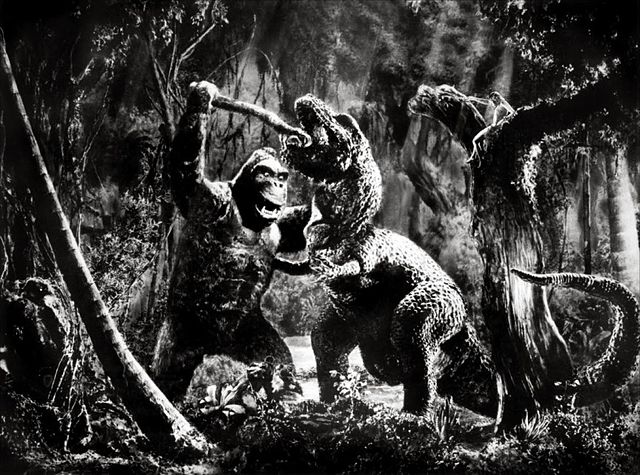
The first film to use a completely original score was written by composer Max Steiner for the classic ‘King Kong’ (1933).
Imagine Alfred Hitchcock’s “Psycho” without those driving Bernard Herrmann violins and strings during the shower scene and the ominous “dun-dun-dun” that alerted the audience to the arrival of “Jaws” thus evoking all kinds of fear. With the Soundtrack Album, audiences have the freedom to listen to and relive the memories of their favorite films at any time.
“Psycho” 1960
“Jaws” 1974
In developing his film projects Director, Quentin Tarantino approaches the movie process in this way:
Quentin Tarantino
“One of the things I do when I am starting a movie, when I’m writing a movie or when I have an idea for a film is, I go through my record collection and just start playing songs, trying to find the personality of the movie, find the spirit of the movie. Then, ‘boom,’ eventually I’ll hit one, two or three songs, or one song in particular, ‘Oh, this will be a great opening credit song.” (Tracks and Fields)
“Pulp Fiction”(1994) is the coolest film and soundtrack ever. QuentinTarantino (Oscar for Best Original Screenplay) certainly had his finger on the pulse of the vital connection music plays in conveying the attitude of this movie and put together the perfect soundtrack to complement the mood.
First of all, I would love to hang at Jack Rabbit Slims. I love all things 60’s and between the cars and the celebrity impersonators, how fun! Second, this is how you dance cool. I remember all the back in the day dances like the twist, the jerk, and the batman.
The album reached No. 21 on the Billboard 200, while Urge Overkill’s cover of the Neil Diamond song “Girl, You’ll Be a Woman Soon” peaked at No. 59 on the Billboard Hot 100.
Billboard chalked up MCA’s compilation to identifying the market niche: “Pulp Fiction…successfully spoke to those attuned to the hip, stylized nature of those particular films.” The eclectic “mix-and-match strategy” is true to the film.
“In some cases, like Pulp Fiction and Reservoir Dogs, which were not geared toward any specific demographic, the soundtracks were still very focused albums,” said Kathy Nelson, senior VP/general manager at MCA Soundtracks. “In both cases, the body of work — both the music and the film — has a specific personality.” (Wikipedia)
Academy Award-winning film “Forrest Gump” (1994) starring Tom Hanks and based on the 1986 novel of the same name by Winston Groom, will always have a special place in my heart. The genuine spirit and remarkable journey of Forrest make you root for him.
The time setting of the ’60’s was perfect with the politics of the day and the Vietnam War being the volatile flashpoint of the decade.
The 32-song soundtrack from the film was released on July 6, 1994, and re-creates the angst of a generation and is perfect for fusing the film with the troubled times.
With the exception of a lengthy suite from Alan Silvestri’s score, all the songs are previously released; the soundtrack includes songs from Fleetwood Mac, Creedence Clearwater Revival, Lynyrd Skynyrd, The Byrds, The Doors, The Mamas & the Papas, The Simon & Garfunkel, and Buffalo Springfield among others.
Music producer Joel Sill reflected on compiling the soundtrack: “We wanted to have very recognizable material that would pinpoint time periods, yet we didn’t want to interfere with what was happening cinematically.”
The soundtrack reached a peak of number 2 on the Billboard album chart and went on to sell twelve million copies and is one of the top-selling albums in the United States. (Wikipedia)
From the 1977 hit film starring John Travolta, the album was certified 15× Platinum for shipments of over 15 million copies. The album stayed atop the album charts for 24 straight weeks from January-July 1978 and stayed on Billboard‘s album charts for 120 weeks until March 1980. In the UK, the album spent 18 consecutive weeks at No. 1.
Maurice, Barry, Robin Gibb – The Bee Gees
The brothers wrote the songs “virtually in a single weekend” at Château d’Hérouville studio in France. Barry Gibb remembered the reaction when Producer Robert Stigwood and music supervisor Bill Oakes arrived and listened to the demos:
“They flipped out and said these will be great. We still had no concept of the movie, except some kind of rough script that they’d brought with them.” The album has been added to the National Recording Registry in the Library of Congress for being culturally significant. (Wikipedia)
Even more, than the incredible music, John Travolta blew me away with his club-worthy dance moves. Who knew the kid from the television show “Welcome Back Kotter” could bust a move!
Trivia – John Travolta’s mother Helen and sister Ann both appeared in minor roles in the beginning of the film. Travolta’s sister is the pizzeria waitress who serves him the pizza slices (and delivers the first dialogue), and his mother plays the woman to whom he sells the can of paint (after being late).
If you haven’t already, check out these rockin’ flicks. Perfect for a musical binge-worthy night!
The disaster genre has been around long before “The Master of Disaster” Irwin Allen came on the scene in the 1970’s when the genre came into particular prominence with the release of high-profile films such as Airport (1970), followed in quick succession by Irwin Allen’s “The Poseidon Adventure“ (1972), Earthquake (1974) and another Allen hit, “The Towering Inferno” in (1974).
These films often feature large casts of actors and multiple plotlines, focusing on the characters’ attempts to avert, escape or cope with the disaster and its aftermath.
Disaster themes are almost as old as the film medium itself. One of the earliest was Fire! (1901) made by James Williamson of England. The silent film portrayed a burning house and the firemen who arrive to quench the flames and rescue the inhabitants.
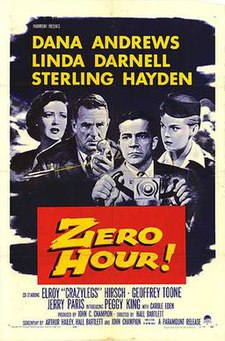
Additional precursors to the popular disaster films of the 1970s include The High and the Mighty (1954), starring John Wayne and Robert Stack as pilots of a crippled airplane attempting to cross the ocean; Zero Hour! (1957), written by Arthur Hailey (who also penned the 1968 novel Airport) about an airplane crew that succumbs to food poisoning.
“Zero Hour!” (1957)
And this is where David and Jerry Zucker and Jim Abrahams enter the picture. Being influenced by the 1957 disaster film, Zero Hour! the 3 writers crafted ideas for a script as they described the movie as a “perfectly classically structured film” according to Jerry Zucker. Abrahams later described Zero Hour! as “the serious version of Airplane!“. It was the first film script the trio wrote and completed around 1975. The film was originally called The Late Show. (Wikipedia)
In 1980 this classic and definitive homage to the disaster genre was released, “Airplane!”
Airplane! (titled Flying High! in Australia, New Zealand, South Africa, Japan and the Philippines) is the brilliant satirical parody directed and written by the incredible team of David and Jerry Zucker, Jim Abrahams, (abbreviated ZAZ) and produced by Jon Davison.
Plot: How do you handle a pilotless airplane full of crazy, food poisoned passengers, one ex-fighter pilot (and the would-be hero) with a drinking problem and a frisky auto-pilot named Otto? These are some of the random problems kinda solved in this totally off the wall, mayhem inspired comedy.
This clip of classic scenes says it all about the madness I love, “Airplane!”
The stars, Robert Stack, Lloyd Bridges and Leslie Nielsen had long established careers as dramatic, action characters before “Airplane!” They were hired because the Zucker Brothers wanted to cast the film against type although Leslie Nielsen insisted that he had always been cast against type. He originally wanted to play comedy.
Leslie Nielsen
Leslie Nielsen’s line (in response to Hays’ question ‘surely you can’t be serious’), “I am serious. And don’t call me Shirley,” was 79th on AFI’s list of the best 100 movie quotes. (Wikipedia)
The superstar cameo of the film was Barbara Billingsley. (The Beaver’s reserved mom, June Cleaver, on the 1950’s tv classic “Leave it to Beaver”) Cast against type as well, she makes an appearance as, “Jive Lady”, a woman who announces she speaks jive (slang) and can translate for two black passengers whom no one could quite understand. Miss June don’t play. 😎 Hilarious! Thanks, June.🤗✊🏽
Barbara Billingsley
“Airplane!” received universal acclaim from critics and is widely regarded as one of the best films of 1980. Although, before its release, the directors had been apprehensive due to a mediocre response at one of the pre-screenings. But the film earned its entire budget of about $3.5 million in its first weekend of release. Overall, it earned more than $83 million in box office gross for $40 million in rentals, making it the fourth highest-grossing film of 1980.
Otto, Julie Hagerty, Robert Hays
Based on 58 reviews, compiled retrospectively, Rotten Tomatoes gives the film a score of 97% judging it “Certified Fresh.” The consensus on the site reads “Though unabashedly juvenile and silly, Airplane! is nevertheless an uproarious spoof comedy full of quotable lines and slapstick gags that endure to this day.” (Wikipedia)
The film is recognized by American Film Institute in these lists:
2000: AFI’s 100 Years…100 Laughs – #10
2005: AFI’s 100 Years…100 Movie Quotes:
The film’s creators received the Writers Guild of America Award for Best Adapted Comedy, and nominations for the Golden Globe Award for Best Motion Picture – Musical or Comedy and a BAFTA Award for Best Screenplay.
In 2010, the film was selected for preservation in the United States National Film Registry by the Library of Congress as being “culturally, historically, or aesthetically significant”.
If you’re ever feeling stressed, and or depressed, just pop this little gem in the DVD player and laugh your ass off!
Seeing this black-and-white masterpiece on the big screen with an audience is a rarity in itself, but to make this screening a truly one-of-a-kind experience, writer, and director Mel Brooks will introduce the film live from the 20th Century Fox Lot in Hollywood, CA.
Mel Brooks “Young Frankenstein”
As I’ve written about before, “Young Frankenstein” is one of my all-time favorite films! Mel Brooks’ genius is on full display as he accurately fuses every Frankenstein film into one of the most hilarious ever produced.
In 2003, it was deemed “culturally, historically or aesthetically significant” by the United States National Film Preservation Board, and selected for preservation in the Library of Congress National Film Registry. On its 40th anniversary, Brooks considered it by far his finest (though not his funniest) film as a writer-director. (Wikipedia)
“Frankenstein” 1931
Dr. Frankenstein & Monster
Dr. Frankenstein & Igor
Dr. Frankenstein
The original “Frankenstein” is no longer a horror film to me since watching Mel’s take on this Universal Classic. There are so many scenes and moments from Brook’s movie that I couldn’t possibly pinpoint one. This is a reel of some of the best moments.
Young Frankenstein brings together Brooks’s inimitable style with a cast of comedy legends, including Gene Wilder as Federick Fronkensteen, Marty Feldman as shifty humpback Igor, Teri Garr as the hay-rolling lab assistant Inga, the brilliant Madeleine Kahn as Dr. Frankenstein’s high-strung fiancée Elizabeth, Peter Boyle as the kind-hearted monster, an uncredited Gene Hackman as the blind man who befriends him, and Cloris Leachman as Frau Blücher!
Check out the doctor and Frankie, Jr. “Puttin’ on the Ritz!”
Join in the fun as the young neurosurgeon (Wilder), inherits the castle of his grandfather, the famous Dr. Victor von Frankenstein. Young Frankenstein believes that the work of his grandfather is to put it in his words, “do do”, but when he discovers the book where the mad doctor describes his reanimation experiment, the light bulb comes on as he exclaims – “It could work!”.
“Dr. Frederick Frankenstein”
The film is an affectionate parody of the classic horror film genre, in particular, the various film adaptations of Mary Shelley‘s novel Frankenstein produced by Universal in the 1930s.
Most of the lab equipment used as props was created by Kenneth Strickfaden for the 1931 film Frankenstein. To help evoke the atmosphere of the earlier films, Brooks shot the picture entirely in black-and-white, a rarity in the 1970s, and employed 1930s’ style opening credits and scene transitions such as iris outs, wipes, and fades to black. The film also features a period score by Brooks’ longtime composer John Morris. (Wikipedia)
If you’ve never experienced this Mel Brooks’ gem, make sure to check out this one-night special event! And, if you’re a fan like I am, this is a great opportunity to quote your favorite lines and re-enjoy this classic on the big screen!
Extras: Behind the scenes of the Making of “Young Frankenstein”.
Tickets available online here. You can also, check with your local theater for showtimes and tickets.
Don’t miss this incredible opportunity to see the classic film on the big screen!
When I first saw this challenge on Facebook I thought, Wow! That’s an interesting and tough question. Owning thousands of videos with thousands of characters to choose from, it was difficult to come up with characters to describe me. But, being the type to rarely turn down a challenge, here goes.
I love her innocence and open heart and strive to be like her every day. She always finds the best in any situation and despite his being a “super-villain”, she even loves Gru. I describe her as my alter ego on my About page.
And we can’t forget her affection for Gru’s “dog?“, Kyle. Whatever Kyle is, when he first sees Agnes he’s terrified by HER! Maybe because she treats him like any other pet and Kyle likes to go for bad. However, by the end of the film, Agnes has won Kyle over with her infectious spirit and even has him enjoying playing dress up with her. (sort of)
KYLE
Agnes, Kyle, Mona
Gru and the Crew
And the best reason of all we’re simpatico is because Agnes loves to hang out with my favorite “little people”, The Minions!
Ever since I first saw Irene Cara as “Sparkle” on the big screen I made an instant connection. She was young, impressional, and fought fiercely for the people she loved.
The relationship between Sparkle and her big Sister, “Sister” is also a comparison point. I have big sisters that as a child idolized and thought were the most beautiful, intelligent, and compassionate women I knew. And those feelings are still true to this day. However, my big sisters are NOTHING like “Sister”. Lonette McKee’s character had a lot of issues, including the drugs.
Sister, Sparkle, and Delores
The other meaningful connection is Sparkle could sing! I was in college when the film came out and had done a little warbling with my sorority sisters. As a kid, I often wished my sisters and I could form a singing group and be even bigger than the Supremes!
However, neither of my sisters had much of a voice so, that idea went out the window. Seeing the movie inspired me to pursue my love of singing. I started auditioning and was able to realize my passion as a featured vocalist in Community Theater productions.
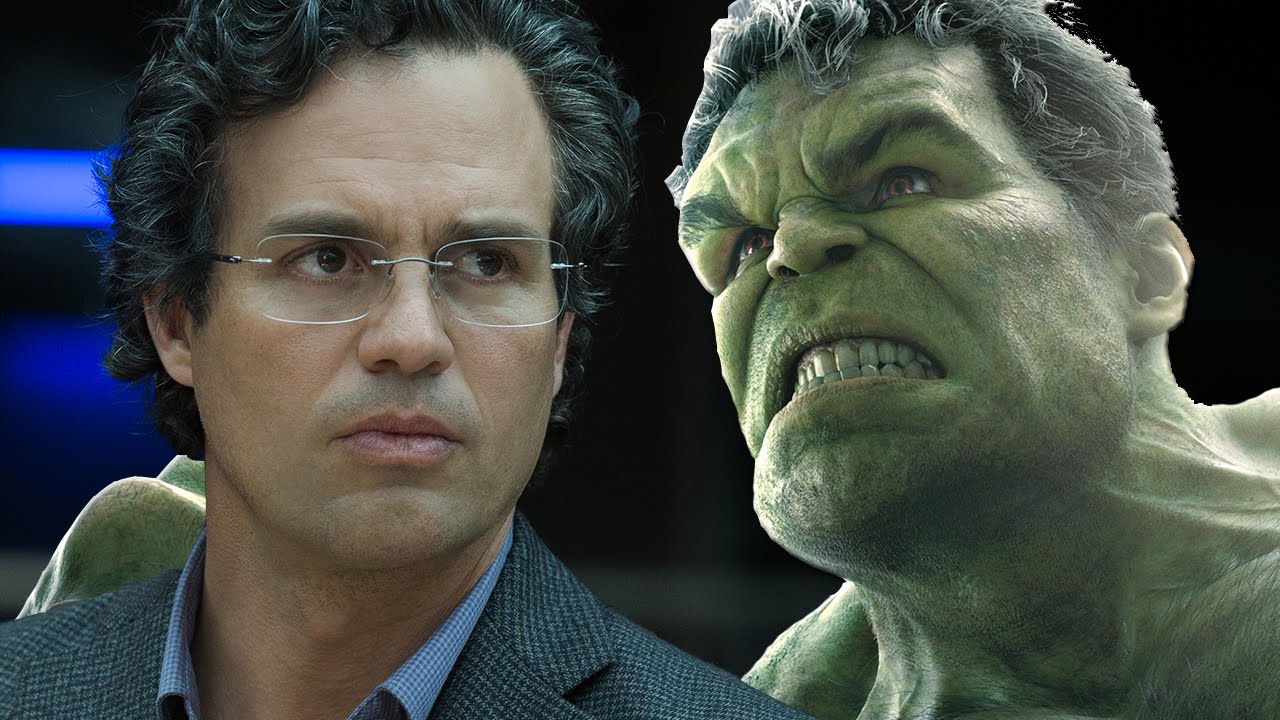
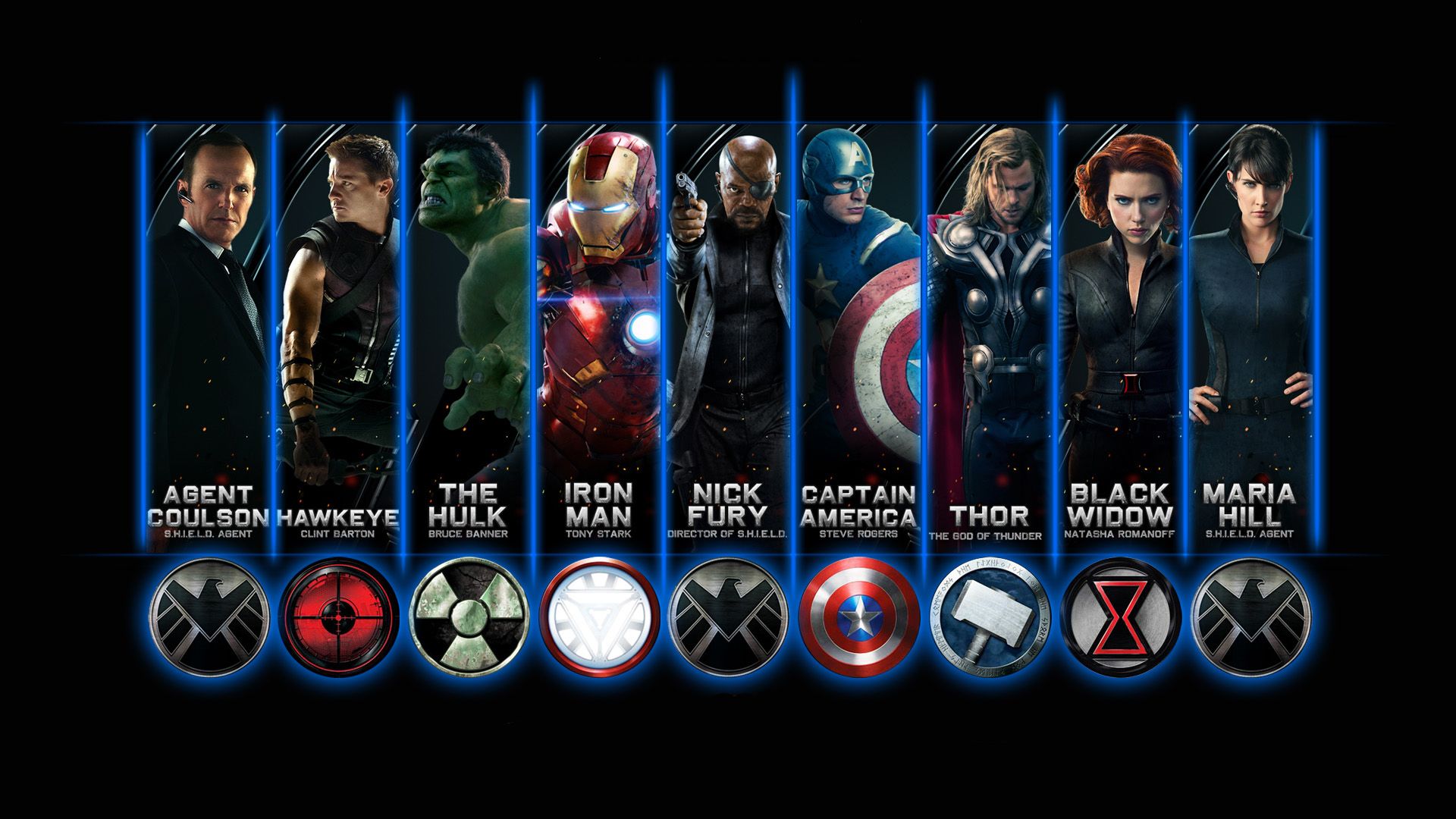
Even though I bet friends and family might find “The Black Widow” (Scarlet Johanson) an odd choice, she is a piece of my psyche. Inside my head, I can totally see me kickin’ the butts of 29 guys simultaneously. I guess she’s my Freudian id, a force to be reckoned with yes, but watching her on the screen is a great way of working out some frustrations. Fortunately, unlike the Hulk, I can keep my girl at bay ’cause, “you wouldn’t like me when I’m angry.”😎
Come on, she’s a well-rounded (no pun intended) figure. Even as an Avenger “Black Widow” takes the time to be a loving aunt to her bestie and fellow Avenger Hawkeye’s (Jeremy Renner) children. They have an enduring friendship they both treasure and despite the fact of sometimes fighting, they remain steadfast friends.
Hawkeye – Jeremy Renner
I love her nurturing relationship with Hawkeye’s children which is even more significant since the option of childbirth was taken away from her in training to be an assassin. Unlike “Black Widow” I was blessed with 2 beautiful children, so I really respect the fact she decided on this positive solution to her childless reality and not use her assassin training as a way to suppress these maternal feelings.
Did I mention she can take a dude down? And, she is the only one who can calm down an angry “Hulk”.
She’s fine just chillin’ at a friends place or if the need arises, she’s down for the fight.
Dr. Bruce Banner, Black Widow, Tony Stark, Thor, Captain America
I’m not an assassin and don’t feel the need to act out my Avengers fantasy but I do consider myself to be tough, determined, and self-sufficient.
Another reason I get into relating to her is because as an Avenger, “Black Widow” has no superpowers, she IS the superpower! A serious badass! And who knows, like the “Widow” when push comes to shove, I just might have to bust out some of my kick-ass moves.😎
The Avengers
I’ve shared my 3 characters, how about sharing yours?
This site is about how to live our life in a meaningful way by accepting complete surrender to the Almighty with purity of mind and character. It is about the eternal religion of the world i.e. Hinduism which is very liberal to anyone because there are many branches or methods to get the divinity to turn our life into an ever blissful one.
Free listening and free download (mp3) chill and down tempo music (album compilation ep single) for free (usually name your price). Full merged styles: trip-hop electro chill-hop instrumental hip-hop ambient lo-fi boombap beatmaking turntablism indie psy dub step d'n'b reggae wave sainte-pop rock alternative cinematic organic classical world jazz soul groove funk balkan .... Discover lots of underground and emerging artists from around the world.







 On a recent trip to visit family, watching the Michigan game and sharing stories, as usual, my cousin quipped, “the sheriff is near..” and we all broke out laughing visualizing the scene with Clevon Little from

















 iheartfilm