Okay, I’m a firm believer that not being shown everything can sometimes be more powerful than exposing it. We didn’t need to see the contents of the box at the end of the movie because the tension and reaction from both Morgan Freeman and Brad Pitt were palpable. Wow!
This outstanding, psychological thriller was directed by David Fincher and stars Brad Pitt, Morgan Freeman, Gwyneth Paltrow, and Kevin Spacey. It was nominated for Best Film Editing at the 68th Academy Awards but lost out to Apollo 13.
The entire movie was one of those peek through your fingers experiences. Just when you thought you’d seen it all, the next shot was more horrific than the first. What a roller coaster ride!
Believe it or not, I saw this Hitchcock classic in the theater when it first came out. I was 5-years-old and I’m still a little paranoid going into the bathroom!
Starring Anthony Perkins, and Janet Leigh, this classic horror-thriller is pure genius and a prime example why Alfred Hitchcock is the “Master of Suspense.” You believe he’s telling one story and suddenly everything is flipped on its ear. Who kills off the lead 1/3 way through the film and gets you to feel sympathetic toward the killer? I still can only watch Psycho during the daytime.
Initially, Hitch was not supported in the making of this little gem to the chagrin of “The Master.” Theater-goer lines were wrapped around the block hyped by a “No Admittance” policy after the start of the movie.
The ending shot still haunts me and remains an amazing ending to one disturbing flick!
◊◊◊
My number 1 choice for brilliant movie endings is without a doubt!
The name Keyser Söze will forever be synonymous with one of the greatest cons ever perpetrated in cinema history.
This crime thriller masterpiece was directed by Bryan Singer and written by Christopher McQuarrie. It stars Kevin Spacey, Gabriel Byrne, Benicio del Toro, Kevin Pollak, Chazz Palminteri, and Stephen Baldwin.
Kevin Spacey’s portrayal of Roger “Verbal” Kint is compelling and flawless! He’s placed in numerous “best villain” lists over the years, including AFI’s 100 Years…100 Heroes & Villains. Spacey won the Academy Award for Best Supporting Actor, turning him from a character actor into a star.
I have so many favorite scenes, it’s hard to pick just one. However, besides the ending, this rates. I crack up just thinking about it, so posting this was a hilarious endeavor!
One of the best parts of watching this film has got to be re-watching it to look back at all the elements of this fantastic set-up!
Love it, Love it, Love it!!
◊◊◊
These are just a few of the myriad of essential movies to ponder.
Let me know some of your favorites in the comments.
I was working on a post the other day and the TV show Nothing but Trailers was on in the background. It got me thinking about some of my all-time favorites and what constitutes a great trailer.
First of all, it can’t just be a series of scenes from the movie. That really irks me! What’s the point of me going if you’ve already given me your best shots? Just lazy.
An excellent trailer peaks your curiosity gets your heart stirring and demands that you’re first in line to see it. An incredible trailer gives you minimal information but builds the anticipation with atmospheric music, punctuation shots, and an ending that elicits the core emotion of the film.
This is the criteria I applied to the following trailers and is the basis for them being some of the most memorable.
◊◊◊◊◊◊
Number One has got to be the 1979 sci-fi classic – Alien. “In space, no one can hear you scream.”
Starring Sigourney Weaver, director Ridley Scott scared the crap out of me and the little boy sitting in front of me at the theater. Oh, and to make matters worse, I was pregnant at the time. Yikes! (if you’ve seen it you understand, if you haven’t, what?? You must!) And my girl Sigourney Weaver showed the world what a badass woman in space looks like.
Sigourney Weaver
This is the epitome of an incredible trailer. Little bits and moments and truly haunting music. My heart was racing and I had no idea of what I’d just seen.
The visuals were outstanding! There was absolutely nothing familiar in the images coming off the screen. The Alien and its accompanying elements were designed by Swiss surrealist artist H. R. Giger. (I don’t know how he slept with those images in his head) The film received both critical acclaim and box office success, receiving an Academy Award for Best Visual Effects.
◊◊◊◊◊◊
Number Two is the sci-fi thriller –The Dark Knight (2008) – “Why So Serious?”
First of all, Heath Ledger. Second of all, Heath Ledger!! Even in the trailer, his intensity shines thru. He draws you in and you’re compelled to see more. His Oscar-winning performance was incredible and the most talked about that year.
Ledger almost made a complete sweep of over twenty awards for acting, including the Academy Award for Best Supporting Actor, Screen Actors Guild Award for Best Supporting Actor, the Golden Globe Award for Best Supporting Actor – Motion Picture, and the BAFTA Award for Best Actor in a Supporting Role.
Heath Ledger
Unfortunately, we lost him, but his genius as The Joker lives on. Starring Christian Bale as the caped crusader and directed by Christopher Nolan, when I saw this trailer I knew where I was going to be on opening night. Totally lived up to the hype.
◊◊◊◊◊◊
Last, but certainly not least of this compilation is the original master of suspense, Alfred Hitchcock’s – Psycho (1960) “…she just goes a little mad sometimes.”
This trailer shows Alfred Hitchcock taught the world just how horror is done. Fits every criterion for an incredible movie trailer and then some. Starring Janet Leigh and Anthony Perkins, my heart is racing right now re-visiting this magnificent piece of cinema.
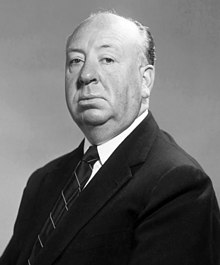
Sir Alfred Hitchcock – (13 August 1899 – 29 April 1980)
Hitch’s stylistic trademarks include the use of camera movement that mimics a person’s gaze, forcing viewers to engage in a form of voyeurism. In addition, he framed shots to maximize anxiety, fear, or empathy and used innovative forms of film editing. (Wikipedia)
To quote me, “An incredible trailer gives you minimal information but builds the anticipation with atmospheric music, punctuation shots, and an ending that elicits the core emotion of the film.”
An unquestionable classic!
◊◊◊◊◊◊◊◊◊
Now that I’ve shared some of my faves, I’d love to hear some of yours! 😎
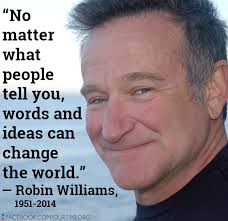
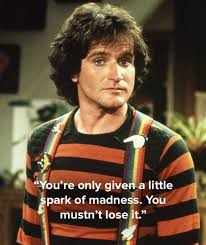
I love Robin Williams. His talent was beyond compare. I’ve written about his unique gifts in a previous post and how deeply his passing affected me. So, I was very excited to see that PBS is paying tribute tonight at 10pm to this comedic genius.
This tribute to actor and comedian Robin Williams features one of his last full-length interviews for the Pioneers of Television series, including never-before-seen comments on his life and comedic and dramatic work, as well as tributes to Williams by those who knew and worked with him, and clips from his career.
In 1998, Williams won the Academy Award for Best Supporting Actor for his performance as Dr. Sean Maguire in Good Will Hunting. In addition, Williams was nominated thrice for Best Actor for his performances in Good Morning, Vietnam, Dead Poets Society and The Fisher King. He also received twoPrimetime Emmy Awards, six Golden Globe Awards, two Screen Actors Guild Awards, and four Grammy Awards throughout his career, and was inducted as a Disney Legend in 2009. (Wikipedia)
Join PBS Tuesday, July 19 at 10 PM for a remembrance of one of the pioneers of comedy, Robin Williams.
As I write on my About page, I’ve loved movies ever since I was a kid at the Saturday matinees. When the VCR was developed, I was in heaven. The ability to view my favorite films whenever I wanted was a day I had envisioned since childhood.
I have two children and raised them to be movie junkies, as well. We frequently have conversations laced with film quotes like – “It doesn’t have to be gold” from the Billy Wilder classic, “Some Like it Hot!” or “Do or do not. There is no try.” from the wise Yoda in “Empire Strikes Back”.
This post features some of my favorite, most notable quotes from my best-loved movies. There are way too many to name, but here goes:
Trivia: Marlon Brando boycotted the Academy Awards and turned down his Oscar for Best Actor in protest of the treatment of Native Americans in film and on television. Al Pacino also was a no-show for being nominated as Best Supporting Actor and not Best Actor. He had more screen time so didn’t appreciate the slight.
This Jack Lemmon, Tony Curtis, Marilyn Monroe comedy vehicle has always been close to my heart because, for its time, was the most subversive film I’d ever seen. And I mean that in a good way! Cross-dressing, gay marriage, it’s brilliant! In my top 5.
Tom Hanks “made his bones” to quote The Godfather in this remarkable cinematic triumph. Forrest Gump will probably go down as one of the most quotable films of all time! “Mama always said life was like a box of chocolates, you never know what you’re gonna get”.
1939 is considered to be the most amazing year in the motion picture industry for the quality of films and audience attendance. “Gone With the Wind”, “Mr. Smith Goes to Washington” and “The Wizard of Oz”, which is one of the most beloved works of our time. It continues to tug at our heart strings with every generation.
“Some people without brains do an awful lot of talking.” Scarecrow
This group is just a sampling of some of the best. Stay tuned for Part Two of the Most Quotable Films. In the meantime:
If you’re a movie junkie like me you probably not only know the stars of the film but the Director, The Cinematographer, the Editor, Writers and possibly the Key Grip. The faces behind the camera.
If you attend a movie with me, be prepared to stay through the end credits. I feel it’s imperative to acknowledge those artists who are responsible for the project. Staying for the credits also gives you a foundation to critique a film based on the direction, writing, and editing. Whether or not to see a movie based on a Director’s previous track record or the Cinematographer’s eye for the visuals.
This month is dedicated to educating and paying homage to the artists who help put it all together. Let’s begin with one of the top 2 of my favorite Directors, Billy Wilder.
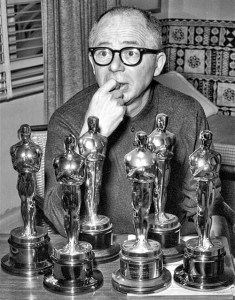
Billy Wilder
Billy Wilder (June 22, 1906 – March 27, 2002) was an Austrian-born American filmmaker, screenwriter, producer, artist and journalist, whose career spanned more than fifty years and sixty films. He is regarded as one of the most brilliant and versatile filmmakers of Hollywood’s golden age.
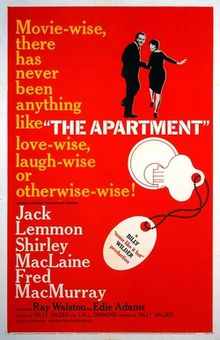
With The Apartment, (starring Jack Lemmon, Shirley MacLaine, and Fred MacMurray) Wilder became the first person to win Academy Awards as the producer, director, and screenwriter for the same film. “The Apartment” was nominated for ten Academy Awards and won five, including Best Picture.
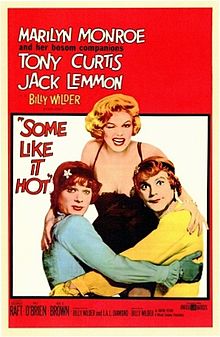
I love Billy Wilder because of his versatility in films and his testing the boundaries of societal norms. The first movie that comes to mind with his pushing the boundaries is “Some Like it Hot” 1959 starring Marilyn Monroe, Jack Lemmon, and Tony Curtis.
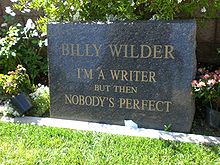
The plot revolves around two musicians who dress in drag in order to escape from mafia gangsters whom they witnessed commit the Saint Valentine’s Day Massacre. These are the final lines of the film delivered by (Daphne/Jerry) Lemmon and Joe E. Brown (Osgood) in regards to their pending marriage: Daphne/Jerry: But you don’t understand, Osgood![Whips off his wig, exasperated, and changes to a manly voice]Uh, I’m a man! Osgood: [Looks at him then turns back, unperturbed]Well, nobody’s perfect!” Wow! for 1959 that was pretty radical.
“Some Like It Hot” is considered to be one of the greatest film comedies of all time. It was voted as the top comedy film by the American Film Institute on their list on AFI’s 100 Years… 100 Laughs poll in 2000. The film is also notable for featuring cross-dressing and homosexuality, which led to it being produced without approval from the Motion Picture Production Code. The Code was the set of industry moral guidelines that was applied to most American motion pictures released by major studios from 1930 to 1968. The Production Code had been gradually weakening in its scope during the early 1950s due to increasing societal tolerance for previously taboo topics in film, but it was still officially enforced. The overwhelming success of “Some Like It Hot” was a final nail in the coffin for the Hays Code.
Wilder became a screenwriter in the late 1920s while living in Berlin. After the rise of the Nazi Party, Wilder, who was Jewish, left for Paris, where he made his directorial debut. He moved to Hollywood in 1933, and in 1939, he had a hit when he co-wrote the screenplay for the screwball comedy Ninotchka. Wilder established his directorial reputation with Double Indemnity (1944), a film noir he co-wrote with crime novelist Raymond Chandler. Wilder earned the Best Director and Best Screenplay Academy Awards for the adaptation of a Charles R. Jackson story The Lost Weekend (1945), about alcoholism. In 1950, Wilder co-wrote and directed the critically acclaimed Sunset Boulevard.
Wilder was recognized with the American Film Institute (AFI) Life Achievement Award in 1986. In 1988, Wilder was awarded the Irving G. Thalberg Memorial Award. In 1993, he was awarded the National Medal of Arts.
Wilder received a total of twenty-one Academy Award nominations; eight for Best Director, twelve for writing, and one as the producer of Best Picture. With eight nominations for Academy Award for Best Director, Wilder is, together with Martin Scorsese, the second most nominated director in the history of the Academy Awards, behind William Wyler, and the second most nominated screenwriter behind Woody Allen.
Wilder won a total of six Oscars: Best Director for The Lost Weekend and The Apartment, Best Screenplay for The Lost Weekend, Sunset Blvd, The Apartment, and Best Picture for The Apartment. In addition, he received the Irving G. Thalberg Memorial Award in 1988.
Wilder died in 2002 of pneumonia at the age of 95 after battling health problems, including cancer, in Los Angeles and was interred in the Westwood Village Memorial Park Cemetery in Westwood, Los Angeles near Jack Lemmon and Walter Matthau. Marilyn Monroe’s crypt is located in the same cemetery. Wilder died the same day as two other comedy legends: Milton Berle and Dudley Moore. The next day, French newspaper Le Monde titled its first-page obituary, “Billy Wilder dies. Nobody’s perfect”, quoting the final gag line in “Some Like It Hot”.
“Lady Sings the Blues” (1972) is the biopic of the troubled life and career of the legendary Jazz singer, Billie Holiday. Loosely based on her 1956 autobiography which, in turn, took its title from one of Holiday’s most popular songs. It was produced by Motown Productions for Paramount Pictures and directed by Sidney J. Furie.
When I first heard Diana Ross had been cast as Billie Holiday I thought, she can’t act and will never pull it off. I wasn’t a big Diana Ross fan but when I saw the movie I had to give her credit for her phenomenal, Oscar-nominated performance. She lost to Liza Minnelli in “Cabaret”, but I thought Ross deserved the award.
The opening sequence (which was shot in black and white in still pictures) made me sit up and go, whoa, she’s serious. Diana Ross, the glamorous diva wore no makeup and looked the part of a heroin addict. The movie overall was a triumph not only for Ross but the incredible cast including – Billy Dee Williams as Holiday’s boyfriend Louis McKay, and Richard Pryor as Piano Man.
(In 1936, New York City, Billie Holiday (Diana Ross) is arrested on a drugs charge.)
The story takes us from Billie’s tumultuous youth when in 1928 she is raped in the Baltimore brothel where she works as a housekeeper. She runs away to her mother who proceeds to get her a job in another brothel in the Harlem section of New York where she becomes a prostitute. Seeing that her life is going nowhere, she quits and heads to a local nightclub to become a showgirl. Billie has always had a love of music and has a remarkable voice. After “Piano Man” (Richard Pryor) accompanies Billie on the song”All of Me“, Jerry, the club owner, books her as a singer in the show.
Billie Holiday
Eleanora Fagan (April 7, 1915 – July 17, 1959), professionally known as Billie Holiday lived a life that was an American tragedy full of turmoil, racism, and drug abuse. Despite all this we are left with her incredible song catalog and heartfelt performances.
Holiday had a tremendous influence on jazz music and pop singing. Her vocal style, strongly inspired by jazz instrumentalists, pioneered a new way of manipulating phrasing and tempo. “God Bless the Child” became Holiday’s most popular and covered record. It reached number 25 on the charts in 1941 and was third in Billboard’s songs of the year, selling over a million records. In 1976, the song was added to the Grammy Hall of Fame.
Billie Holiday died of cirrhosis of the liver in 1959 when she was 44. The biggest triumph of her career was her sold-out, standing ovation performance at Carnegie Hall.
Awards and Honors
“Lady Sings the Blues” was nominated for five Academy Awards. The nominations were for Best Actress in a Leading Role (Diana Ross), Best Art Direction-Set Decoration (Carl Anderson and Reg Allen), Best Costume Design (Norma Koch), Best Music, Original Song Score and Adaptation (Gil Askey & Michel Legrand) and Best Writing, Story and Screenplay Based on Factual Material or Material Not Previously Published or Produced.The film was also screened at the 1973 Cannes Film Festival but was not entered into the main competition.
Soundtrack
Motown released a hugely successful soundtrack double-album of Ross’ recordings of Billie Holiday songs from the film, also titled Lady Sings the Blues. The album went to number one on the Billboard Hot 200 Album Charts, for the week-ending dates of April 7 and 14, 1973.
A long time ago in a galaxy far, far away…Women were the driving force behind Hollywood and the movies. This is the third part of a series paying homage to contemporary women filmmakers who broke the glass ceiling and wrote and directed the films that took 86 years from pioneer Lois Weber’s day to achieve. Hollywood is still run by men but these women prove that it may be a man’s world but it would be nothing without a woman or a girl. Thanks, James Brown for the lyric.
In 86 years, only four women have been nominated for the Best Director Oscar. Only one, Kathryn Bigelow, has won.
Women filmmakers nominated for the Best Director:Lina Wertmüller for Seven Beauties (1976), Jane Campion for The Piano (1993), Sofia Coppola for Lost in Translation (2003), and Kathryn Bigelow for The Hurt Locker (2009).
Sofia Coppola was thefirst American woman to ever be nominatedfor Best Director for the 2003 movie, “Lost in Translation.”
◊◊◊◊◊◊
Kathryn Ann Bigelow ( born November 27, 1951) is an American director, producer, and writer. Her films include the vampire Western horror film Near Dark (1987), the action crime film Point Break (1991), the controversial science fiction action thriller Strange Days (1995), the mystery thriller The Weight of Water (2000), the submarine thriller K-19: The Widowmaker (2002), the war film The Hurt Locker (2009), the action thriller war film Zero Dark Thirty (2012), and the short film Last Days of Ivory (2014). The Hurt Locker won the 2009 Academy Award for Best Picture, won the BAFTA Award for Best Film, and was nominated for the 2009 Golden Globe Award for Best Drama.
Kathryn Ann Bigelow
Bigelow’s trilogy of action films — Blue Steel, Point Break, and Strange Days — are looked at by critics as rethinking the conventions of action cinema while exploring gendered and racial politics. In her career, Bigelow has become recognizable as both a Hollywood brand and an auteur.
Married to director James Cameron from 1989-1991, she and Cameron were both nominated for Best Director at the 2010 82nd Academy Awards, which Bigelow won. Yay, Kathryn!
Sofia Coppola
Sofia Carmina Coppola (born May 14, 1971) is an American screenwriter, director, producer, and actress. In 2003, she received the Academy Award for Best Original Screenplay for the comedy-drama Lost in Translation and became the third woman to be nominated for an Academy Award for Best Director. Her nomination for Best Director made her the first American woman in history to be nominated in that category, and the third woman overall, after Lina Wertmüller and Jane Campion. In 2010, with the drama Somewhere, she became the first American woman (and fourth American filmmaker) to win the Golden Lion, the top prize at the Venice Film Festival. Her father is the director, producer, and screenwriter Francis Ford Coppola.
She made her feature film directing debut with The Virgin Suicides (1999). It received critical acclaim upon its premiere in North America at the 2000 Sundance Film Festival and was released later that year. If you haven’t seen it, check it out. It’s brilliant and makes you think about parenting skills or the lack thereof.
◊◊◊◊◊◊
African American Women Filmmakers
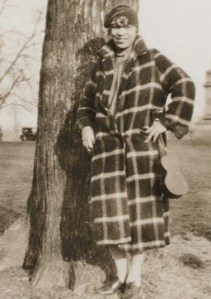
Zora Neale Hurston
(January 7, 1891 – January 28, 1960)
Better known for her work as a novelist, Zora Neale Hurston could be, according to an essay by academic Gloria Gibson, the first African-American woman filmmaker. The film footage, which includes Children’s Games (1928), Logging (1928), and Baptism (1929), appears to be from her work as a student of anthropology under the guidance of famed anthropologist, professor, and mentor, Dr. Franz Boas of Columbia University.
A graduate of Barnard College (B.A. in anthropology in 1928) and a Guggenheim fellow, Hurston traveled back to a South similar to her hometown of Eatonville, Florida (one of the first all-black towns to be incorporated in the United States) to capture a variety of short takes of African-American life. Ethnographic in nature, the films reflect a focus of folklorists of that time period who believed that “…cultural performance and beliefs must be expeditiously collected and documented because they would soon be gone forever” (Gloria Gibson).
During a period of financial and medical difficulties, Hurston was forced to enter St. Lucie County Welfare Home, where she suffered a stroke. She died of hypertensive heart disease on January 28, 1960, and was buried at the Garden of Heavenly Rest in Fort Pierce, Florida. Sadly, her remains were in an unmarked grave until 1973 when novelist Alice Walker and literary scholar Charlotte Hunt found an unmarked grave in the general area where Hurston had been buried and decided to mark it as hers.
Our future:
Ava DuVernay – Current/future generation screenwriter/director – She would have been the first black woman nominated for best director in Oscar history, and just the fifth woman, following Lina Wertmüller for Seven Beauties, Jane Campion for The Piano, Sofia Coppola for Lost in Translation, and Kathryn Bigelow for The Hurt Locker. Instead, she’s been added to the list of female directors who have seen their films get nominated while they’ve been snubbed.
Ava DuVernay
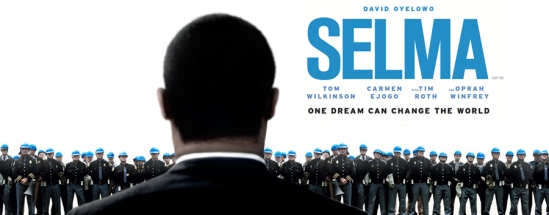
Ava Marie DuVernay (born August 24, 1972) is an American director, screenwriter, film marketer, and film distributor. At the 2012 Sundance Film Festival, DuVernay won the Best Director Prize for her second feature film Middle of Nowhere, becoming the first African-American woman to win the award. For her work in Selma, DuVernay is the first black woman director to be nominated for a Golden Globe Award. With Selma, she is also the first black woman director to have their film nominated for the Academy Award for Best Picture.
In 2015, it was announced that DuVernay would be writing, producing, and directing her next project, Queen Sugar which is an upcoming American drama television series, created, directed and executive produced by Ava DuVernay alongside Oprah Winfrey. The series is based on the novel of the same name by Natalie Baszile.The series is set to air on the Oprah Winfrey Network.
Women filmmakers are essential to the stories and voices of Hollywood. We’ve made some progress but we still have a long way to go!
At first, I was skeptical on how this history would be portrayed. I didn’t want a melodrama about Bloody Sunday and those on the front lines of the Civil Rights Movement. But, Director, Ava DuVernay did an incredible job and for me, the film should be included as part of the historical record.
Selma was a turning point in the Civil Rights Movement. In your living room. In your face. The first march took place on March 7, 1965, organized locally by SCLC Director of Direct Action James Bevel, who was directing SCLC’s Selma Voting Rights Movement. State troopers and county posse men attacked the unarmed marchers with billy clubs and tear gas after they passed over the county line, and the event became known as Bloody Sunday. Law enforcement beat activist Amelia Boynton unconscious, and the media publicized worldwide a picture of her lying wounded on the bridge.
Selmahad four Golden Globe Award nominations, including Best Motion Picture – Drama, Best Director, and Best Actor, and won for Best Original Song. It was also nominated for Best Picture and won Best Original Song at the 87th Academy Awards.
Whether you know the history or just learning, I consider the film Selma essential viewing for a pivotal moment in the Civil Rights Movement. A Movement which we must always remember and never forget as …
iheartfilm is dedicating the month of November to the lesson of Gratitude in films; the quality of being thankful.
This is a re-post from last year. It so fits the theme of gratitude and is my official movie to kick-off the holiday season. We lost Maureen O’Hara (Doris) last month (more on the late actress here) so this is also a tribute to her career and role in this holiday classic. Enjoy!
Today marks the start of the holiday season, but it doesn’t officially kick off for me until I’ve watched the Thanksgiving Day Parade and one of my favorite holiday films, Miracle on 34th Street (1947).
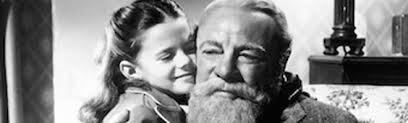
Until I see Santa arrive at the end of the parade there can be no Christmas Tree, tinsel, ornaments or stockings. This has been a tradition of mine since I was a kid. Without a doubt, Edmund Gwenn is Santa Claus. No matter what other films he’s made, each character turns into Kris Kringle. (he won the Academy Award for Best Supporting Actor) Gwenn played a cockney assassin in Hitchcock’s Foreign Correspondent in 1940, but all I could scream was “Santa, don’t throw that man off the ledge!”
Natalie Wood was precious as Susan, the precocious daughter of Maureen O’Hara (Doris) who doesn’t believe in fairy tales and attends a “progressive” school. Natalie Wood had an illustrious career until her death in 1981. She was able to make the transition from child star to ingenue starring opposite James Dean in Rebel Without a Cause (1955) and Warren Beatty in Splendor in the Grass (1961). Known as a loving, giving person, as well as a star, she’s always had a special place in my heart.
Doris is cynical as a result of a bitter divorce so she’s raising her daughter to be practical and sensible. None of this believing in fairy tales and Santa crap. All was going well until Doris – the Macy’s parade coordinator – asks Kris to replace the drunken Santa originally set for the Macy’s Thanksgiving Parade. Kris is a big hit and becomes Macy’s official Santa resulting in a personal relationship with Doris and Susan.
Kris is an immediate influence teaching Susan it’s okay to pretend after she tells him the other kids don’t play with her because she won’t join in their game and act like a zoo animal.
The production took flack from the Catholic League of Decency because how dare you depict a divorced woman with a successful career and a young child as a “normal family.” Yep, 1940’s mentality and morality were hard at work.
Susan learning to act like a monkey!
Just as Doris is learning to have more faith in life and Susan is embracing imagination, Kris’s sanity is questioned and a legal battle ensues to prove that not only is he sane but the one and only Santa Claus. Fred (John Payne) who is Kris’s lawyer and Doris’s boyfriend, understands the importance of the spirit of Santa especially in the lives of Susan and Doris.
Kris is exonerated and Christmas day has arrived. Susan has asked for a very special present and is disappointed at the Christmas party to see it isn’t under the tree. Doris, in a refreshing change of heart, tells Susan she must have faith.
But, Santa Claus moves in mysterious ways and in the end teaches them both the true value of faith and miracles.
In a previous post I talked about maybe being a little anal about the rules for Saturday and Sunday afternoon movie watching. I shared my rules for Saturday afternoon movie viewing which is B-horror and science fiction. I also shared 3 of my favorite flicks. The Blob (1958), The Incredible Shrinking Man (1957) and The Tingler (1959). (hope you check ’em out)
So, for Part 2 I’m showcasing Sunday and my criteria for some great classic melodrama.
I love melodramas because they can be so over the top and cathartic (think movie therapy) and there’s no better day to indulge than on a lazy Sunday, vegging on the couch, better yet if it’s a rainy day.
According to dictionary.com:
Melodrama – Exaggerated and emotional or sentimental, sensational or sensationalized: over dramatic.
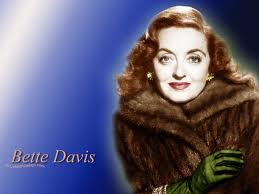
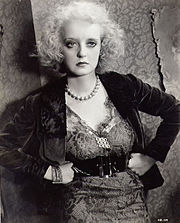
Bette Davis is my favorite Melodrama Diva! Talk about emotional and dramatic, she had those attitudes down pat. With her I find myself either talking back to my TV screen or weeping. (this is why rain helps) So, let’s find out about “The First Lady of the American Screen:
Bette was known for her no-nonsense, no-holds barred personality and wasn’t afraid to take on unsympathetic character roles. In the RKO film Of Human Bondage (1934), she played such a character as Mildred, the cruel and vicious waitress. A film adaptation of the 1915 novel of the same name by W. Somerset Maugham. This melodramatic adaptation about a crippled doctor’s destructive and compulsive passion for this coarse waitress was advertised with the tagline on one of its posters: “The Love That Lifted a Man to Paradise…and Hurled Him Back to Earth Again.”
In her 1st major, critically acclaimed part she insisted on looking hideous to depict the ravages of the disease tuberculosis on the human body. She wasn’t nominated for an Oscar but so impressed fellow artists that they insisted she be a write-in on the ballot.
Let’s take a look at her 10 Oscar nominations and 2 wins:
1935: Won for Dangerous, as a self-destructive, alcoholic actress (really a make-up for not winning Of Human Bondage)
1938: Won for Jezebel, as a self absorbed 1850’s southern belle whose insistence on wearing a red-dress to a formal affair (white = chaste) brings scandal and disapproval. Her man “Pres” Henry Fonda was too through with her.
1939: Nominated for Dark Victory, as Judith Traherne, an impetuous, terminally ill Long Island socialite. (yes that’s Bette with a drunken Ronald Reagan) Big time tear-jerker! – Bette’s favorite!
1940: Nominated for The Letter, as a low-down, adulterous murderer who has absolutely no remorse for blowing her lover away. However, karma is a bitch.
1941: Nominated for The Little Foxes, as Southern aristocrat Regina Giddens – that girl put the cold in cold-blooded.
1942: Nominated for Now, Voyager, as Charlotte Vale – a dowdy, overweight, spinster, abused by her mother but fights back and achieves a starling transformation in body and spirit. An incredible performance! My absolute favorite Bette Davis role!
Charlotte on the edge of a well deserved nervous breakdown:
Charlotte’s journey:
1944: Nominated for Mr. Skeffington, as Fanny Skeffington, a woman so conceited that she tries to steal her daughter’s boyfriend, loses her looks after an illness but still has the nerve to treat her husband like dirt and still believe she can have any man – no way. In the end she learns the hard way that “a woman is beautiful when she’s loved and only then.” (too bad it’s after her husband goes blind in a concentration camp)
1950: Nominated for All About Eve, as Margo Channing an insecure Broadway star challenged by the younger, conniving Eve – “Fasten your seat-belts, it’s going to be a bumpy night.” It was selected in 1990 for preservation in the United States National Film Registry and was among the first 50 films to be registered.
1952: Nominated for The Star, as Maggie, a washed-up actress trying to revive her career. Notably, at this time in Bette Davis’ career, she was struggling for roles despite her body of work. Bette’s ego was blamed.
1962: Nominated for What Ever Happened to Baby Jane?, as the demented Baby Jane Hudson who tortures and terrorizes her sister Blanche (Joan Crawford) Much like their real life rivalry. This role renewed her success and paved the way for other deranged characters in such films as: Hush, Hush Sweet Charlotte (1964) and The Nanny (1965)
♦♦♦♦
Bette continued to perform in film and on television in the 70’s and 80’s. In 1983 at the age of 75 she had a mastectomy as a result of breast cancer. Nine days later she suffered a stroke. Despite her failing health she continued to work until her death in 1989.
This is an in-depth retrospect of “The First Lady of the American Screen”
This site is about how to live our life in a meaningful way by accepting complete surrender to the Almighty with purity of mind and character. It is about the eternal religion of the world i.e. Hinduism which is very liberal to anyone because there are many branches or methods to get the divinity to turn our life into an ever blissful one.
Free listening and free download (mp3) chill and down tempo music (album compilation ep single) for free (usually name your price). Full merged styles: trip-hop electro chill-hop instrumental hip-hop ambient lo-fi boombap beatmaking turntablism indie psy dub step d'n'b reggae wave sainte-pop rock alternative cinematic organic classical world jazz soul groove funk balkan .... Discover lots of underground and emerging artists from around the world.



.jpg)
















 iheartfilm