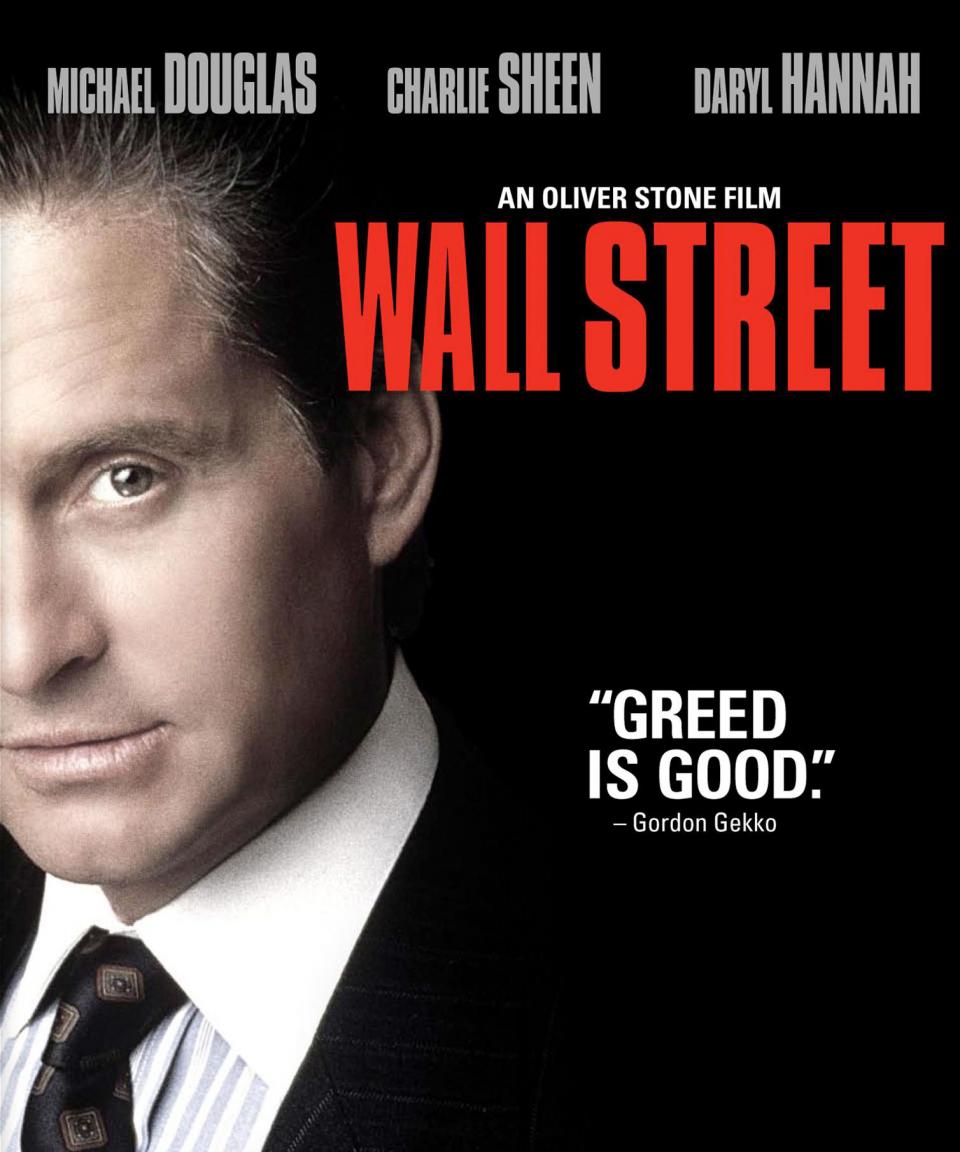
In this riveting behind-the-scenes look at big business in the 1980s, an ambitious young broker (Charlie Sheen) is lured into the illegal, lucrative world of corporate espionage when he is seduced by the power, status and financial wizardry of Wall Street legend Gordon Gekko ( Michael Douglas in his Oscar-winning performance).
But, he soon discovers that the pursuit of overnight riches comes at a price that’s too high to pay. Daryl Hannah and (Martin Sheen‘s) co-star in Oliver Stone’s gripping morality tale about the American dream gone wrong. (Fathom Events)
This special 30th-Anniversary event also includes a unique look at ‘Greed is Good”, a retrospective.
When I experienced “Wall Street” at its release I thought it hit the nail on the head as far as the state of Ronald Reagan’s America. All about the Benjamins, this country ventured down a road we continue to travel, with even more disastrous results – “Citizens United”, “Corporations are People”, “Enron”, “The Worse Recession since the Great Depression”, all in the name of “Greed is Good”.
Stone made the film as a tribute to his father, Lou Stone, a stockbroker during the Great Depression. The character of Gekko is said to be a composite of several people, including Dennis Levine, Ivan Boesky, Carl Icahn, (endorsed Trump for the 2016 U.S. presidential election) Asher Edelman, Michael Ovitz, Michael Milken, and Stone himself. The character of Sir Lawrence Wildman, meanwhile, was modeled on the prominent British financier and corporate raider Sir James Goldsmith. (Wikipedia)
Check out “Wall Street” in a theater near you and take a look back at the not so distant past to fully understand why the rich get richer and the poor beg for healthcare. Brilliantly directed by Oliver Stone, it reminds us that if we don’t know our history we are bound to repeat it.
Believe it or not, I appreciate being corrected and kept on my toes about the facts and details of film history.
Thanks to the observant eye of one of my fabulous readers, I’m making a correction to a previous post about “Cabin in the Sky”. I labeled it as the first all black cast and musical which it was not.
Spencer Williams was an American actor, writer, director, and producer whose early pioneering work in African-American or “race” films was eclipsed in fame by his role as one of the title characters in the equally pioneering and also controversial 1950s sitcom The Amos ‘n Andy Show (1951). (IMDb)
Directed by Arvid E. Gillstrom, the plot of “The Melancholy Dame” involves a nightclub owner’s wife (Evelyn Preer), jealous of his attentions to his star singer, scheming to get her fired. The look on the wife’s face from the opening frame says it all!
I can’t believe I found a copy of the film (20 min.) on YouTube.
The first two full-length films with all black casts were “Hearts in Dixie” (1929) starring Daniel Haynes, Nina Mae McKinney, and Victoria Spivey and “Hallelujah” (1929) which starred Clarence Muse, Stepin’ Fetchit, and Mildred Washington. “Hearts in Dixie” was also the first all black-oriented all-talking film from a major company. (The Chronical History of the Negro in America)
“Hearts in Dixie” celebrates African-American music and dance and was released by Fox Film Corporation just months before Hallelujah,produced by competitor Metro-Goldwyn-Mayer. The director of Hearts in Dixie was Paul Sloane. Walter Weems wrote the screenplay, and William Fox was the producer. (Wikipedia)
“Hearts in Dixie” unfolds as a series of sketches of life among American blacks. It featured characters with dignity, who took action on their own, and who were not slaves. The plot focuses on Grandfather Nappus (Clarence Muse), his daughter, Chloe (Bernice Pilot), her young son, Chinaquapin (Eugene Jackson), and her husband, Gummy (Stepin Fetchit).
To make certain his grandson Chinaquapin does not end up like his father or become tainted by the superstitions that dominate the community, the grandfather decides to send the boy away.
“Hallelujah”(1929), was the first all black musical and was directed by King Vidor and produced by MGM studios. It was intended for a general audience and was considered so risky a venture by MGM that they required King Vidor to invest his own salary in the production.
Vidor expressed an interest in “showing the Southern Negro as he is”(whatever that means) and attempted to present a relatively non-stereotyped view of African-American life.
“Hallelujah!” was King Vidor’s first sound film, and combined sound recorded on location and sound recorded post-production in Hollywood. King Vidor was nominated for a Best Director Oscar for the film.
It was the first major studio musical and the first of its kind in Hollywood history. In 2008, “Hallelujah!” was selected for preservation in the United States National Film Registry by the Library of Congress as being “culturally, historically, or aesthetically significant.”
Vidor thought the time was right to test the waters of racial tolerance with a tale of sex, murder, religion, and music enacted by a black cast. He also wanted to take advantage of the emerging sound technology that was revolutionizing the film industry.
ΔΔΔΔΔ
These 3 films were some of the first race talkies ever and despite the stereotypes, these films are important as they were made with black actors for black audiences (thus ‘race films’).
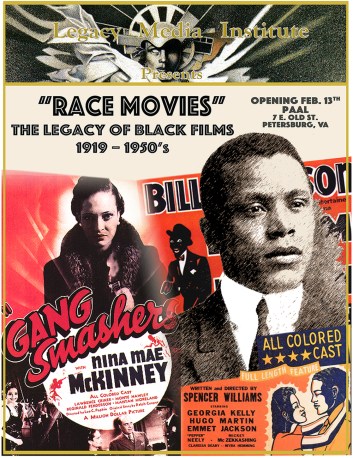
African Americans produced films for black audiences as early as 1905, but most race films were produced after 1915. As many as 500 race films were produced in the United States between 1915 and 1952. As happened later with the early black sitcoms on television, race movies were most often financed by white-owned companies, such as Leo Popkin, and scripted and directed by whites, although one producer, Alfred N. Sack, made some films written and directed by black talent such as Spencer Williams (actor).
Many race films were produced by white-owned film companies outside the Hollywood-centered American film industry such as Million Dollar Productions in the 1930s and Toddy Pictures in the 1940s. One of the earliest surviving examples of a black cast film aimed at a black audience is A Fool and His Money (1912), directed by French emigree Alice Guy for the Solax Film Company. The Ebony Film Company of Chicago, created specifically to produce black-cast films, was also headed by a white production team.
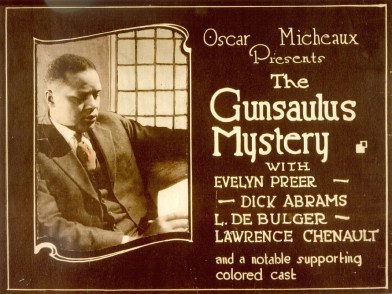
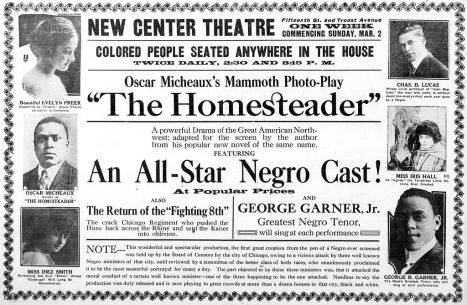
Some black-owned studios existed, including Lincoln Motion Picture Company (1916–1921), and most notably Oscar Micheaux‘s Chicago-based Micheaux Film Corporation, which operated from 1918–1940. On his posters, Micheaux advertised that his films were scripted and produced exclusively by African Americans. Astor Pictures also released several race films and produced Beware with Louis Jordan.
Race films vanished during the early 1950s after African-American participation in World War II contributed to black actors in leading roles in several Hollywood major productions, which focussed on the serious problems of integration and racism, such as Pinky with Ethel Waters; Home of the Brave with James Edwards; and Intruder in the Dust, all in 1949; and No Way Out (1950), which was the debut of the notable actor Sidney Poitier. The last known race film appears to have been an obscure adventure film of 1954 called Carib Gold. (Wikipedia)
Thanks to my original error, I ended up learning so much more about the history of black ‘race’ films and the long, rich history of African American artists.
A tremendous treat for Star Trek fans like myself and one of the most celebrated and essential chapters in Star Trek lore, Star Trek II: The Wrath of Khan is now presented in this spectacular Director’s Cut from legendary filmmaker Nicholas Meyer.
On routine training maneuvers, Admiral James T. Kirk (William Shatner) seems resigned that this may be the last space mission of his career. But Khan is back, with a vengeance!
Aided by his exiled band of genetic supermen, Khan ((Ricardo Montalbán) brilliant renegade of 20th century Earth-has raided Space Station Regula One, stolen the top-secret device called Project Genesis, wrested control of another Federation starship, and now schemes to set a most deadly trap for his old enemy Kirk…with the threat of a universal Armageddon! (Fathom Events)
I’ve shared memories of my favorite Star Trek movie before, celebrating the adversarial reunion of Kirk and Khan in this next chapter and look back at the outstanding tv series episode, “The Space Seed” on which the movie is based. Ricardo Montalban is mesmerizing as the “super-man” Khan Noonien Singh!
Fans won’t want to miss this special 35th-anniversary screening that includes an exclusive introduction from William Shatner.
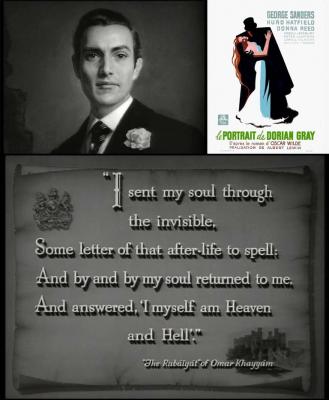
“I am jealous of everything whose beauty does not die. I am jealous of the portrait you have painted of me. Why should it keep what I must lose? Every moment that passes takes something from me and gives something to it. Oh, if it were only the other way! If the picture could change, and I could be always what I am now! Why did you paint it? It will mock me some day — mock me horribly!” The hot tears welled into his eyes; he tore his hand away and, flinging himself on the divan, he buried his face in the cushions, as though he was praying.”
“Dorian Gray” – Oscar Wilde’s -“The Picture of Dorian Gray”
Dorian Gray
If you could, would you, sell your soul for eternal youth?
That was the choice made by Dorian Gray. His story is a classic cautionary tale. Be careful what you wish for.
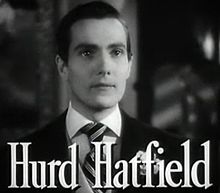
Dorian Gray (Hurd Hatfield) is a striking and wealthy young man living in 19th century London. While posing for his portrait with his artist friend Basil Hallward (Lowell Gilmore), he meets the cynical and audacious Lord Henry Wotton (George Sanders) who tells him that youth and beauty are fleeting and while he’s young he should entertain every worldly pleasure. Dorian is naive and in the presence of an enchanted Egyptian cat wishes he would stay forever young and only his portrait would age.
While visiting a local pub, The Two Turtles, he meets the beautiful and demure Sybil Vane. She sweetly sings “Goodbye Little Yellow Bird” and Dorian is totally enamored. Falling in love, he asks Miss Vale for her hand in marriage and invites both Basil and Lord Wotton to the pub to meet his love.
Sybil Vane
When Dorian informs Lord Wotton of his intention to marry Sybil, Wotton suggests he tests her virtue by inviting her to spend the evening with him. If she rebukes him then she’s chaste if she accepts she’s a tramp and as the saying goes “why pay for the cow when you can have the milk for free.” Dorian buys into this plan thus beginning his downward spiral into narcissism and pleasures of the flesh.
Sybil accepts Dorian’s request to stay with him and the following day Dorian sends her a breakup letter expressing his disappointment in her. Heartbroken, Sybil is devastated and Dorian becomes aware of the first signs of cruelty to appear upon his portrait’s face.
Years pass with his peers aging, but Dorian’s youth remains. Gossip swirls and his friends begin to shun him; questioning why his appearance is the same. Dorian goes full tilt debauchery until he finally reaches rock bottom.
There are people today who could benefit from heeding the lesson in the “Picture of Dorian Gray.” The evil you do comes back to bite. Karma is a bitch.
Produced in 1943 at MGM by Arthur Freed and directed by Vincent Minnelli, “Cabin in the Sky” is the 1st all Black film produced by a major studio in Hollywood. “Happiness is a Thing Called Joe” was nominated for an Academy Award for Best Original Song and sung by the film’s star, Ethel Waters.
This musical take on Faust pits Little Joe (Eddie “Rochester” Anderson) against Luther Jr. (Lucifer’s baby boy). Enter temptress Georgia Brown (Lena Horne). Does Little Joe’s wife, Petunia (Ethel Waters) even stand a chance or will Joe be condemned to Hell?
“Cabin in the Sky” in featuring an all-African American cast was an unusual production for its time. In the 1940s, movie theaters in many cities, particularly in the southern United States, refused to show films with prominent black performers, so MGM took a considerable financial risk by approving the film. (Wikipedia)
Some remember “Cabin in the Sky” for its intelligent and witty script, which some claimed treated its characters and their race with a dignity rare in American films of the time. Others described Cabin in the Sky’s racial politics as the same “old stereotypes of Negro caricatures”.
Ethel Waters, Kenneth Spencer, Eddie “Rochester” Anderson, Lena Horne, Rex Ingram
According to liner notes in the CD reissue of the film’s soundtrack, Freed and Minnelli sought input from black leaders before production began on the film.
When I first saw this film as a kid in the 60’s I was absolutely floored. This was during the civil rights era and I had no idea that in the 1940’s a major production company had taken on the issue of the lack of black representation in film. I understand the point about the stereotypical characterizations – Lena Horne, the aggressive, hypersexual black woman. Ethel Waters, the dutiful, prayerful housewife and “Rochester”, the buffoonish and no account lazy black man.
My feelings of the film are mixed because to some extent, it feeds into the political narrative that some black folks aren’t worthy of equality because they wouldn’t know what to do with it if they had it. But on the other hand, there was finally a film with all black faces, the most gifted entertainers of all-time – Cab Calloway, Lena Horne, Ethel Waters, Duke Ellington, Louis Armstrong and their stories. These characters weren’t just sprinkled in, they were integral to the plot and couldn’t be cut out in racist southern theaters.
As a black woman, it both breaks my heart and angers me that we even needed to have this conversation, not only in the ’40’s but as an ongoing fight for all aspects of African-American representation on-screen.
After years of unavailability, Warner Home Video and Turner Entertainment released “Cabin in the Sky” on DVD on January 10, 2006. I recommend checking it out with this backstory in mind. These legendary artists deserved to have worldwide exposure the same as their white counterparts of the day.
We’ve come along way, but the truth is we still have a long way to go.
Josephine Baker is most celebrated as the “Bronze Venus” and her infamous “Banana Dance” in Paris c. 1927. However, the sum of her life is so much more! I was blown away by her boldness and sexual freedom, but it wasn’t until I saw the 1991 HBO movie starring Lynn Whitfield as Josephine Baker that I started doing research on her life. Whitfield won an Emmy Award for Outstanding Lead Actress in a Miniseries or a Special—becoming the first Black actress to win the award in this category which seems apropos since Josephine Baker was The Lady of firsts.
I’ve always been intrigued by Baker’s provocative reputation but had no idea of her involvement in the fight for justice, racial equality, and the civil-rights movement.
Born Freda Josephine McDonald in St. Louis, Missouri, (June 3, 1906 – April 12, 1975) she was an American-born French dancer, singer, and actress who came to be known in various circles as the “Black Pearl,” “Bronze Venus” and even the “Creole Goddess”. Her parents were Carrie McDonald and Vaudeville drummer Eddie Carson. Growing up poor she started working early cleaning homes and babysitting for wealthy white families.
Baker dropped out of school at the age of 13 and lived as a street child in the slums of St. Louis. Her street-corner dancing attracted attention from the Dixie Steppers which lead to her opportunity to appear in the groundbreaking and hugely successful Broadway revue Shuffle Along (1921). She performed as the last dancer in the chorus line, a position where, traditionally, the dancer performed in a comic manner, as if she were unable to remember the dance, until the encore, at which point she would perform it not only correctly but with additional complexity. Baker’s act set in motion the career which would make her an international star.
Josephine Baker dancing the Charleston, 1926
Josephine traveled to Paris, France, for a new venture, and opened in “La Revue Nègre” on October 2, 1925, at the Théâtre des Champs-Élysées. Her erotic dancing and performing in next to nothing made her a sensation in Paris. The bohemian culture of interwar Paris embraced Baker’s skin color, allowing her to catapult to stardom. At the Folies Bergère, she performed the Danse Sauvage, wearing a costume consisting of a skirt made of a string of artificial bananas – voila! – a star is born.
Josephine Baker became the most successful and highest paid American entertainer working in France and the first Black woman to star in a major motion picture. Baker starred in three films which found success only in Europe: the silent film Siren of the Tropics (1927), Zouzou (1934) and Princesse Tam Tam (1935). She also starred in Fausse Alerte in 1940.
However, despite her acclaim in Europe, upon returning to New York in 1936 to star in the Ziegfeld Follies, she walked right back into good ole American racism. Audiences rejected the idea that a black woman could be so sophisticated and she was replaced by stripper Gypsy Rose Lee later in the run. Time magazine referred to her as a “Negro wench”. She returned to Europe heartbroken.
Josephine Baker and the French Resistance of World War II
Josephine returned to Paris in 1937, married a Jewish Frenchman, Jean Lion, and became a French citizen. In September 1939, when France declared war on Germany she was recruited by Deuxième Bureau, French military intelligence, as an “honorable correspondent”. Baker collected what information she could about German troop locations from officials she met at parties. She was awarded the Legion of Honor and given a Medal of Resistance for her work during World War II. She was also the first American woman to receive the Croix du Guerre, a notable French military honor.
Josephine Baker Legion of Honor
Josephine Baker and the Civil Rights Movement
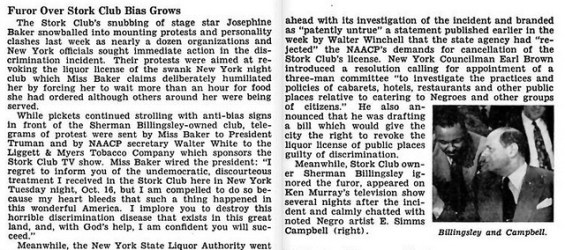
Though based in France, Baker fought for American civil rights in the 1950’s and 1960’s. When she arrived in New York with her fourth husband French composer and conductor Jo Bouillon, they were refused reservations at 36 hotels because she was black. In 1951 when the famous New York Stork Club refused to serve Baker because she was black, she wrote letters to President Truman and enlisted the aid of the NAACP which focused a spotlight on the issues of inequality and racism in popular establishments.
Stork Club Controversy
Josephine Baker was one of the few female speakers at the March on Washington for Jobs and Freedom on August 28, 1963, introducing “Negro Women Fighters for Freedom”, including Rosa Parks, Martin Luther King, Jr., and Congressman John Lewis. The NAACP, National Association for the Advancement of Colored People, named May 20th Josephine Baker Day in her honor.
Josephine Baker in French uniform March on Washington 1963
“The Rainbow Tribe”
Long before Angelina Jolie and Brad Pitt’s multicultural family, there was Josephine Baker and her “Rainbow Tribe”. Josephine wanted to prove that “children of different ethnicities and religions could still be brothers.” Baker raised two daughters, French-born Marianne and Moroccan-born Stellina, and ten sons; Korean-born Jeannot (or Janot), Japanese-born Akio, Colombian-born Luis, Finnish-born Jari (now Jarry), French-born Jean-Claude and Noël, Israeli-born Moïse, Algerian-born Brahim, Ivorian-born Koffi, and Venezuelan-born Mara.
Josephine Baker and “The Rainbow Tribe”
On April 12, 1975, we lost Josephine after she suffered a cerebral hemorrhage, she was 68 years old. She performed right up to her death, starring in a retrospective revue at the Bobino in Paris, Joséphine à Bobino 1975, celebrating her 50 years in show business.The opening night audience included Sophia Loren, Mick Jagger, Shirley Bassey, (best known for recording the theme song to the James Bond film Goldfinger (1964), Diana Ross, and Liza Minnelli.
20,000 people lined the streets of Paris to watch her funeral procession. She received a 21 gun salute, making her the first Black American female to be buried with military honors in France. Josephine Baker leaves behind a legacy of accomplishments including breaking color barriers and fighting for justice and equality around the world. I thank her for channeling her celebrity into championing the rights of all.
A fascinating rock n roll politico film from 1968. I’ve been intrigued by “Wild in the Streets” since I was a 9 year-old kid, I totally related to the concept of the film that the “younger generation” should be running things and not the “old cats” who always mess things up in this country. “Thirty and out” was my mantra. “Old fat cats” only in the game for their own personal gain. Yeah, I was a bit of a rebel. (or so my sisters always say:)
What resonated with me then and now are the political implications of organizing and using that voice and numbers to effect change. But also the nightmare when ideologies take a turn for the extreme.
Wild in the Streets was first released to theaters in 1968. Its storyline was a “reduction to absurdity”projection of contemporary issues of the time, taken to extremes, and played poignantly during 1968 —an election year with many controversies (the Vietnam War, the draft, civil rights, the population explosion, rioting and assassinations, and the baby boomer generation coming of age). (Wikipedia)
“Fourteen or Fight” is a perfect example of the youth movement of the sixties. This was the first time teens were a bigger block than their parents. Baby Boomers exerting power in numbers.
Richard Pryor’s appearance in this film is amazing! One of the most controversial comedians of our time, it was hilarious watching him fake playing the drums as a member of Max Frost’s “Troopers”.
Christopher Jones had the perfect swag for his character. He had that whole brooding, tortured vibe like Marlon Brando in “The Wild One”and James Dean in “Rebel Without a Cause”. The Christopher Jones’ character Max Frost was a pop star millionaire who gets “turned on” to the 60’s political scene and decides to exercise his views on free love, youth is the majority in the U.S., women’ rights and ultimately runs for President of the United States. Let the absurdities begin!
The Music
The soundtrack is the backdrop for the politics in the film as well as real life. Max and The Troopers deal with current issues of the time (’67). Voting age: “14 or Fight”.”If I can fight I can vote”. Ageism: If you’re 50 does that make you more competent? The 25 and under age group is the majority. “We have the power”. Women’s rights: “Chicks would have killed for the vote”.
In 1968, “The Shape of Things to Come”, written by Barry Mann and Cynthia Weil, was a #22 chart hit for Max Frost and the Troopers. (a “studio group”, made up of session musicians)
This flick was over the top but had its pulse on the fears of the 60’s and a possible dysfunctional future. Growing up in the sixties I see a lot of similarities to today. “The Shape of Things to Come” was very prophetic.
American International founders Samuel Z. Arkoff and James H. Nicholson were genius! They were one of the first production companies to recognize and capitalize on the growing teen market. Think beach, biker, monster, drive-in movies. Think American International.
Christopher Jones
After “Wild in the Streets” Christopher Jones only made a couple more films, “Three in the Attic” 1968. Classic 60’s love in fest. The big studios took notice and David Lean offered him the romantic lead in the big budget drama “Ryan’s Daughter” 1970. Reportedly it was on the set of the film he had a nervous breakdown after hearing of Sharon Tate’s murder and shortly after left the Hollywood scene.
His last appearance was in the 1996 crime comedy “Mad Dog Time” opposite Richard Dreyfuss. In his later years he had a career as an artist and sculptor. He died from cancer on January 31, 2014 at the age of 72.
Watching this video I was reminded that some things never change. Progressives trying to build a better country while others, threatened by change, desperately clinging to the past.
For a comprehensive and what I consider a definitive history of one of the original Hollywood Studios – Universal, check out the Documentary – “Universal Horror.” Universal was founded in 1912 by Carl Laemmle and is the world’s fourth oldest major film studio.
Originally airing on Turner Classic Movies in 1998, “Universal Horror” showcases the golden age of 1930’s movie monsters. The film also highlights Carl Laemmle’s family and Carl Laemmle, Jr’s game-changing vision of producing films based on classic horror tales.
Casting for the film became problematic initially since Laemmle was not at all interested in Lugosi, in spite of good reviews for his stage portrayal. Laemmle instead considered other popular actors of the day, including Paul Muni and Chester Morris.
In 1991, the Library of Congress selected Frankenstein for preservation in the United States National Film Registry as being “culturally, historically, or aesthetically significant.
Also affectionately called “Forry,” Ackerman was central to the formation, and spread of science fiction fandom, and a key figure in the wider awareness of science fiction as a literary, art and film genre. Famous for his wordplay he coined the genre nickname “sci-fi”.
Universal Monsters Tribute
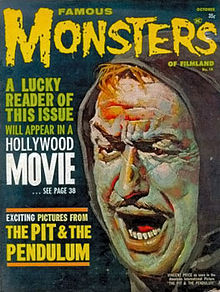
The end of Universal’s first run of horror films came in 1936 as the Laemmles were forced out of the studio after financial difficulties and a series of box office flops due partly to censorship and a temporary ban on American horror films in Britain. The release of MGM’s Mad Love and The Raven (both 1935) were the final nail in the coffin for monster movies, being too strong for 1935 tastes, with its themes of torture, disfigurement, and grisly revenge.
The monster movies were dropped from the production schedule altogether and would not re-emerge for another three years. In the meantime, a theater owner revived Dracula and Frankenstein as a double feature, resulting in an immediate smash hit and leading to the original movies being re-released by the studio to surprising success.
Be sure to checkout these films and experience the original horror classics from the original horror classics studio – Universal!
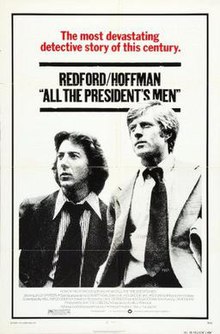
The Academy Award winning film, “All the President’s Men” is the 1976 American political thriller directed by Alan J. Pakula and starring Robert Redford and Dustin Hoffman. I believe it’s the best film on the Watergate scandal and the incredible journalism of Carl Bernstein and Bob Woodward. The gold standard of journalists, their hard work ultimately uncovered the truth of the events that changed the course of American history; the first time ever that an American President resigned from office.
The Plot: On June 17, 1972, a security guard (Frank Wills) at the Watergate complex finds a door kept unlocked with tape. He calls the police, who find and arrest five burglars in the Democratic National Committee headquarters within the complex. The next morning, The Washington Post assigns new reporter Bob Woodward (Robert Redford) to the local courthouse to cover the story, which is thought to be of minor importance.
Woodward learns that the five men, four Cuban-Americans from Miami and James W. McCord, Jr., had bugging equipment and have their own “country club” attorney. At the arraignment, McCord identifies himself in court as having recently left the Central Intelligence Agency and the others also have CIA ties. Woodward connects the burglars to E. Howard Hunt, a former employee of the CIA, and President Richard Nixon‘s Special CounselCharles Colson. (Wikipedia)
Carl Bernstein (Dustin Hoffman), another Post reporter, is assigned to cover the Watergate story with Woodward. The two are reluctant partners but work well together. Executive editor Benjamin Bradlee (Jason Robards) believes their work is incomplete, however, and not worthy of the Post’s front page. He encourages them to continue to gather information.
Woodward contacts “Deep Throat” (Hal Holbrook), a senior government official, an anonymous source he has used in the past. Communicating through copies of The New York Times and a balcony flowerpot, they meet in a parking garage in the middle of the night. Deep Throat speaks in riddles and metaphors about the Watergate break-in, but advises Woodward to “follow the money.” (Wikipedia)
Theatrical Release Poster
Yes, “follow the money” indeed.
I was in high school when the Washington Post reporters Carl Bernstein and Bob Woodward uncovered the historic Watergate scandal and I have never forgotten the outrage and for some disbelief that the President of the United States was guilty of a cover-up; it shook American politics to its core.
Carl Bernstein, Bob Woodward
However, it was true and instead of being impeached Nixon resigned his office. That is why the overwhelming evidence against the current resident of 1600 Pennsylvania Ave is so very shocking; Richard Nixon did far less and with a bi-partisan agreement, Articles of Impeachment were drawn.
“All the President’s Men” is the 1974 non-fiction book by Carl Bernstein and Bob Woodward, that was subsequently made into the motion picture starring Dustin Hoffman and Robert Redford. The book chronicles the investigative reporting of Woodward and Bernstein from Woodward’s initial report on the Watergate break-in through the resignations of H. R. Haldeman and John Ehrlichman, and the revelation of the Nixon tapes by Alexander Butterfield in 1973. (Wikipedia)
The cover of the 1974 first edition.
It relates the events behind the major stories the duo wrote for the Post, naming some sources who had previously refused to be identified for their initial articles, notably Hugh Sloan. It also gives detailed accounts of Woodward’s secret meetings with his source Deep Throat whose identity was kept hidden for over 30 years.Gene Roberts, the former executive editor of The Philadelphia Inquirer and former managing editor of The New York Times, has called the work of Woodward and Bernstein “maybe the single greatest reporting effort of all time.” (Wikipedia)
To hear more about the history of Watergate from the words of the reporters themselves: Bob Woodward and Carl Bernstein.
This site is about how to live our life in a meaningful way by accepting complete surrender to the Almighty with purity of mind and character. It is about the eternal religion of the world i.e. Hinduism which is very liberal to anyone because there are many branches or methods to get the divinity to turn our life into an ever blissful one.
Free listening and free download (mp3) chill and down tempo music (album compilation ep single) for free (usually name your price). Full merged styles: trip-hop electro chill-hop instrumental hip-hop ambient lo-fi boombap beatmaking turntablism indie psy dub step d'n'b reggae wave sainte-pop rock alternative cinematic organic classical world jazz soul groove funk balkan .... Discover lots of underground and emerging artists from around the world.

















 iheartfilm