I enjoy classic television just like classic films so I’m hooked on a tv station called METV. Perry Mason with Raymond Burr is one of my favorites so I usually catch an episode daily. I love the convoluted storylines and the less than plausible show ending of the murderer jumping up in court and hysterically coping to the charge; a full confession no less.
I say all this because an episode the other day featured the scenario of the rich father trying to eliminate his son’s less than a suitable new bride; “There’s $50,000 in the safe for you to fly to Paris and get a divorce.” That’s quite the offer.
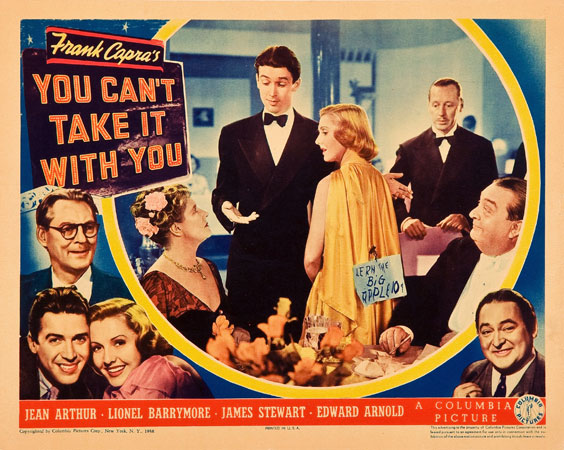
Adapted from the Pulitzer Prize-winning play of the same name by George S. Kaufman and Moss Hart, the film is about a man (Jimmy Stewart) from a family of rich snobs who becomes engaged to a woman (Jean Arthur) who speaks her mind and is from a good-natured but decidedly eccentric family.
The film received two Academy Awards from seven nominations: Best Picture and Best Director for Frank Capra. An iconic director, this was Capra’s third Oscar for Best Director in just five years, following It Happened One Night (1934) and Mr. Deeds Goes to Town (1936). It was also the highest-grossing picture of the year.
I love Jean Arthur’s character (Alice) because she is a strong woman who knows who she is and isn’t afraid to tell Jimmy Stewart (Tony) that his family can go to the blazes because they aren’t better than hers; as a matter of fact, her family understands what Jimmy’s doesn’t, that money isn’t everything and you can’t take it with you. Friends and family are what gives your life worth.
Jimmy Stewart and Jean Arthur
Alice, sensing that her engagement to Tony will not be well received by his parents informs Tony that if their engagement is to go forward, he must invite his parents to the house to meet her family. I’m not sure what Tony was trying to prove but, he gives his parents the wrong date so the house is in disarray with the usual family “madness” in full view. (I said they were eccentric.)
Just another Tuesday night at the Sycamore house.
For me, the lesson of the movie is to live life to the fullest and cherish your family and friends. Don’t worry about being judged by others, they’re probably just jealous of how happy you are and how miserable they feel.
In the words of “Auntie Mame” from the 1958 movie.
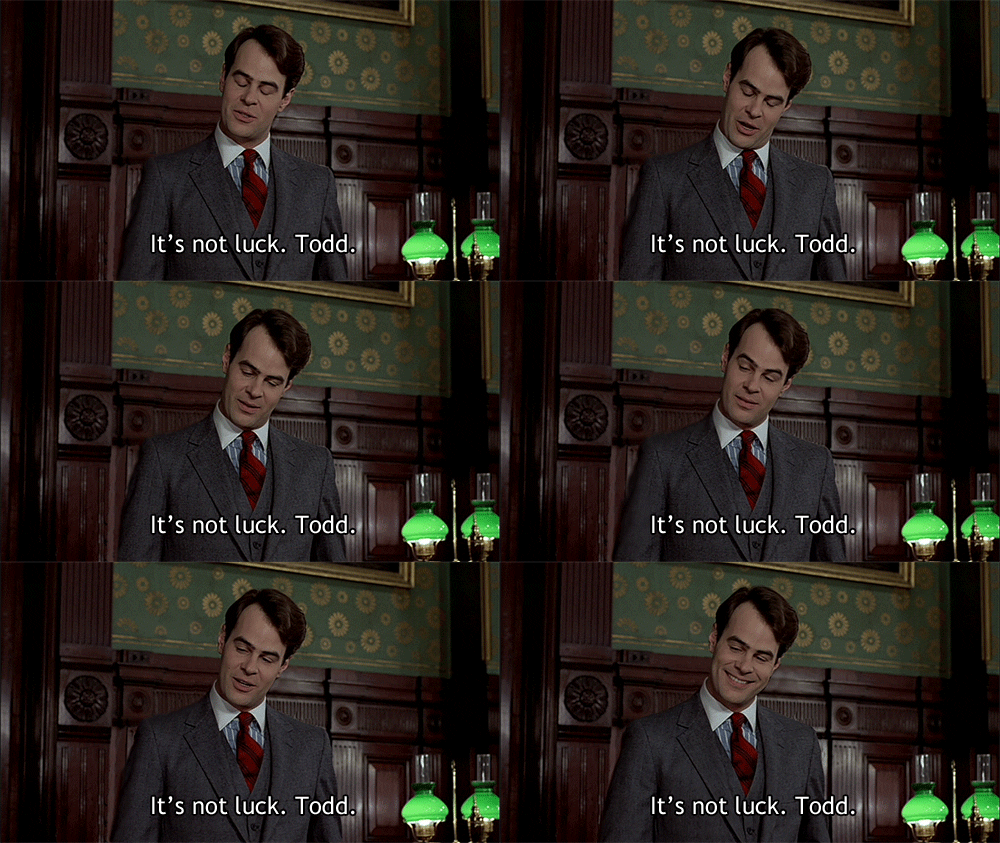
“Trading Places” (1983) is a tour de force example of Gratitude meets “walk a mile in my shoes!” Dan Aykroyd is (Louis Winthorpe III) the typical “privileged” ivy leaguer with a twist. He’s not as “top drawer” as he thinks and his life is truly in the hands of the callous Duke brothers – Mortimer ((Don Ameche) and Randolph (Ralph Bellamy).
His perfect world is turned upside down by the $1 bet by the brothers to settle the debate of nature vs nurture. Because we’ve got nothing better to do, let’s strip Louis of everything he knows and see if he’ll sink or float.
Randolph and Mortimer Duke
What better “brother” switch than with (Billy Ray Valentine) Eddie Murphy, the wily con man who sees the brothers straight up for what they are – numbers runners.
“Billy Ray”
The parable wouldn’t be complete without the lovely damsel in distress (but in this case with a plan for her own escape). One of my favorite actresses, Jamie Lee Curtis plays “Ophelia”, the classy hooker with a heart of gold.
Jamie Lee Curtis – “Ophelia”
Denholm Elliott – “Coleman”
Louis’s butler/valet, “Coleman” (Denholm Elliott) is hilarious trying to juggle the Duke brothers’ sick plan.
Dan Aykroyd – “Louis”
Louis’s abrupt experiment in poverty forces him to get his nose out of the air and think twice about judging people based solely on their socio/economic situation.
After a stint in jail, being reduced to stuffing a whole salmon into his Santa suit (don’t ask, you have to see) and attempting to take his own life, he realizes how shallow his life has been. By coming together with Billy Ray, Coleman and Ophelia he finds out that it’s friends and the love of a good woman that really counts.
An incredibly important life and Gratitude lesson!
However, if you can get rich with your friends and give payback to those who’ve done you wrong (Dukes) go for it! 😎
I was first introduced to the Marx Brothers (Groucho, Harpo, Chico, and Zeppo) in one of my favorite classes at The University of Michigan – Cinema. It was more like an afternoon of fun at the movies since in our lecture all we did was analyze and critique classic films.
(top to bottom) Chico, Harpo, Groucho, and Zeppo 1931
◊◊◊
The Marx Brothers laugh riot film, “Duck Soup”, has to go down as one of the best and most hilarious political films of the century! Pure anarchy reigned as the idiocy of war was laid bare and Rufus T. Firefly’s (Groucho Marx) rapid-fire one-liners were pure genius.
Enter Rufus T.
On days we screened The Marx Brothers films, the lecture hall seemed a little bit fuller. I was also guilty of padding the room since I would tell my boyfriend what movie we were reviewing and the Marx Brothers quickly became his and my favorites. “Whatever it is, I’m against it.” Groucho in (“Horse Feathers”1932)
◊
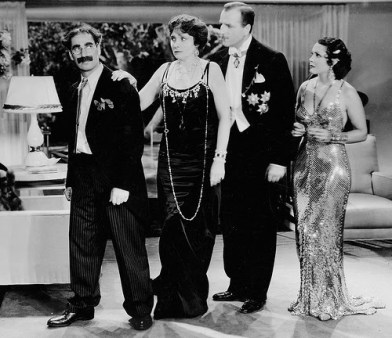
Directed by Leo McCarey and written by Bert Kalmar and Harry Ruby, the film was first released theatrically by Paramount Pictures on November 17, 1933. The storyline of “Duck Soup” involves the wealthy Mrs. Teasdale (Margaret Dumont) insisting that Rufus T. Firefly (Groucho) be appointed the leader of the small, bankrupt country of Freedonia before she will continue to provide their much-needed financial aid. (Wikipedia)
Groucho, Margaret Dumont, Louis Calhern, and Raquel Torres
◊◊◊
Meanwhile, neighboring country Sylvania is attempting to annex Freedonia. Sylvanian ambassador Trentino (Louis Calhern) tries to instigate a revolution while attempting to woo Mrs. Teasdale. To further tip the scale in his favor, he also tries to dig up dirt on Firefly by sending in bumbling spies Chicolini (Chico) and Pinky (Harpo).
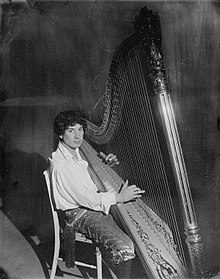
I adore Harpo (Arthur Duer Marx born Adolph Marx; November 23, 1888 – September 28, 1964), he is totally off the wall with his facial expressions and his manic pantomime sight gags! Harpo actually played the harp (hence his nickname) and there was usually a scene in the Marx Brothers movies that featured Harpo playing a beautiful piece on the harp.
Harpo playing the harp.
Margaret Dumont is often described as not getting the Brothers humor. In fact, she did. In a 1940 interview, Dumont said, “Scriptwriters build up to a laugh, but they don’t allow any pause for it. That’s where I come in. I ad lib—it doesn’t matter what I say—just to kill a few seconds so you can enjoy the gag”.
Personally, I don’t know how she could keep a straight face working with Groucho.
Margaret Dumont would typically portray the rich widow that Groucho was always trying to dupe. He could simultaneously insult and make advances towards her. It was fabulous to watch since his wit and timing were impeccable.
Julius Henry Marx (October 2, 1890 – August 19, 1977)
◊◊◊
Premiering during The Depression, “Duck Soup” was not initially received as well as their previous films. However, critical opinion has evolved and the film has since achieved the status of a classic. “Duck Soup“ is now widely considered by critics to be a masterpiece of comedy and the Marx Brothers’ finest film. (Wikipedia)
In 1990 the United States Library of Congress deemed Duck Soup “culturally, historically, or aesthetically significant” and selected it for preservation in the National Film Registry.
Chico and Zeppo round out the troupe. Chico was known for being the crafty con artist (who was usually teamed with Harpo) and for his broken Italian accent (although the Brothers were Jewish) and Zeppo, who always played the straight man. (This was also Zeppo’s last film with his brothers)
In the famous “mirror scene,” Pinky, dressed as Firefly, pretends to be Firefly’s reflection in a missing mirror, matching his every move—including absurd ones that begin out of sight—to near perfection. In one particularly surreal moment, the two men swap positions, and thus the idea of which is a reflection of the other. Eventually, and to their misfortune, Chicolini, also disguised as Firefly, enters the frame and collides with both of them.
Although its appearance in Duck Soup is the best-known instance, the concept of the mirror scene did not originate in this film. Max Linder included it in Seven Years Bad Luck (1921), where a man’s servants have accidentally broken a mirror and attempt to hide the fact by imitating his actions in the mirror’s frame. Charlie Chaplin used a similar joke in The Floorwalker (1916), though it did not involve a mirror. (Wikipedia)
◊◊◊
“Just Wait ‘Til I Get Through With It” parodies the ridiculous state of politics and sounds all too familiar.
I admit to being a political junkie and the Marx Brothers humor and point of view ring true in how ludicrous and corrupt the political system is. We know it’s a racket, the Brothers know it’s a racket and they have no compunction with sticking that fact right in your face.
Bravo!
If you’re interested in binge-watching The Marx Brothers, Universal Home Video has released Duck Soup on DVD, unrestored but uncut, as part of a six-disc box set The Marx Brothers: Silver Screen Collection, which includes the Brothers’ other Paramount films, The Cocoanuts, Animal Crackers, Monkey Business, and Horse Feathers. Definitely worthy of the buy.
Like Galaxy Quest was an homage to Star Trek, Mel Brooks off-the-wall comedy Spaceballs (1987) was a send-off of Star Wars. Its setting and characters parody the original Star Wars trilogy, as well as other sci-fi franchises including Star Trek, Alien, and the Planet of the Apes films.
The plot is set in a distant galaxy, planet Spaceball which has depleted its air supply, leaving its citizens reliant on a product called “Perri-Air.” (See, I told you off-the-wall)
Mel Brooks
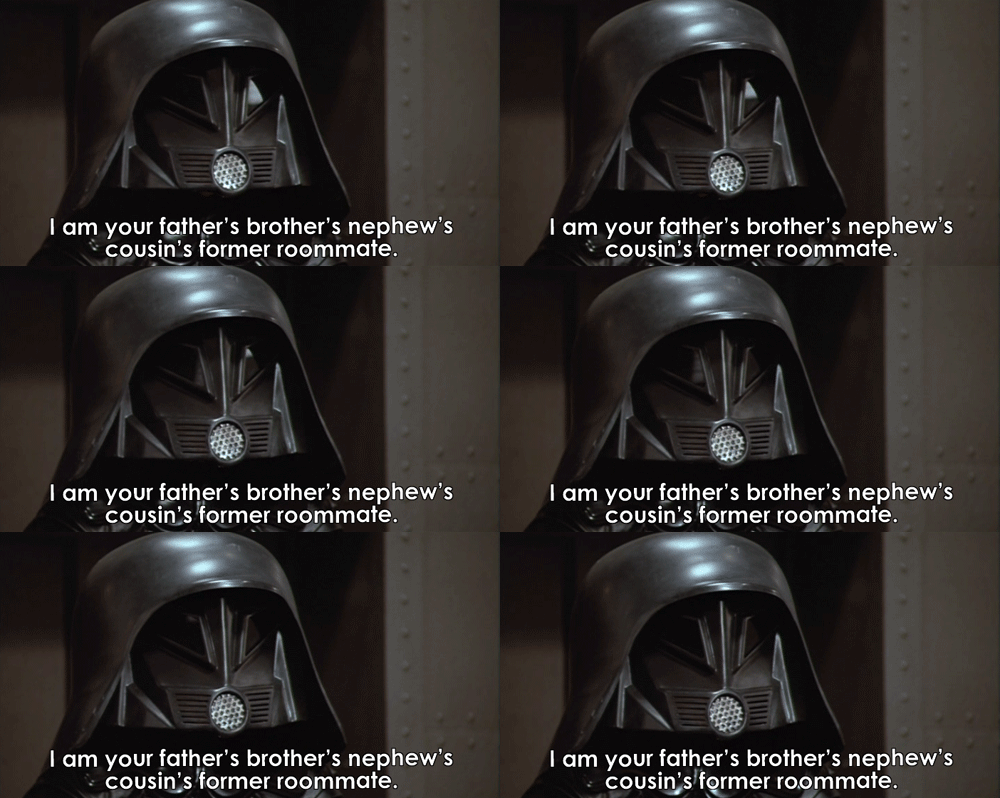
In desperation, Spaceball’s leader President Skroob (Mel Brooks) orders the evil Dark Helmet (Rick Moranis) to kidnap Princess Vespa (Daphne Zuniga) of oxygen-rich Druidia and hold her hostage in exchange for air.
Rick Moranis (Dark Helmet)
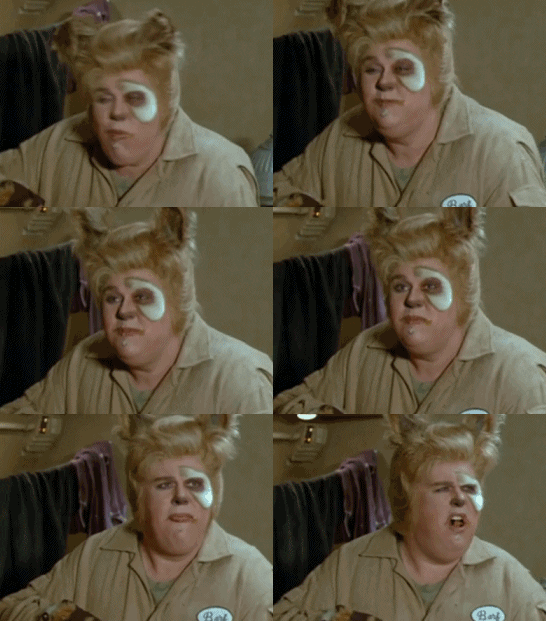
But help arrives for the Princess in the form of renegade space pilot Lone Starr (Bill Pullman) and his half-man, half-dog partner, Barf (John Candy). (IMDb)
Spaceballs is a 1987 American science fiction parody film co-written, produced and directed by Mel Brooks. Starring Brooks, Bill Pullman, John Candy, and Rick Moranis, the film also features Daphne Zuniga, Dick Van Patten, and the voice of Joan Rivers as Dot Matrix. (Wikipedia)
John Candy, Joan Rivers (Dot), Daphne Zuniga, Bill Pullman
Rick Moranis
John Candy – Barf
The film was met with a mixed reception but I think it can be classified as a cult classic, definitely an off the-wall-classic.
Going back and researching this film I almost forgot the funniest scene that had me on the floor. When I first saw this I literally screamed! Which I’m sure had the cleaning lady a the Residence Inn, where I was staying, shaking her head. (This chick is nuts!)
OMG, that was hilarious!! Who would have thought you could turn that incredibly terrifying moment in Alien into this “spit your milk out” moment.
Once again, Rick Moranis is absolutely brilliant! Just looking at him in that ginormous helmet, you can’t help but crack-up. Portraying the embodiment of the “Napoleon complex” his action playing with his dolls is too precious.
Trivia:
IT WASN’T THE FIRST STAR WARS PARODY FILM.
Amateur filmmaker, Ernie Fosselius was so enamored with Star Wars in 1977 that he cobbled together a 12-minute short, Hardware Wars, which he shot for just $8,000 in an abandoned laundromat. It was even declared a “cute little film” by George Lucas.
LUCAS GAVE HIS (CONDITIONAL) BLESSING.
Based on Brooks not doing any merchandising. The Lucas people were just upset about one aspect of Spaceballs,” Brooks told Starlog in 1987. “They didn’t think it was fair for us to do a take-off and then merchandise the characters.”
BILL PULLMAN WAS BROOKS’ THIRD CHOICE.
According to Pullman, the actor—who had not yet had a starring role—was approached by Brooks only after Tom Cruise and Tom Hanks turned down the role of Lone Starr, the Han Solo-esque lead of the film. Pullman said that hiring Rick Moranis and John Candy freed Brooks up to cast a relative unknown.
BARF’S EARS UPSTAGED THE ACTORS.
John Candy, who played half-dog/half-man Barf, was usually trailed on-set by Effects artist Rick Lazzarini and the effects crew, who had to control both his tail and his ears. At one point, Lazzarini was told by Brooks that he didn’t “have to move the ears so much!” They were too active in scenes focused on other characters. (Candy, incidentally, performed with a 40-pound battery backpack strapped to him to control the animatronics.)
(Jake Rossen-(mental_floss)
John Candy – Barf
So, if you’re looking for a good laugh and a total mind distraction, I recommend “Spaceballs” as the perfect gag-filled tonic.
I enjoy classic television just like classic films so I’m hooked on a tv station called METV. Perry Mason with Raymond Burr is one of my favorites so I usually catch an episode daily. I love the convoluted storylines and the less than plausible show ending of the murderer jumping up in court and hysterically coping to the charge; a full confession no less.
I say all this because an episode the other day featured the scenario of the rich father trying to eliminate his son’s less than a suitable new bride; “There’s $50,000 in the safe for you to fly to Paris and get a divorce.” That’s quite the offer.
Adapted from the Pulitzer Prize-winning play of the same name by George S. Kaufman and Moss Hart, the film is about a man (Jimmy Stewart) from a family of rich snobs who becomes engaged to a woman (Jean Arthur) who speaks her mind and is from a good-natured but decidedly eccentric family.
The film received two Academy Awards from seven nominations: Best Picture and Best Director for Frank Capra. An iconic director, this was Capra’s third Oscar for Best Director in just five years, following It Happened One Night (1934) and Mr. Deeds Goes to Town (1936). It was also the highest-grossing picture of the year.
I love Jean Arthur’s character (Alice) because she is a strong woman who knows who she is and isn’t afraid to tell Jimmy Stewart (Tony) that his family can go to the blazes because they aren’t better than hers; as a matter of fact, her family understands what Jimmy’s doesn’t, that money isn’t everything and you can’t take it with you. Friends and family are what gives your life worth.
Jimmy Stewart and Jean Arthur
Alice, sensing that her engagement to Tony will not be well received by his parents informs Tony that if their engagement is to go forward, he must invite his parents to the house to meet her family. I’m not sure what Tony was trying to prove but, he gives his parents the wrong date so the house is in disarray with the usual family “madness” in full view. (I said they were eccentric.) 😁
Just another Tuesday night at the Sycamore house.
For me, the lesson of the movie is to live life to the fullest and cherish your family and friends. Don’t worry about being judged by others, they’re probably just jealous of how happy you are and how miserable they feel.
In the words of “Auntie Mame” from the 1958 movie.
iheartfilm is dedicating the month of November to the lesson of Gratitude in films; the quality of being thankful.
“Trading Places” (1983) is a tour de force example of Gratitude meets “walk a mile in my shoes!” Dan Aykroyd is (Louis Winthorpe III) the typical “privileged” ivy leaguer with a twist. He’s not as “top drawer” as he thinks and his life is truly in the hands of the callous Duke brothers – Mortimer ((Don Ameche) and Randolph (Ralph Bellamy).
His perfect world is turned upside down by the $1 bet by the brothers to settle the debate of nature vs nurture. Because we’ve got nothing better to do, let’s strip Louis of everything he knows and see if he’ll sink or float.
Randolph and Mortimer Duke
What better “brother” switch than with (Billy Ray Valentine) Eddie Murphy, the wily con man who sees the brothers straight up for what they are – numbers runners.
“Billy Ray”
The parable wouldn’t be complete without the lovely damsel in distress (but in this case with a plan for her own escape). One of my favorite actresses, Jamie Lee Curtis plays “Ophelia”, the classy hooker with a heart of gold.
Jamie Lee Curtis – “Ophelia”
Denholm Elliott – “Coleman”
Louis’s butler/valet, “Coleman” (Denholm Elliott) is hilarious trying to juggle the Duke brothers’ sick plan.
Louis’s abrupt experiment in poverty forces him to get his nose out of the air and think twice about judging people based solely on their socio/economic situation.
After a stint in jail, being reduced to stuffing a whole salmon into his Santa suit (don’t ask, you have to see) and attempting to take his own life, he realizes how shallow his life has been. By coming together with Billy Ray, Coleman and Ophelia he finds out it’s friends and the love of a good woman that really counts.
An incredibly important life and Gratitude lesson!
However, if you can get rich with your friends and give payback to those who’ve done you wrong (Dukes) go for it! 😎
Business is bad at Mushnick’s Flower shop. Shy Seymour and brave Audrey will soon be unemployed. That is until Seymour pricks his finger and a sickly little exotic plant gets its first taste of human blood. The plant spurts ten feet tall. As horticultural interest in “Audrey II” sprouts, Mushnick’s business takes off. But fresh blood must be found—and people start disappearing. Love and business bloom at a hilarious yet bloody cost. (Fathom Events)
I’m so excited to see one of my Halloween favorites back on the big screen. And, fascinated to see Frank Oz’s restored original dark ending, staying true to the play.
“It will be very interesting to see if, in this new political and cultural climate, if there will be any association with that, with the plant. Let’s just say that,” says Oz. The original ending, he acknowledges, “may still be too dark for people, and I accept that.
It may not be as satisfying emotionally, and I accept that. But on the other hand, the reason screenwriter Howard Ashman and I wanted it was that it is the Faustian legend. Seymour does have consequences for his actions. We needed to omit those consequences to keep the audience happy, which I agreed with, by the way. I think we had to do it. But now it will be very interesting to see.” (Yahoo Entertainment)
Fans will not want to miss Little Shop of Horrors: The Director’s Cut, which features the rarely-seen original ending and an exclusive introduction from Frank Oz.
The 1986 Frank Oz film is a remake of the hit Broadway stage production which was a remake of the 1960 movie.
The original 1960 film was a black comedy horror film directed by Detroit-born (my hometown) and celebrated B-movie legend, Roger Corman and written by Charles B. Griffith. The film is a farce about an inadequate florist’s assistant (Jonathan Haze) who cultivates a plant that feeds on human flesh and blood.
The film stars Jonathan Haze (Seymour), Jackie Joseph (Audrey), Mel Welles (Mr. Mushnick), and Dick Miller, all of whom had worked for Corman on previous films. Produced under the title “The Passionate People Eater”. It was a lot creepier and darker than either the 1986 film or Broadway production.
For a true Halloween treat, I highly recommend screening the original! Check out Jack Nicholson in one of his first film roles.
Check out this previous post for background and trivia on the Broadway stage production and the original 1960 film.
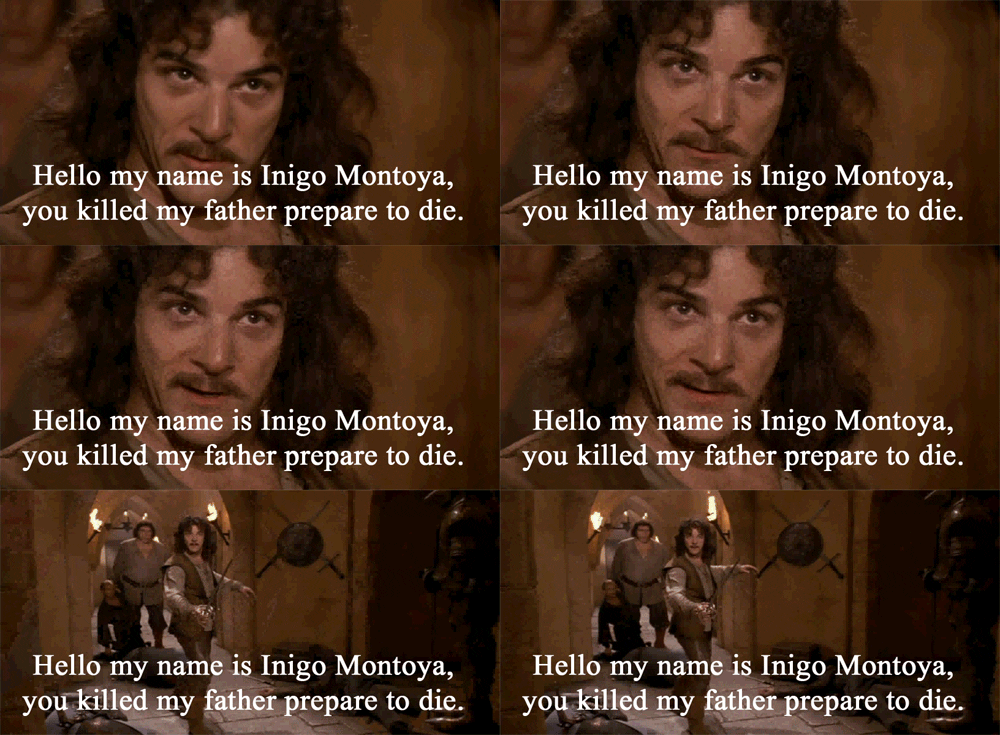
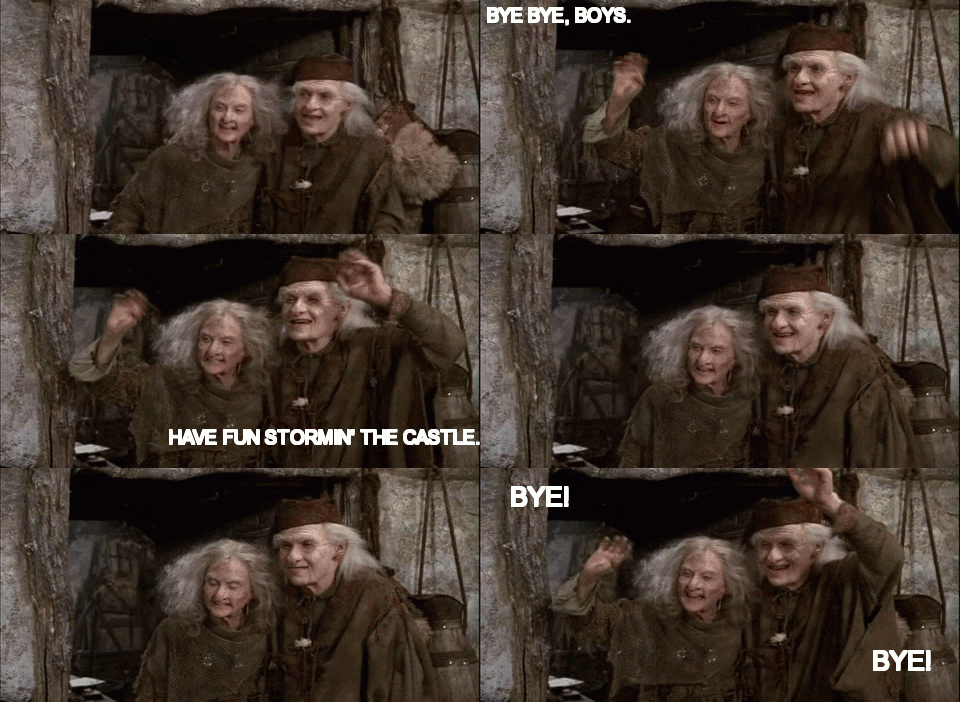
One of my favorite and definitely most quotable films, “The Princess Bride”(1987) brings together all the classic elements of the damsel in distress story and style of the irreverent and hilarious Monty Python franchise to the 1980’s generation.
It’s back in the theaters and even if you’ve quoted it a thousand times, there’s nothing like sharing the laughter in the theater with fellow “Princess Bride” aficionados!
The film was adapted by William Goldman from his 1973 novel of the same name and tells the story of a farmhand named Westley, accompanied by befriended companions along the way, who must rescue his true love Princess Buttercup from the odious Prince Humperdinck.
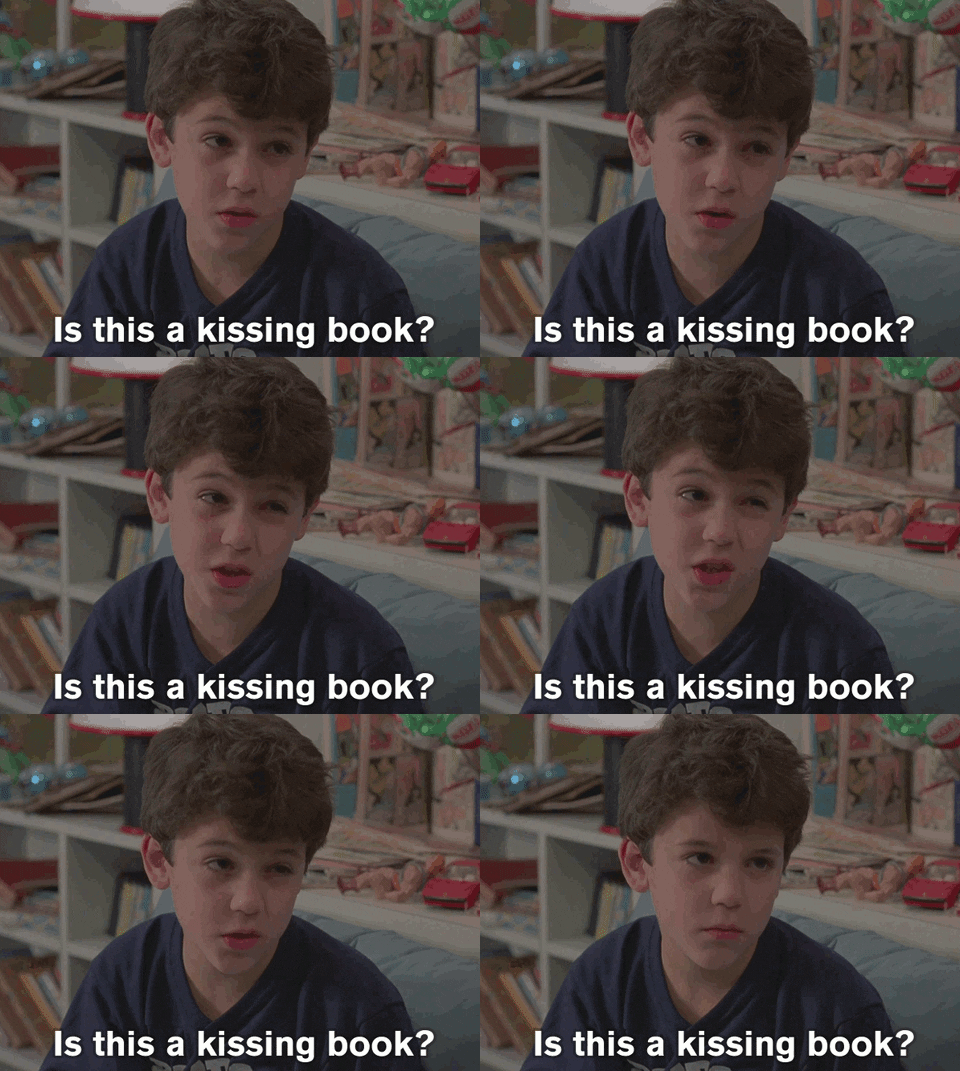
The story is presented in the film as a book being read by a grandfather (Peter Falk) to his sick grandson (Fred Savage), thus effectively preserving the novel’s narrative style. (Wikipedia)
Fred Savage
This 30th-anniversary event includes a specially produced interview with Ben Mankiewicz and Rob Reiner.
Awards:
*1992: Best Picture (David Brown, Rob Reiner and Andrew Scheinman, Producers), A Few Good Men. **1976: Adapted Screenplay, All the President’s Men; 1969, Original Screenplay, Butch Cassidy and the Sundance Kid.
Cast now: Cary Elwes, Robin Wright, Mandy Patinkin, Chris Sarandon, Wallace Shawn, Carol Kane, and Billy Crystal
Make sure to mark your calendar, buy your ticketand get ready to enjoy this classic on the big screen. Relive this epic adventure filled with fencing, fighting, giants, monsters, Miracle Max, and true love!
I can appreciate there are those who don’t like Top 10 lists but I tend to enjoy them because of getting to find out the favorites of fellow film lovers. Also, reminiscing about my best-loved movies that perhaps I haven’t thought about for a while.
Closing lines can serve as punctuation, the cherry on top. They can also, wrap up the film. One-liners that recall the movie all over again. Often times these are the quotes we remember most and become representative of the movie’s theme.
There are way too many movies to choose from so these are just a sampling that made this particular list. I love the Top 2 but as I was watching so many other films came to mind.
Please, let me know in the comments some of your best quotes. I’m looking forward to reading them.
∴∴∴∴∴∴
Spoiler Alert: I make it a point to never reveal a film’s ending because it’s a matter of courtesy. Don’t spoil the movie!
While watching Marlene Dietrich’s sultry performance of “The Laziest Gal in Town” in Alfred Hitchcock’s 1950 thriller,”Stage Fright”, I asked my husband if the song and performance seemed familiar. Because I’ve raised him right (on film history that is😎), he remarked, “of course, Madeline Kahn’s performance of “I’m Tired” in the Mel Brooks satirical Western comedy classic, “Blazing Saddles” (1974).
Marlene Dietrich “Laziest Gal in Town”
Madeline Kahn “I’m So Tired”
(Top) Marlene Dietrich (Bottom) Jane Wyman
I loved hearing his response because it’s the main reason I pen this post; for the history and appreciation of films. Understanding a writer or director’s references to past movies in theirs adds to the richness of the production. It helps young people comprehend that few things in life are original and imitation can be the sincerest form of flattery.
Sometimes the homage in a movie isn’t to a particular scene in a film but the music. I love Minions period but I especially enjoyed the “Minions” movie’s 1960’s soundtrack that made the perfect nod to James Bond type villains (“Minions” Scarlet Overkill) and the time period of the setting.
As a child of the ’60’s I remember turning to my husband in the theater saying, 99% of the people in here weren’t even born yet and I wonder if any of them appreciate the inclusion of the classic songs of this era.
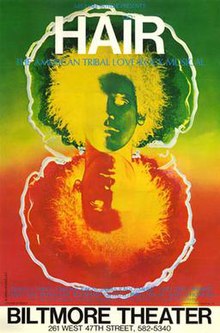
The song is “Hair” from the iconic 1968 counter-culture and controversial stage and film production “Hair”
I’ve spent my lifetime watching and loving the cinema and have educated my children with a more sophisticated palette for black and white films and how they just don’t make them like that anymore.😊
Hundreds of full-length films were produced during the decade of the 1940s; during Hollywood’s Golden Age. The great actor Humphrey Bogart made his most memorable films in this decade. Frank Capra’s masterpiece It’s a Wonderful Life and Orson Welles’s cinema genius production of Citizen Kane were released. The film noir genre was at its height. Alfred Hitchcock made his American debut with the film Rebecca and made many classics throughout the 1940s. (Wikipedia)
(Top) Cary Grant, Audrey Hepburn, Marlon Brando (Middle) Lauren Bacall, Marilyn Monroe, Grace Kelly (Bottom) Humphrey Bogart, Marlene Dietrich, Clark Gable
Movie Stars of the 1940’s & 1950’s
Of course, I want you to visit my website as a source of reference material, but if you want to see these full-length gems for free, I recommend tuning into the Turner Classic Movies channel. They show everything from the great silent films, Chaplin, Buster Keaton, etc. through Hollywood’s “Golden Age”.
These classic films bring me great joy and I hope you’ll find a special place in your heart for them, too!
This site is about how to live our life in a meaningful way by accepting complete surrender to the Almighty with purity of mind and character. It is about the eternal religion of the world i.e. Hinduism which is very liberal to anyone because there are many branches or methods to get the divinity to turn our life into an ever blissful one.
Free listening and free download (mp3) chill and down tempo music (album compilation ep single) for free (usually name your price). Full merged styles: trip-hop electro chill-hop instrumental hip-hop ambient lo-fi boombap beatmaking turntablism indie psy dub step d'n'b reggae wave sainte-pop rock alternative cinematic organic classical world jazz soul groove funk balkan .... Discover lots of underground and emerging artists from around the world.

_02.jpg)




















 iheartfilm